multi-task learning
multi-task learning on Beyond Market Intelligence: a running collection of 2 stories we have gathered and hand-picked because they are worth your time. Every post here touches on multi-task learning in some way — the news, the analysis, the deep dives, and the occasional surprise find. Acme AI is the next-generation, AI-powered spreadsheet platform built to replace Excel and redefine how analysts, data scientists, and enterprise teams work with data. New stories are added to this page as we find them, so check back if you want to keep up with what is happening around multi-task learning, or subscribe to the RSS feed to get them as soon as they are published. Browse the collection below, or head back to the homepage to see everything Beyond Market Intelligence is covering right now.
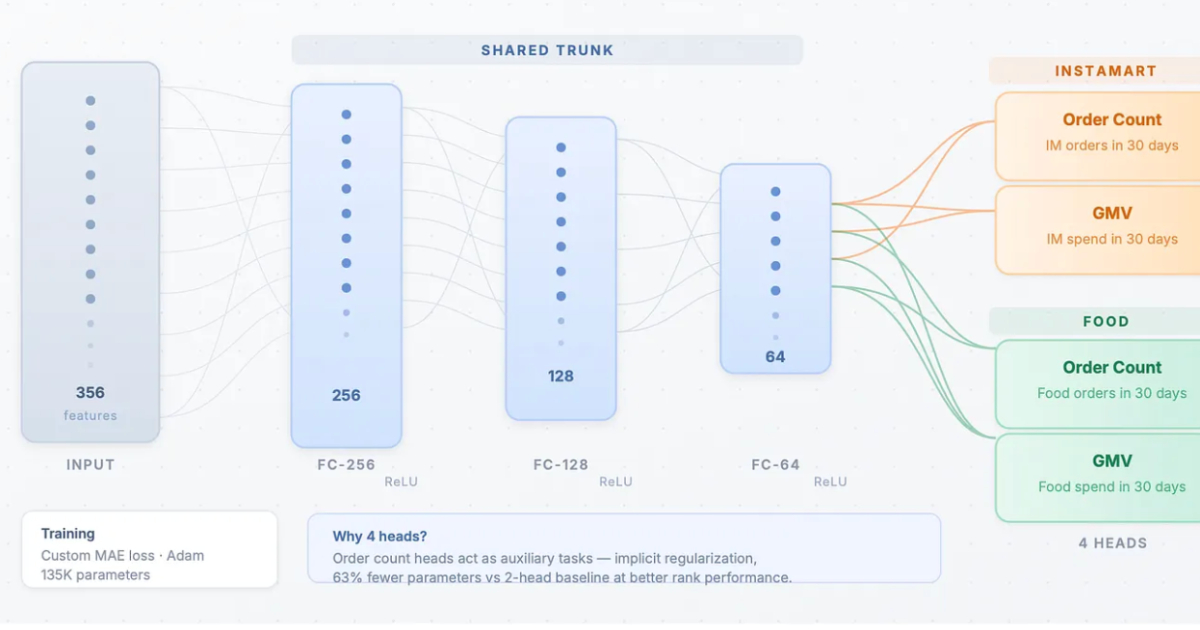
Swiggy Uses 350+ Features and Multi-Task MLP to Predict Customer Lifetime Value
Swiggy has developed an innovative, in-house predictive lifetime value (pLTV) model, leveraging over 350 pre-order features and a multi-tasking MLP architecture for both its Food and Instamart services. This approach, incorporating order count as an auxiliary task, significantly streamlined the model—reducing parameters by 63% while simultaneously boosting predictive accuracy. Now, Swiggy utilizes this refined pLTV signal with Google Target ROAS bidding, optimizing customer acquisition strategies with data-driven precision. For further exploration of related methodologies, consider our article, "Are HMMs still used for unsupervised tasks? [D]".
One encoder, seven heads: what we learned training a unified security classifier with masked losses [P]
We've consolidated seven distinct sequence classifiers into a single, unified model—our apex security classifier—streamlining data processing and enhancing efficiency. This architecture utilizes a shared mmBERT-small encoder with seven task heads, achieving impressive results across diverse security functions, including injection detection and threat type identification. Notably, we implemented masked losses to handle training rows with incomplete labels, a technique validated by a rigorous gradient self-test. Explore the released weights and detailed per-head metrics on Hugging Face.