OCR
Beyond Market Intelligence keeps OCR in one place: 11 stories so far. The section currently leads with “Cut token costs by routing text-heavy images away from pixel processing”, “Small AI Model Beats GPT-5.6 on Tax Forms but Stumbles on Dates”, and “Refining product ID: When similar packages confuse embeddings, what should Stage 2 do?”. Routing text-heavy images through pixel processing is a waste of VRAM and context space. A small 8-billion-parameter model just beat GPT-5.6 Terra on tax forms, 21 out of 32 W-2s fully correct versus 7. Acme AI is the next-generation, AI-powered spreadsheet platform built to replace Excel and redefine how analysts, data scientists, and enterprise teams work… The list below is every OCR story on Beyond Market Intelligence, newest first.

Cut token costs by routing text-heavy images away from pixel processing
Routing text-heavy images through pixel processing is a waste of VRAM and context space. One developer built a smarter path: a deterministic pre-pass that classifies images and sends schematics to the VLM while extracting text from code screenshots as plain strings. The result is an 88.7% token reduction. That kind of practical optimization feels more valuable than chasing raw model size. For a deeper look at efficiency trade-offs, our piece on two AI transcribers compares real-world performance where the numbers actually matter.

Small AI Model Beats GPT-5.6 on Tax Forms but Stumbles on Dates
A small 8-billion-parameter model just beat GPT-5.6 Terra on tax forms, 21 out of 32 W-2s fully correct versus 7. That's the kind of result that makes you rethink what "small" means. But Qwen3-VL stumbled on dates, reading dd-mm-yyyy as mm-dd, and struggled with contract expiry fields. The lesson isn't that bigger is worse. It's that focused fine-tuning can outperform scale on specific tasks. For a deeper look at optimization trade-offs, our piece on Tauon explores how smarter training methods can reshape performance.
Refining product ID: When similar packages confuse embeddings, what should Stage 2 do?
A shelf audit tool lives or dies on telling a 1.25L bottle from a 2L one, and that's exactly where this project hits a wall. Cropping works, but the embedding stage fails because letterboxing scrubs away the tiny size text, leaving the model to guess on shape alone. Fine-tuning on hard negatives feels like the right move, though OCR as a second check could break the tie more directly.
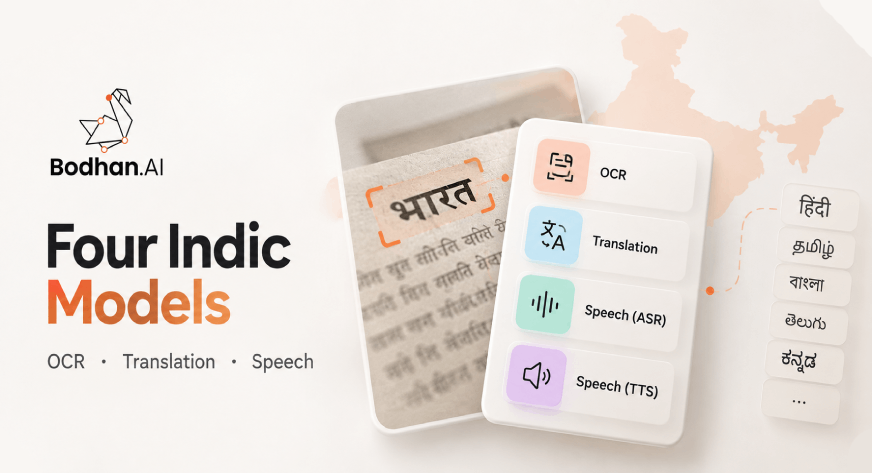
Four New Models Make Indian Language Data Searchable and Accessible
A Hindi lesson can blend Devanagari script with English loan words, scanned tables, and handwritten equations. That mix has long made such content difficult to search, translate, or read aloud. Bodhan AI and AI4Bharat's four new models, released in September 2026, tackle these tasks directly across Indian languages. They handle document parsing, translation, speech recognition, and speech generation, all while respecting mixed scripts. It is a practical step toward making real-world documents more accessible.

Why Embeddings Outperform Classical Spell-Check on Noisy Data
Three sources of noisy text plague enterprise RAG: user typos, transcription slips, and OCR character errors. Classical spell-check catches only the first, leaving embeddings to absorb the rest. That gap matters more than most teams realize, because retrieval quality hinges on how well your system tolerates imperfection. This piece breaks down the problem clearly, and it pairs well with our guide on paragraph structure and token space. Both explore how LLMs actually process the messiness we feed them.

Choose the right tool first, not just the AI default
Retrieval answers one kind of question, but it is not the whole toolkit. Classifying a request, matching free text to a reference list, or cleaning OCR noise each has a cheaper, more direct method. The real engineering is knowing which tool to reach for. That practical focus makes this a useful read for anyone feeling stuck in RAG's limitations. For a deeper look at how LLMs handle structure, explore our related piece on paragraph and token space.

Enterprise data extraction meets its cost-performance sweet spot
Most document parsers force enterprises to choose between accuracy and affordability. Cohere's Parse 5 doesn't dodge that trade-off; it prices it honestly. At $1.50 per 1,000 pages, it trails frontier models like GPT-5.5 on raw scores but slashes costs by over 98 percent in high-volume workflows. That's a practical bet on structure preservation, not benchmark glory. For teams feeding millions of documents into AI pipelines, the real question isn't who wins parse tests, but what survives downstream.
Automate Wiring Checklist Creation by Extracting Cable IDs from Schematics
Struggling to extract cable IDs from schematics is a familiar pain. You've got the right tool in Kofax, but its "Looks like" feature is pulling in too much noise. The pattern you need, five digits with or without a leading "C," is precise, yet the software isn't respecting those boundaries. That's frustrating, but it's solvable. Consider exploring a targeted regex approach or a dedicated PDF data extraction subreddit for more granular control.
Transcribing Long Documents with a More Intelligent OCR Approach
A month after Baidu launched Unlimited-OCR, the model's focus on long-document transcription stands out. Unlike typical vision-language systems, it tackles the real bottleneck of expanding Key-Value caches, which slow down multi-page processing. That is a practical step forward. For readers eager to understand how AI handles context at scale, our guide to distributed training offers a useful parallel. Baidu's approach feels less like a flashy demo and more like a genuine fix for a persistent workflow problem.
From receipts to white backgrounds, discover how a simpler model extracts text with clarity.
A small model that pulls text off a white background sounds deceptively simple, yet that's exactly why it works. The journey from DONUT's document parsing to a focused text extraction tool shows a clear-eyed pivot, one that prioritizes utility over ambition. Starting with receipts is a familiar pain point, but narrowing scope to solve the core problem first is smart engineering. It's accessible AI, the kind that invites tinkering.
Simplify legal document extraction with smarter structural modeling.
A single mislabeled `TITLE I` is a small crack, but in legal documents, that crack runs deep. Your instinct to treat this as a sequence problem rather than a per-line classification task is sound. A CRF is a reasonable, proven choice here because it lets you model the relationship between a centered `ANNEX I` and the left-aligned `(a)` that follows it. Just remember that geometry is a hint, not a rule.