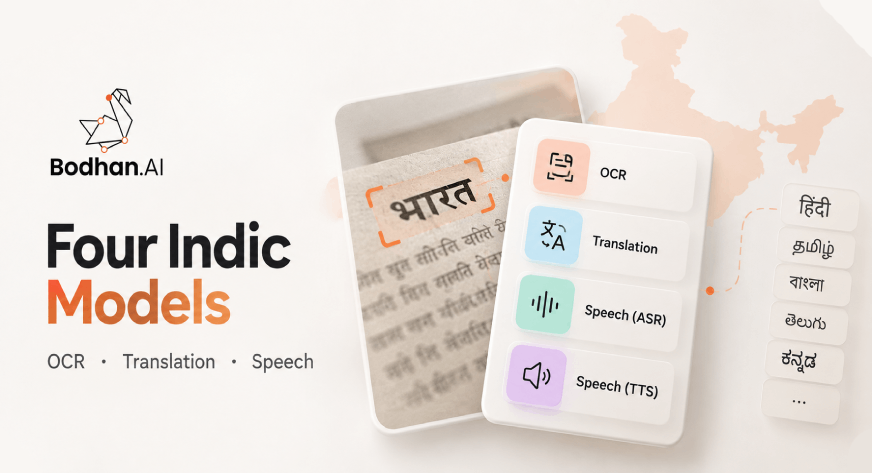
A Hindi lesson can mix English loan words, scanned tables, and handwritten equations. Making that content searchable, translating it, and reading it aloud requires several kinds of AI. Bodhan AI and AI4Bharat's four new models, released in September 2026, target those jobs across Indian languages. The models cover document parsing, translation, speech recognition, and speech generation, with support for mixed languages and scripts. This is not a niche convenience. It is a direct answer to a problem that has quietly slowed down productivity for millions of people who work across English and Indic languages every day.
We have written before about how Verify Your AI's Understanding: A Simple Check for Tax Season shows that AI is only as useful as its ability to handle real-world messiness. The same logic applies here. A model that can translate clean, typed Hindi is easy. A model that can parse a scanned table with handwritten margin notes, recognize that "software" is an English loan word, and then generate natural-sounding speech in Hindi is doing something far more demanding. Bodhan AI is not selling a single trick. They are bundling the full pipeline, and that is what makes this release notable. For anyone who has tried to stitch together separate OCR, translation, and text-to-speech tools, the friction is familiar. Each step introduces errors that compound. By addressing the entire workflow, these models reduce the integration burden and the error rate that comes with it.
The practical takeaway for our readers is straightforward. If you are building tools for education, government services, or customer support in India, this changes what you can assume about your users' input. You no longer need to force people into a single language or a clean digital format. You can accept the messy reality of how people actually write and speak. This also connects to a broader shift we have observed in Exploring Paragraph Structure: How LLMs Navigate Token Space, where the structure of language matters as much as the individual tokens. Bodhan AI is essentially applying that lesson at the document and speech level, respecting the structure of mixed-language content rather than flattening it into a single script.
What we would tell a reader asking about this is simple: the models are worth testing against your own messy data, not just clean benchmarks. The real test is whether they hold up when a student scans a textbook page with a phone camera in a dimly lit classroom. That is where the value lives, and that is also where the risk of overpromising lies. We are not saying these models are perfect. But the direction is correct. The open question we are watching is how well they handle the long tail of regional dialects and low-resource scripts that are not represented in standard datasets. That is the detail to watch, because it will determine whether this release is a one-time convenience or a durable foundation. If Bodhan AI continues to iterate on that edge, they will have built something worth building on.