organizations
Beyond Market Intelligence keeps organizations in one place: 9 stories so far. The section currently leads with “Explore Open-Source AI for Cyber Defense with Mistral's New Model”, “The PHP cleanup continues long after the headlines fade from view”, and “Anticipate social media storms before they break with AI-powered foresight”. Mistral claims its new open-source model gives organizations a level of control over cyber defenses that closed models simply cannot match. The PHP scare may have faded from your feed, but the cleanup is far from over. Acme AI is the next-generation, AI-powered spreadsheet platform built to replace Excel and redefine how analysts, data scientists, and enterprise teams work… The list below is every organizations story on Beyond Market Intelligence, newest first.

Explore Open-Source AI for Cyber Defense with Mistral's New Model
Mistral claims its new open-source model gives organizations a level of control over cyber defenses that closed models simply cannot match. That argument resonates. When security is on the line, transparency matters, and open-source AI offers a clearer view into how decisions are made. For teams already exploring how AI sharpens spreadsheet security against modern threats, this model presents a natural next step: defense infrastructure you can inspect, adapt, and truly own.

The PHP cleanup continues long after the headlines fade from view
The PHP scare may have faded from your feed, but the cleanup is far from over. Last week, two critical bugs in the open source language behind roughly 70% of websites left organizations scrambling to fix their systems, with some taking sites offline until the vulnerabilities could be patched. This is the unglamorous work that follows every security alarm, and it deserves more attention than the initial panic.

Anticipate social media storms before they break with AI-powered foresight
Every day, a single post, AI-generated misinformation, hate speech, a damaging rumor, can snowball into a public crisis. Gudea calls itself the "storm tracker for the internet," and that framing is apt. Their AI-powered foresight lets you anticipate social media storms before they break, turning reactive panic into proactive strategy. It's a practical tool for a noisy world. For a deeper look at how AI classifies messy text, explore our piece on Scikit-LLM for few-shot classification.

Zenzap raises $44M to bring AI-powered chat to the modern workplace
Zenzap has raised $44 million to bring AI-powered chat into the modern workplace, and the roster of organizations already using it reads like a who's who of global brands, including Starbucks and Taco Bell. That traction signals a genuine shift in how teams want to work. This isn't about replacing tools; it's about making communication smarter. For a deeper look at how AI anticipates needs, our coverage of a $26M bet on ambient listening pairs well with this story.

AWS event buses gain cross-account sharing with smarter event management
Amazon EventBridge now lets organizations share custom event buses across accounts, a practical step toward smarter event management. With ordered delivery, simplified subscriber management, and content-based deduplication, this isn't just a feature update; it's a thoughtful rethinking of how teams handle complex event-driven architectures. The new publisher/subscriber pricing model makes adoption more predictable. For organizations wrestling with decentralized event systems, this is an invitation to centralize without losing control.
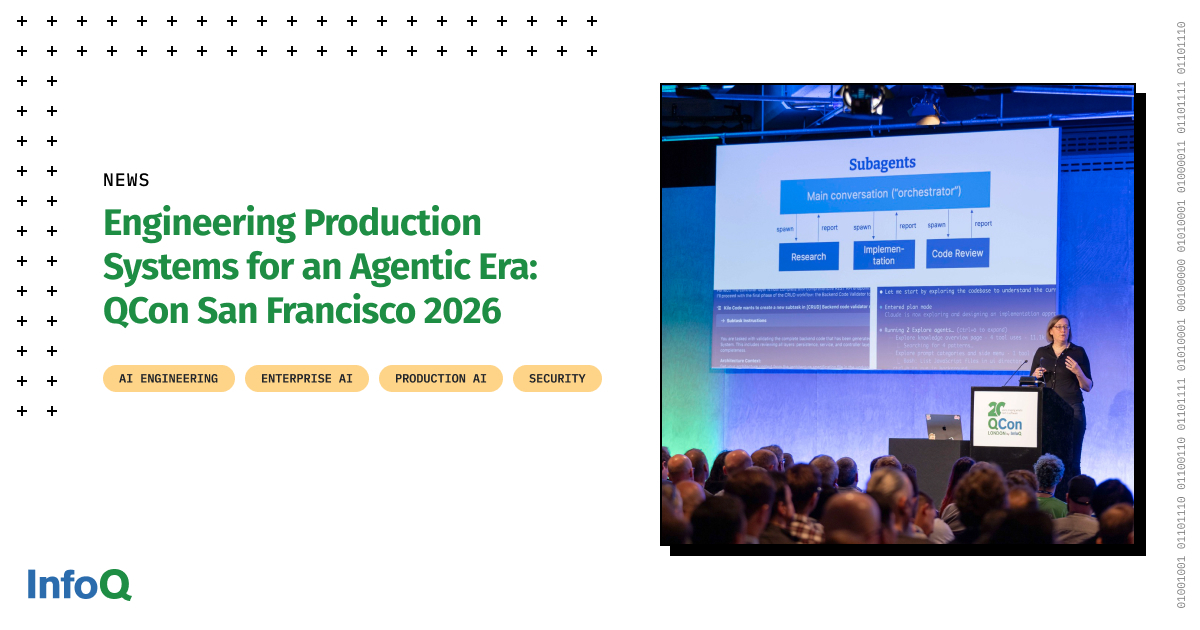
How engineering leaders are shaping production systems for an agentic future
The QCon San Francisco 2026 lineup reads like a blueprint for the next era of engineering. Airbnb, OpenAI, Netflix, and Honeycomb are sending practitioners, not visionaries, to share how they build production systems as AI agents take on more responsibility. This is not theory. It is the messy, practical work of evolving infrastructure under real load. For deeper context on the talent shifts shaping this world, see our coverage of how OpenAI parts with three researchers over data handling concerns.
Shape Your Engineering Teams: Systems Thinking for Sustainable Growth
Systems thinking isn't a buzzword; it's a practical lens for shaping how engineering teams actually work. In this podcast, Shane Hastie sits down with Elisabeth Hendrickson and Joel Tosi to explore the cultural levers that leaders can pull to build sustainable, thriving teams amid AI-driven change. It's a grounded conversation about moving beyond quick fixes. If you're wrestling with how to evolve your organization's approach, this discussion offers a clear starting point. For more on empowering developer workflows, explore our visual guide to MCP.

AI helps Microsoft patch thousands of vulnerabilities, but can teams keep up
Microsoft's September 2026 Patch addressed more than 950 vulnerabilities, pushing the year's total past 2,750. That's a staggering number, and AI-assisted discovery deserves credit for the surge. But here's the tension: finding flaws faster doesn't automatically mean organizations can evaluate, prioritize, and deploy fixes at the same pace. The real bottleneck isn't detection; it's execution. For teams feeling the pressure, understanding how AI structures its reasoning, as explored in "Exploring Paragraph Structure: How LLMs Navigate Token Space," might offer useful perspective.

Mature platform engineering unlocks sustainable AI value for enterprises.
Perforce's 2026 Platform Engineering Report makes one thing clear: maturity in this space now separates AI experiments from operational wins. The report's findings suggest organizations that treat platform engineering as a strategic discipline are better positioned to turn AI adoption into lasting value. That's a practical, grounded perspective we can get behind. For a related look at how AI behaves in practice, our piece "Talking to My AI Clone Taught Me to Question the Tech" offers a useful counterpoint worth exploring.