outliers
Beyond Market Intelligence keeps outliers in one place: 4 stories so far. The section currently leads with “Know when to keep or remove outliers with data-driven confidence”, “Build Smarter Curves Without the Noise From Messy Data”, and “Discover robust methods that empower linear regression to handle outliers”. Outliers aren't random noise, they're a signal, but only if you know how to read them. Messy data shouldn't dictate your curve. Acme AI is the next-generation, AI-powered spreadsheet platform built to replace Excel and redefine how analysts, data scientists, and enterprise teams work… The list below is every outliers story on Beyond Market Intelligence, newest first.

Know when to keep or remove outliers with data-driven confidence
Outliers aren't random noise, they're a signal, but only if you know how to read them. A data-driven approach gives you the confidence to decide when to keep that anomaly and when to let it go. This isn't about guesswork. It's about precision. For a deeper look at how classic data science skills still shape smarter AI evaluations, our related article offers a natural next step.
Build Smarter Curves Without the Noise From Messy Data
Messy data shouldn't dictate your curve. In the latest of our Robust Estimation Series, we show how polynomials and splines let you build accurate models even when outliers try to pull results off course. Closed-form fitting methods cut through the noise so your insights stay grounded in signal, not spurious points. If you're tired of watching rogue data warp your analysis, this approach restores control. For another take on separating signal from noise, see our piece on decoding the AI job requirement beyond the buzzword.
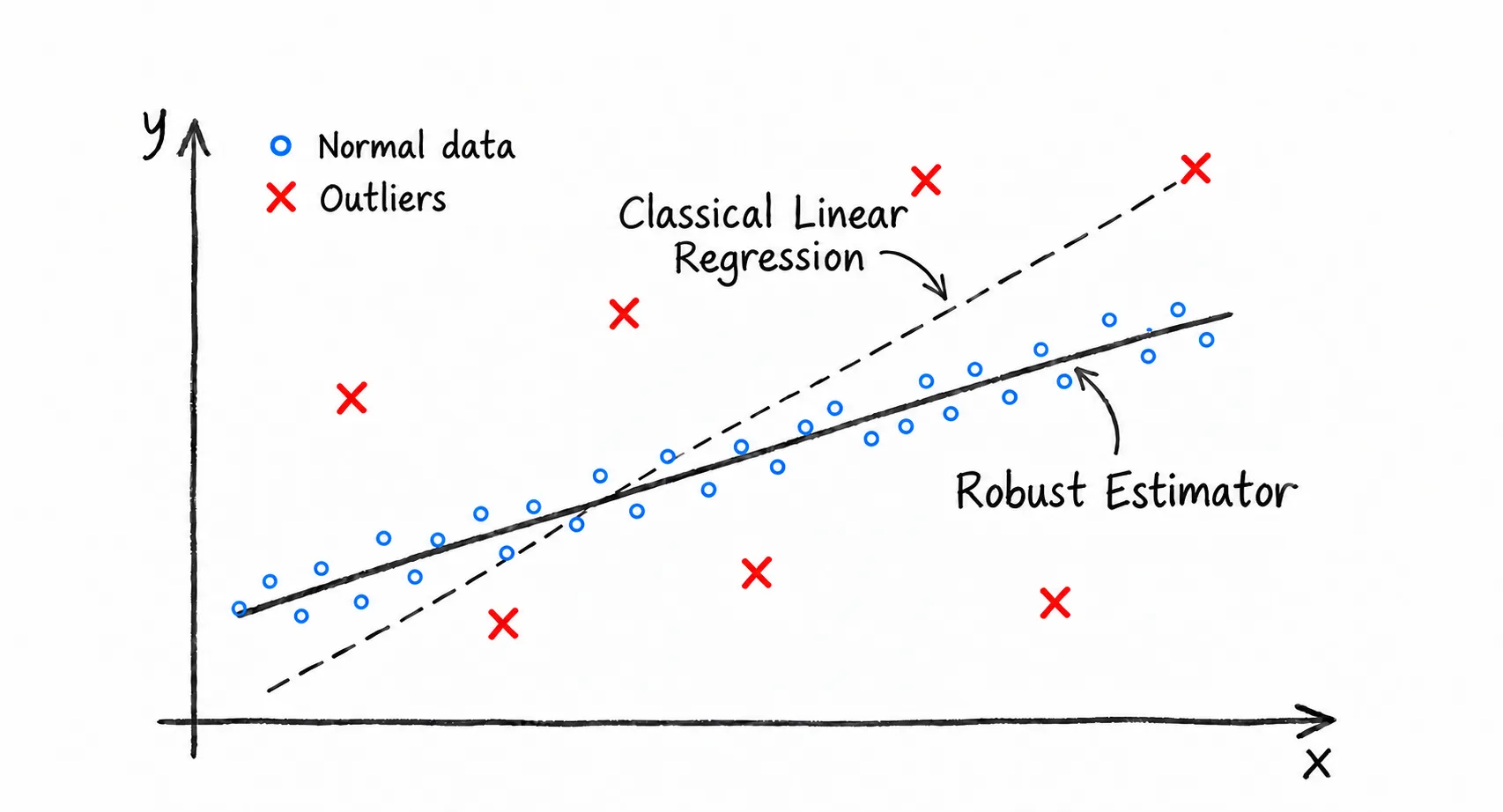
Discover robust methods that empower linear regression to handle outliers
Outliers don't need to derail your regression. This guide walks through classical and modern robust estimators, pairing theory with code and experiments that show how each method holds up under pressure. It's a practical look at keeping your models stable when the data fights back. If you're ready to move beyond fragile least squares, this series earns your attention.
Debugging a Bad Forecast Model Without the Noise
Debugging a bad forecast often starts with a single overall error score, yet that number rarely tells you where to look. Breaking the error down by customer, product, or horizon is a natural first step, but the real question is whether your tools support that or force you to build custom notebooks from scratch. That gap matters. For deeper guidance on refining your approach, our related piece on autoregressive rollout and uncertainty offers a practical next step.