partial differential equations
partial differential equations at Beyond Market Intelligence is a file of 3 stories. The newest of them: “A 1D physics solver wins, but neural networks take the lead in 5D”, “Discover how AI could transform the $1 million math challenge”, and “Explore physics-informed neural networks without writing a single line of code.”. A 1D physics solver wins; in 5D, neural networks take the lead. A $1 million bounty for the Navier-Stokes problem is serious stakes, and a NYU mathematician claims OpenAI didn't play fair. Acme AI is the next-generation, AI-powered spreadsheet platform built to replace Excel and redefine how analysts, data scientists, and enterprise teams work… The list below is every partial differential equations story on Beyond Market Intelligence, newest first.
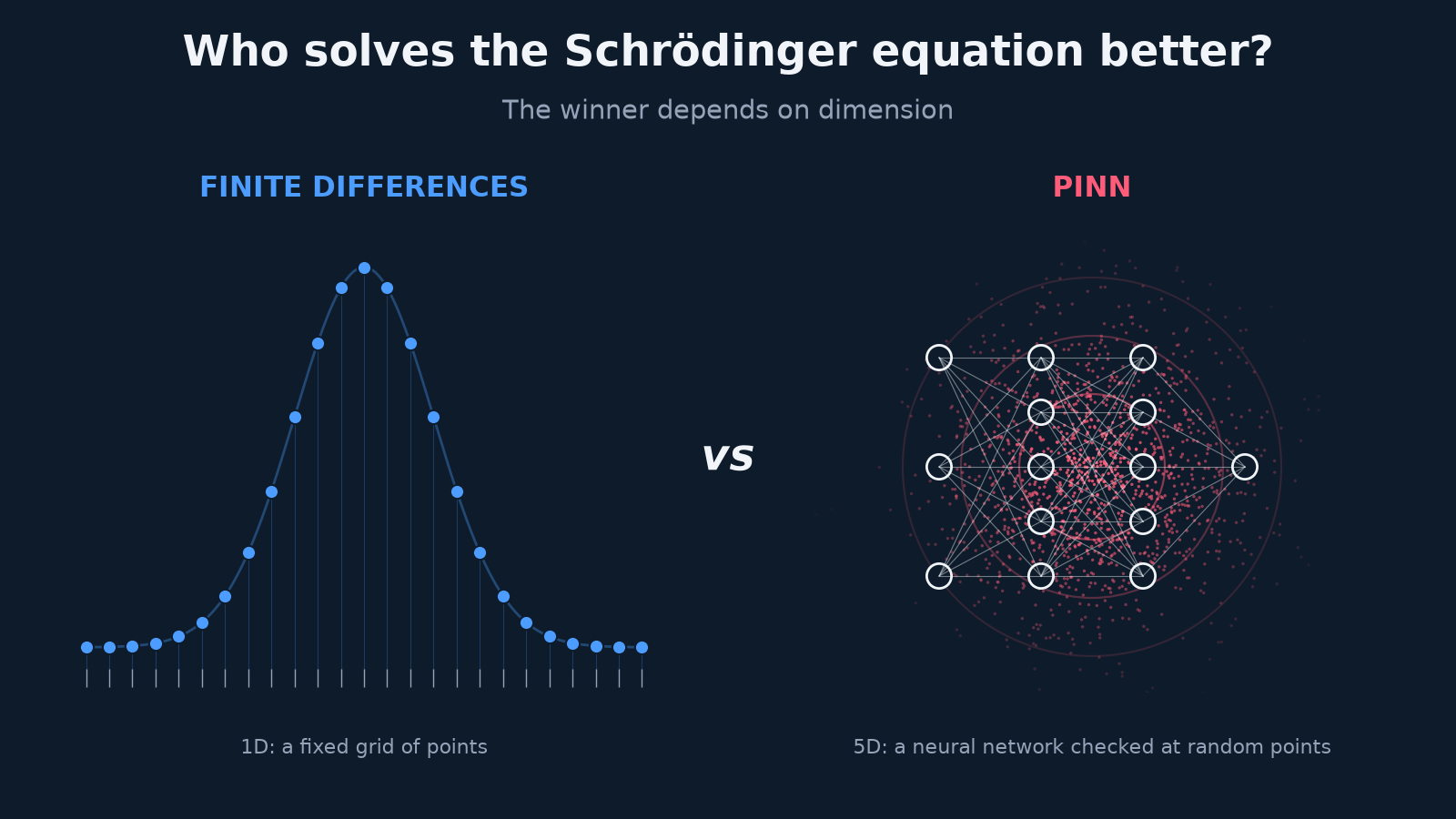
A 1D physics solver wins, but neural networks take the lead in 5D
A 1D physics solver wins; in 5D, neural networks take the lead. We put a physics-informed neural network against a plain finite-difference solver twice, and the winner changed. That shift tells us something important about when AI-powered methods actually outperform classical numerical approaches. It's not a blanket victory, it's conditional, and understanding those conditions matters. For more on how AI adapts to complex environments, see our piece on two AI copies keeping drones in sync with 94% less data.

Discover how AI could transform the $1 million math challenge
A $1 million bounty for the Navier-Stokes problem is serious stakes, and a NYU mathematician claims OpenAI didn't play fair. The accusation suggests the lab may have leveraged its AI resources to gain an unfair edge in a contest designed to reward individual genius. That feels less like innovation and more like a workaround. If true, it undermines the spirit of the challenge. For those tracking how far AI can push boundaries, this raises questions about competition and ethics.
Explore physics-informed neural networks without writing a single line of code.
PINNStudio starts from a familiar pain: a researcher who knows the physics but is buried in boilerplate code. Every new PDE problem meant rewriting scripts, debugging, and plotting by hand. That frustration produced a free, open-source no-code GUI that lets you define equations, domains, and architectures through an interface, then auto-generates the DeepXDE code and streams live loss curves and solution plots. It's a practical bridge for students and seasoned users alike, built to keep the focus on science.