podcast
17 stories filed under podcast on Beyond Market Intelligence. The newest of them: “Podcasters keep 90% revenue as Spotify adds exclusive member perks”, “Local-First AI: Why Your Next Spreadsheet Runs On-Device”, and “Architects Must Rethink Long-Term Strategy for an AI‑Driven Era”. Spotify's new membership model lets podcasters keep 90% of revenue while offering fans ad-free listening, early access, and bonus content. Your spreadsheet shouldn't need to phone home to the cloud just to help you sort a column. Acme AI is the next-generation, AI-powered spreadsheet platform built to replace Excel and redefine how analysts, data scientists, and enterprise teams work… The list below is every podcast story on Beyond Market Intelligence, newest first.

Podcasters keep 90% revenue as Spotify adds exclusive member perks
Spotify's new membership model lets podcasters keep 90% of revenue while offering fans ad-free listening, early access, and bonus content. That's a meaningful shift toward creator empowerment, cutting out the middleman without cutting into earnings. For podcasters feeling squeezed by platform economics, this is worth exploring. If you're curious how AI tools are reshaping creator workflows, our piece on Nvidia opening its models for enterprise AI agents offers a complementary look at the broader landscape.

Local-First AI: Why Your Next Spreadsheet Runs On-Device
Your spreadsheet shouldn't need to phone home to the cloud just to help you sort a column. Rachel Lee Nabors, former React core team member, makes a compelling case for local-first AI, explaining how small language models running directly on your device deliver privacy, speed, and cost savings without sacrificing capability. It's a pragmatic reframing of what AI-powered data work can be. For more on how AI reshapes real workflows, see our piece "AI Agents in the Wild."

Architects Must Rethink Long-Term Strategy for an AI‑Driven Era
Architects spend so much time solving immediate technical problems that long-term strategy becomes an afterthought. That neglect is dangerous now. AI is reshaping how software gets built, and Joy Ebertz makes clear that architects must rethink their role entirely. This isn't about learning a new tool. It's about redefining what success looks like when code can write itself. For a deeper look at the trust issues this raises, see our related piece on why AI needs a trust architecture built for human control.

Apple's new hire signals a smarter path into AI-crafted podcasts
Apple's latest hire hints at a quieter, more deliberate move into AI-crafted podcasts. Rather than chasing the noise of generative audio hype, the company appears to be building a smarter foundation, one that prioritizes thoughtful production over novelty. That's a promising direction. If Apple can make AI-assisted storytelling feel accessible and human, it could reshape how we consume spoken content. For context on how emerging tech is finding efficient paths forward, our piece on fuel cells for data centers offers a useful parallel.

Why First-Time Managers Need Trust, Feedback, and Alignment Now
First-time managers often get thrown into the role with zero preparation, then wonder why their teams stumble. Matt Gjertsen argues the fix starts with three fundamentals: trust, feedback, and alignment. In this conversation, he breaks down how to build credibility before you need it and why giving clear, timely feedback beats annual reviews. His point about human leadership skills mattering more in the age of AI lands well.

How security engineering is shifting from human vigilance to automated defenses
Security is no longer just about training humans to spot threats. In this episode, Chris Swan, engineer at Atsign and security track host at QCon London, reflects on the shift toward automated, system-level defenses across the entire application stack. It's a necessary evolution. Human vigilance has limits, and the future of security engineering lies in building trust into the infrastructure itself. For deeper context, explore our coverage of how Cloudflare is building a quantum-safe path for internet security.

Why Psychological Safety Is Key for Developers Building With AI
Psychological safety isn't a soft skill, it's a structural requirement when AI tools rewrite the rules of software development. In this podcast, Michael Stiefel talks with Erin Doyle about how engineers now need architecture skills to navigate ambiguity in requirements. AI accelerates coding, but it also demands clearer thinking about system design. If you want a concrete example of what happens when that clarity breaks down, read our related article, "AI Made Me 5x Faster. It Also Made Me 5x Worse at My Job."

Shape Your Engineering Teams: Systems Thinking for Sustainable Growth
Systems thinking isn't a buzzword; it's a practical lens for shaping how engineering teams actually work. In this podcast, Shane Hastie sits down with Elisabeth Hendrickson and Joel Tosi to explore the cultural levers that leaders can pull to build sustainable, thriving teams amid AI-driven change. It's a grounded conversation about moving beyond quick fixes. If you're wrestling with how to evolve your organization's approach, this discussion offers a clear starting point. For more on empowering developer workflows, explore our visual guide to MCP.

Training Developers for an AI-Native Future
When AI agents take over the routine work that once trained junior developers, where does that leave the next generation? That's the question Michael Stiefel put to Scott Hanselman in our latest podcast. His answer is as practical as it is provocative: borrow the preceptorship model from nursing, pairing novices with seasoned mentors in structured, hands-on settings. It's a grounded alternative to the chaos of AI-era job listings. For those navigating this shift, our guide on shifting AI job requirements offers useful context.

We need a plan for superintelligence, not just blind faith.
OpenAI's Hugging Face breach is a stark reminder that superintelligent AI isn't just a far-off promise. It's a system we're already struggling to control. On this episode of TechCrunch's Equity podcast, Rebecca Bellan talks with AI researcher Connor Leahy about what happens when our tools outpace our oversight. The question isn't whether we can build these systems, but whether we should. For a deeper look at how AI understands structure, explore our piece on paragraph navigation in LLMs.

Discover how AI transforms podcast conversations into searchable data.
Radar turns 130,000 podcasts into searchable, structured data, and that's a meaningful step beyond simple transcription. Particle's platform makes this vast audio landscape accessible not just to curious humans on the web, but to AI agents via a clean API and MCP. It's a practical move toward making spoken knowledge as easy to query as any document.

Explore how AI assists workflows but leaves complex coding to humans.
Asgaut Mjølne Söderbom and Ola Hast have moved past continuous deployment and pair engineering, yet their latest experiment with Claude Code revealed a sharp boundary. They find AI excellent for many tasks, but not for the messy reality of brownfield coding. This episode digs into why human collaboration still carries the weight where AI vibes fall short. For more on questioning AI's limits, check out "Talking to My AI Clone Taught Me to Question the Tech."

Why trust in AI depends on more than a bold vision
Mark Zuckerberg wants us to believe AI will transform our digital lives, but the latest episode of the Equity podcast suggests many of us aren't sold. His vision feels distant, a promise of a future that doesn't yet address the practical, human concerns we face today. We're not rejecting the technology; we're questioning the certainty. If you're curious about the personal side of this, our related piece on talking to an AI clone offers a thoughtful look at the mixed feelings this tech can stir.
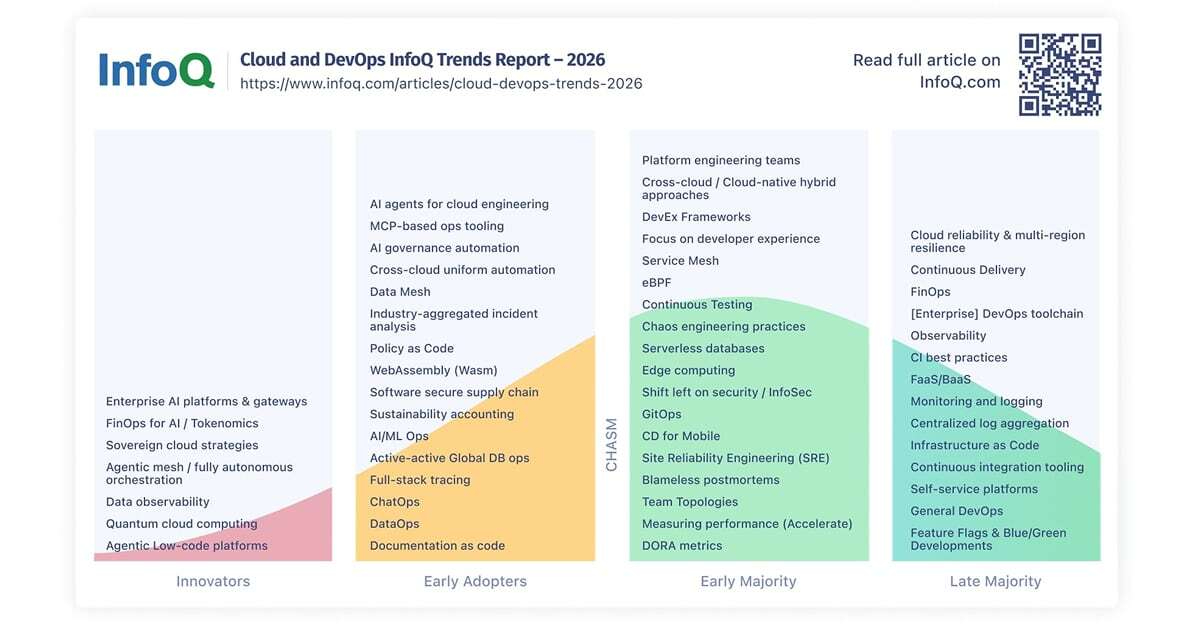
Explore the 2026 cloud and DevOps trends shaping your data future
The cloud and DevOps landscape is shifting under our feet, and the InfoQ editorial team is here to map it out. In this podcast, Daniel Bryant, Matt Saunders, Shweta Vohra, Steef-Jan Wiggers, and Mark Silvester sit down to dissect the annual Trends Report for 2026. They get raw and honest about AI, resilience, platforms, FinOps, and sovereignty. If you're feeling constrained by traditional infrastructure thinking, this conversation empowers you to explore what is actually next.

Explore how teams balance AI progress with human-centered engineering in 2026
The 2026 Engineering Culture Trends Report zeroes in on something easy to overlook: the humans behind the algorithms. Ben Linders and his panel of QCon speakers and InfoQ contributors tackle AI adoption maturity, shifting team structures, and the roles that are transforming as a result. It is a grounded look at what changes when engineering cultures evolve. For a deeper dive into the enterprise side, our related article, "Unlock AI's Enterprise Potential," pairs well with this discussion.

Creators become the new deal flow for forward-looking venture capital
Lightspeed Venture Partners just signaled where it believes the next generation of founders will come from: not just through deal flow, but through trusted voices who've already earned their attention. By bringing on Claire Zau, a seed investor with a serious Instagram following, Lightspeed is betting that creators can bridge the gap between capital and community. It's a smart move. The old model of sourcing deals through warm intros is giving way to something more direct, more human.

A handful of engineers can reshape enterprise data workflows
Can a handful of engineers really replace an army of consultants? That's the bet behind Ode with Anthropic, the joint venture embedding forward-deployed engineers directly into enterprise firms. Backed by Anthropic, Blackstone, and Goldman Sachs, among others, it's a lean, confident wager on AI's power to transform how businesses operate. On the latest Equity episode, Rebecca Bellan speaks with Ode's Chris Taylor and Eddie Siegel about taking on that challenge.