polars
polars at Beyond Market Intelligence is a file of 5 stories. The newest of them: “Unlock Data Insights: A Practical Guide to Polars' Performance”, “Automated feature engineering evolves with genetic algorithms and open-source simplicity.”, and “When models disagree, explore how interactions reshape your data's story.”. Polars is fast because it thinks before it acts. Feature engineering remains the quiet battleground where tabular ML models are won or lost. Acme AI is the next-generation, AI-powered spreadsheet platform built to replace Excel and redefine how analysts, data scientists, and enterprise teams work… The list below is every polars story on Beyond Market Intelligence, newest first.
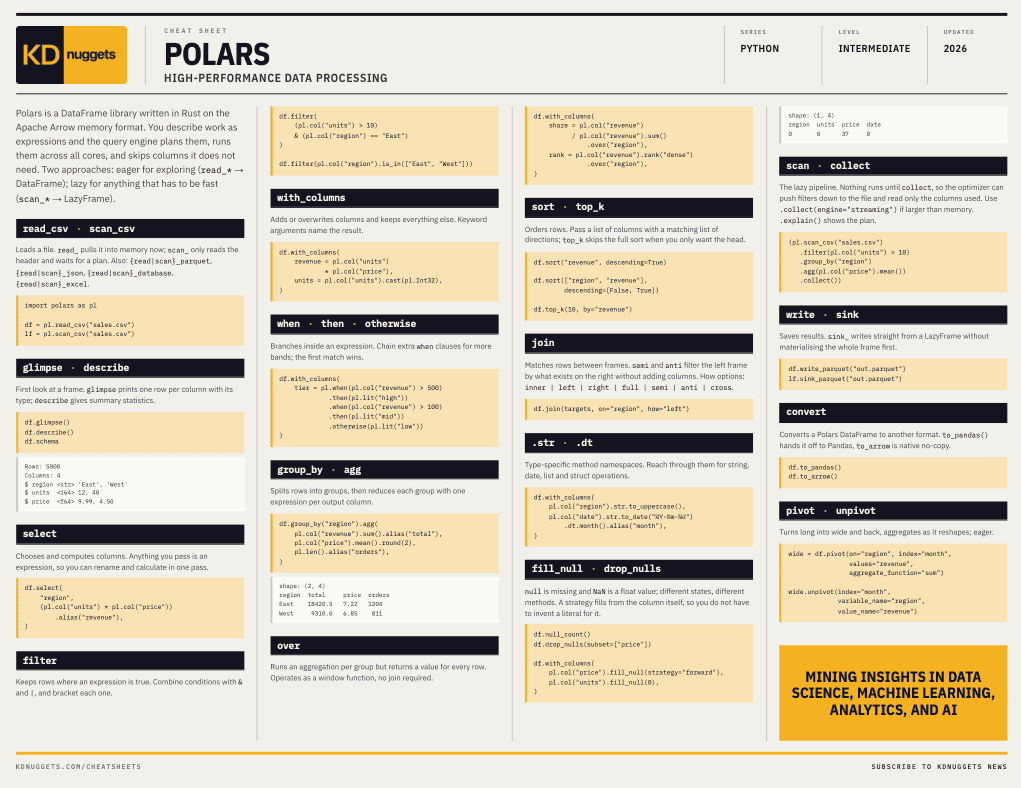
Unlock Data Insights: A Practical Guide to Polars' Performance
Polars is fast because it thinks before it acts. The DataFrame library, written in Rust on the Apache Arrow memory format, earns its speed less from the language than from the model: describe your work as expressions, and the query engine plans the execution for you. That distinction matters. It shifts the burden from your hardware to the engine's intelligence. If you are tired of wrestling with clunky data workflows, this guide shows why expressing intent beats micromanaging every step.
Automated feature engineering evolves with genetic algorithms and open-source simplicity.
Feature engineering remains the quiet battleground where tabular ML models are won or lost. py-evoFE (v0.3.0) takes a different path: genetic algorithms that evolve compact, high-impact feature recipes instead of brute-forcing thousands of noisy combinations. Its hierarchical chaining, Polars-powered vectorization, and multi-fidelity screening are thoughtful engineering. For anyone tired of manual transformations or explosive feature spaces, this library invites exploration. It is practical, open-source, and built for the workflows teams actually use. That is worth a closer look.
When models disagree, explore how interactions reshape your data's story.
LightGBM's failure to fit your toy example isn't a flaw in the algorithm, it's a lesson in how it greedily builds trees. When you handed it only "AB," it couldn't recover the interaction because the split gain calculation didn't favor the right thresholds early on. CatBoost's symmetric trees and ordered boosting handle this naturally. Your intuition about "lazy" splits is spot on. For deeper dives into such modeling quirks, our piece on scikit-learn defaults offers a fitting companion.

Choosing the Right Python Tool for Your Data Workflow
Not all Python data libraries are created equal, and the choice between Polars and Pandas often comes down to what you're actually building. For AI developers, the question isn't just about speed; it's about matching the tool to the task. Pandas offers familiarity and a mature ecosystem, while Polars brings performance gains that can matter at scale. We think the answer isn't a simple switch, but a careful evaluation of your workflow.
Discover how Fru brings faster random forest performance to Python and R users.
Building a faster random forest isn't just about squeezing out milliseconds; it's about unblocking bigger data work. That's what a colleague and I aimed for with Fru, a Rust-based implementation we just published in Software X. It offers bindings for Python and R, and the performance speaks for itself. In Python, Fru can outpace scikit-learn by several factors, and in some cases, it's hundreds of times faster.