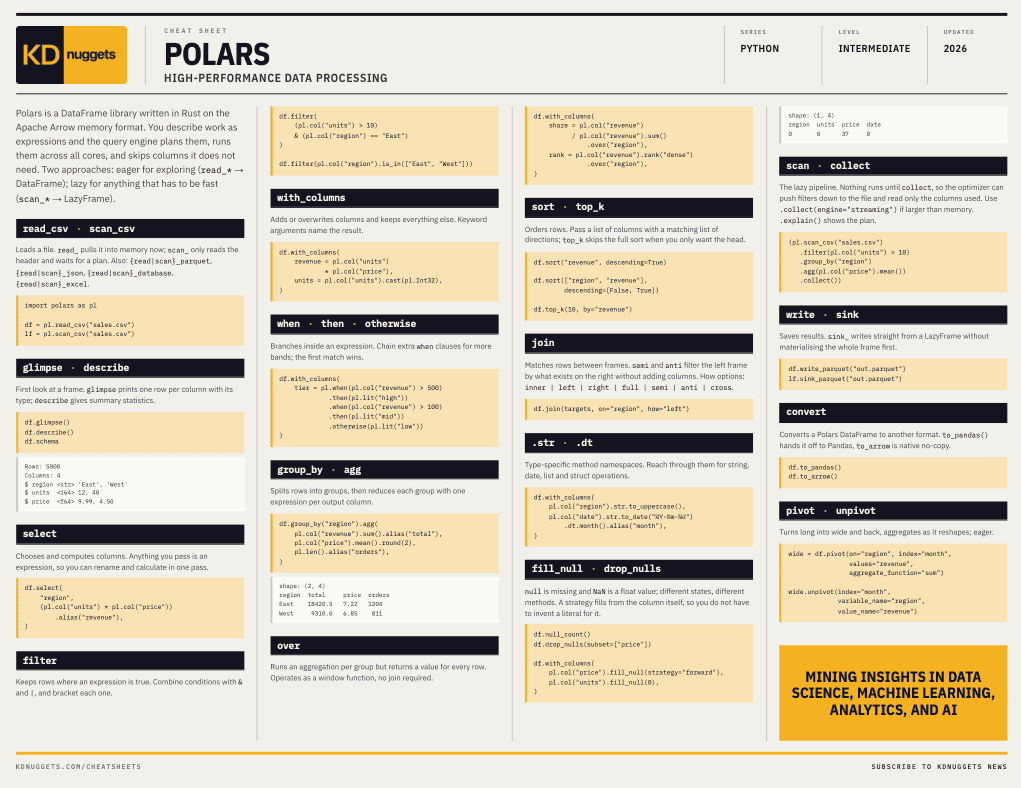
The rapid evolution of AI is reshaping the landscape of data manipulation, and Polars’ emergence as a high-performance DataFrame library marks a significant step forward. It’s easy to get caught up in the hype surrounding language choices – Rust versus Python, for example – but as the recent article, "Unlock Data Insights: A Practical Guide to Polars' Performance" highlights, the true power lies in the underlying model. Polars’ speed isn’t solely attributable to Rust; it's the ingenious query engine that plans and optimizes expressions, turning declarative descriptions of data transformations into efficient execution plans. This approach echoes the advancements we’re seeing elsewhere, like Qualcomm’s efforts to bring AI processing local with their new chips Unlock AI Power: Qualcomm’s New Chips Bring Local Processing, demonstrating a broader trend towards optimized, performant AI workflows, and the ongoing innovation in data-as-a-service exemplified by Snorkel AI’s substantial Series E funding Fueling AI Innovation: Snorkel AI Secures $350M Series E.
The shift towards expression-based data manipulation within Polars is particularly compelling. Traditional spreadsheet tools and even many data science libraries often operate with an imperative style – you write out the steps to achieve a result. Polars, however, encourages a declarative approach: you define *what* you want, and the engine figures out *how* to get it most efficiently. This abstraction layer not only unlocks significant performance gains, but it also simplifies the development process. Data scientists can focus on the logic of their analysis rather than the intricacies of low-level optimization. Consider, too, the recent advancements in model reasoning capabilities, as seen in Claude Opus 5.5 Unlock New Reasoning Power: A Deep Dive into Claude Opus 5.5; Polars' efficiency allows for faster experimentation and iteration on complex data workflows, directly contributing to the advancement of AI models themselves. The ability to rapidly process and analyze large datasets is becoming increasingly crucial as AI models demand ever-larger training sets and more sophisticated feature engineering.
The implications of Polars extend beyond just speed. Its foundation on Apache Arrow provides a standardized memory format, fostering interoperability with other data processing tools and languages. This is a vital step towards creating a more cohesive and efficient data ecosystem. The limitations of legacy spreadsheet software are becoming increasingly apparent as data volumes and complexity grow. These tools, while familiar, often struggle to handle the scale and performance demands of modern data science. Polars represents a future-focused alternative, offering a more scalable and efficient solution for data manipulation without requiring users to completely abandon their existing skills. The emphasis on expressions also lends itself well to automation and reproducibility, crucial elements for building reliable and trustworthy AI systems.
Ultimately, Polars’ approach to performance—centered on intelligent query planning rather than just language choice—signals a fundamental shift in how we think about data processing. It’s not just about making things faster; it’s about making them more intuitive, more scalable, and more integrated into the broader AI landscape. As AI continues to permeate every aspect of our lives, tools like Polars will be essential for unlocking the full potential of data and driving innovation across industries. The question now is whether this paradigm shift—moving from imperative to declarative data manipulation—will become the new standard, and how quickly other data processing libraries will adapt to embrace similar approaches.