prediction
prediction at Beyond Market Intelligence is a file of 15 stories. The newest of them: “Moving Beyond Accuracy to Build Machine Learning You Can Trust”, “Stacking Only Wins When Your Models Disagree”, and “Why Your Forecast Gets the Future Right and Still Fails”. Accuracy is the starting line for machine learning adoption, not the finish. Stacking only pays off when your models disagree. Acme AI is the next-generation, AI-powered spreadsheet platform built to replace Excel and redefine how analysts, data scientists, and enterprise teams work… The list below is every prediction story on Beyond Market Intelligence, newest first.
Moving Beyond Accuracy to Build Machine Learning You Can Trust
Accuracy is the starting line for machine learning adoption, not the finish. The real challenge is moving from "this model works" to "this model earns our trust." That's where conformal prediction enters the conversation, offering a framework for calibrated, decision-grounded reliability. It's a shift from asking if a model is right to understanding how confident it can be. For teams building toward trustworthy AI, this is the practical next step.
Stacking Only Wins When Your Models Disagree
Stacking only pays off when your models disagree. If every model in your ensemble stumbles on the same rows, combining them just compounds the error. The real win comes from diversity, models that fail differently can cover each other's gaps. That distinction matters more than chasing a slightly better single model. For teams wrestling with how to build reliable pipelines, this is the practical insight worth testing.

Why Your Forecast Gets the Future Right and Still Fails
A forecast can nail the mean and the variance and still describe a future that never happens. That is the paradox this piece tackles head-on, introducing a diffusion head for probabilistic time series forecasting that fixes the gap between statistical accuracy and real-world outcomes. It is a sharp, necessary correction for anyone who trusts their MSE a little too much. For a related look at how models can mislead, explore our coverage of why Gemini Argon tops charts but skips the test that counts.

Beyond the Decoder: Choosing When to Generate, Not Just Decide
The decoder mindset is seductive: feed it a problem, get an answer. But generation is a different beast. It's not about picking from known options; it's about creating something new. We agree, and we think that distinction is where the real value lies. Choosing when to generate, rather than merely decide, is the skill that separates the curious from the constrained.
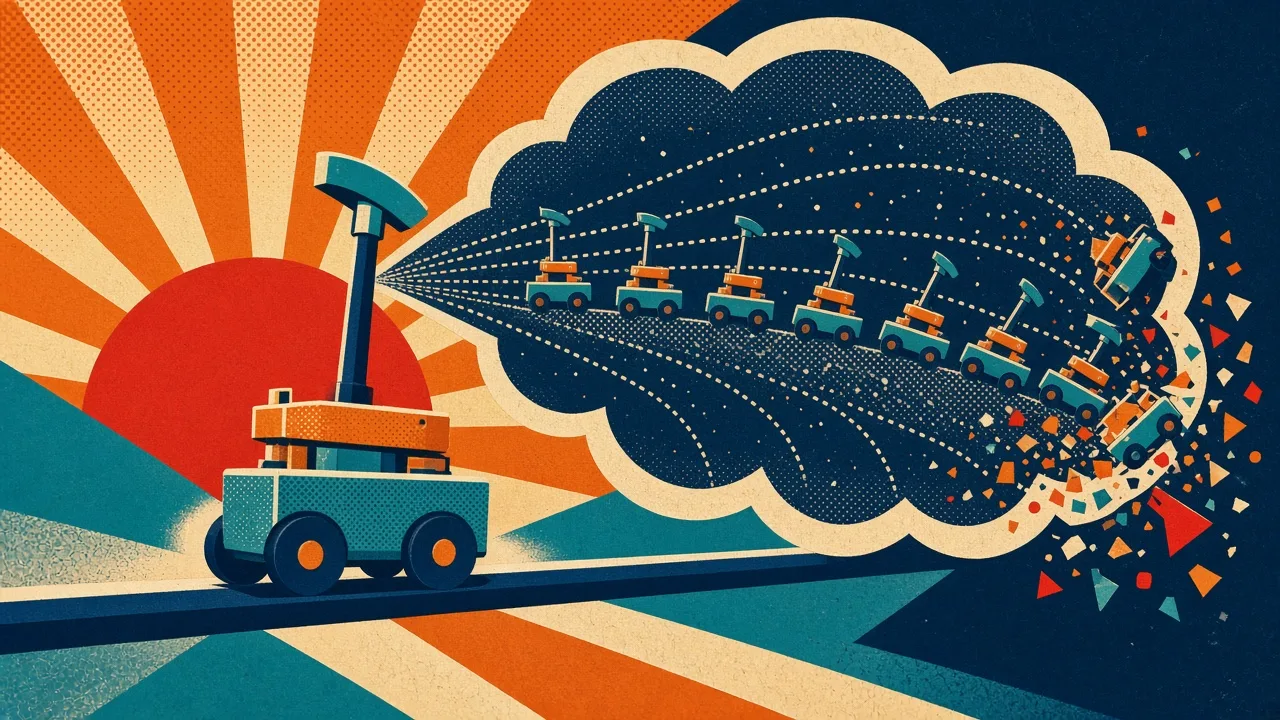
Build Your First World Model: A Practical Python Guide
Building a world model sounds abstract until you watch one learn to play CartPole by imagining the future. That's exactly what this practical guide delivers: a hands-on Python walkthrough for creating a model that daydreams its way through the environment, then shows you precisely when that illusion starts to crack. It's a smart, grounded introduction for anyone ready to move beyond static spreadsheets. For more on how AI behaves in real-world systems, explore "Exploring Real-World Computer Vision: Deployments, Edge Models, and Current Challenges."
Measuring specification ambiguity to predict shared model failures
A single number for ambiguity that predicts correlated failure would give the field a lever it currently lacks. The question is whether that relationship is a gentle slope or a cliff. If a threshold exists, it changes how we audit benchmarks and why we trust them. Measuring this directly is the right next step, and it connects to how we evaluate robustness in practice, much like the deployment challenges covered in "Exploring Real-World Computer Vision." The metric is the missing piece.

Predict infrastructure failures before they disrupt your workflow.
Empirik has launched with $21M in funding, backed by Sequoia, to predict IT outages before they strike. The mission is straightforward: give infrastructure the same proactive intelligence that Cursor brought to software engineering. That comparison matters because it signals a shift from reacting to problems to preventing them. For teams tired of firefighting, this is a practical step toward calmer operations. And if you're curious how similar predictive logic plays out in other fields, our piece on adaptive recommendation systems offers a useful parallel.
Explore how a simple model estimates NeurIPS acceptance from your scores.
A quick, practical tool just landed for anyone tired of refreshing review portals. A Reddit user built a small model that estimates NeurIPS acceptance odds from scores and an assumed acceptance rate. It is a simple calculator, not a crystal ball, but it gives researchers a useful sense of where they stand before decisions land. That sort of accessible, data-driven clarity is exactly what the future of academic tools should look like.

Explore How Bounded AI Agents Navigate Knowledge Graphs for Smarter Insights
Most of us hand our AI agents a search box and call it a day. The approach argues for something sharper: typed tools, hard bounds, and a gate the model cannot talk past. The payoff is letting the agent wander a knowledge graph on its own, within strict limits. Four models and one wrong prediction later, the question is whether that discipline is worth it. We think it is, and the reasoning here is worth your attention.

The Equation That Reveals Bagging's Limits and Why Randomness Matters
Bagging has a ceiling, and no amount of trees will break it. The equation explains why random forests need that extra layer of chaos to keep improving. It's a sharp reminder that more isn't always better when the mechanism stalls. The experiment makes the point concrete, turning theory into something you can see. If distributed systems intrigue you, *Unlock LLM Training* pairs well with this mindset, though it stands firmly on its own.
Precision in preprocessing: refine your camera frames for accurate AI predictions.
Your model aced training, but the gap between those clean validation images and your live camera feed is where accuracy goes to die. The culprit is rarely the model itself, it's the preprocessing pipeline. Your YUV-to-RGB conversion looks solid, but the real suspect is the tensor scaling. TFLite models typically expect normalized float inputs in a specific range, like [0,1] or [-1,1], not raw 0-255 integers. Feeding raw pixel values into MobileNetV3 will skew the learned feature maps significantly.
Explore how AI uncovers exactly where world models break down.
World-model evaluation has a blind spot, and it's not where you'd expect. When a "predict nothing changes" baseline scores 0.983 SSIM on real robot video, and the error stays flat across six steps, the metric isn't lying; the setup is. The usable ranking window sits between 8 and 24 steps on DROID footage, bookended by ties. That's a measurement worth stealing for your own data.

Why Pure Reasoning Reaches Its Limit Without Real-World Data
Reasoning alone has a hard ceiling. No matter how advanced non-physical AI becomes, it cannot predict the chaotic, messy reality of the physical world without a sensory and motor interface. We are asking for breakthroughs in science and technology, but those demands outstrip what pure logic can deliver. This isn't a limitation to be coded around; it's a fundamental gap. To truly transform our data-driven future, intelligence must touch the ground.

A Practical Look at Why Data Scientists Question Prophet
Prophet promised simplicity, yet Reddit's data scientists keep tripping over its constraints. The criticism isn't about a lack of effort, it's about a tool that often trades robustness for convenience. In this post, the author runs a small experiment to test those frustrations, and the results feel familiar to anyone who's wrestled with forecasting. We appreciate the hands-on approach. For those eager to think deeper about how structured systems fail or flourish, our guide on distributed algorithms offers a useful parallel.

Explore how data models failed when empathy mattered most on a flight.
An overbooked flight cost one airline $8 million in a single incident, while an affected passenger walked away with $5,000 and a story poised to go viral. That gap is the real tragedy of data science. Numbers tell us what happened, but they rarely capture the human cost behind the spreadsheets. This tale is a reminder that even the smartest models miss what matters most. For those eager to explore how data-driven systems fail, this is a compelling place to start.