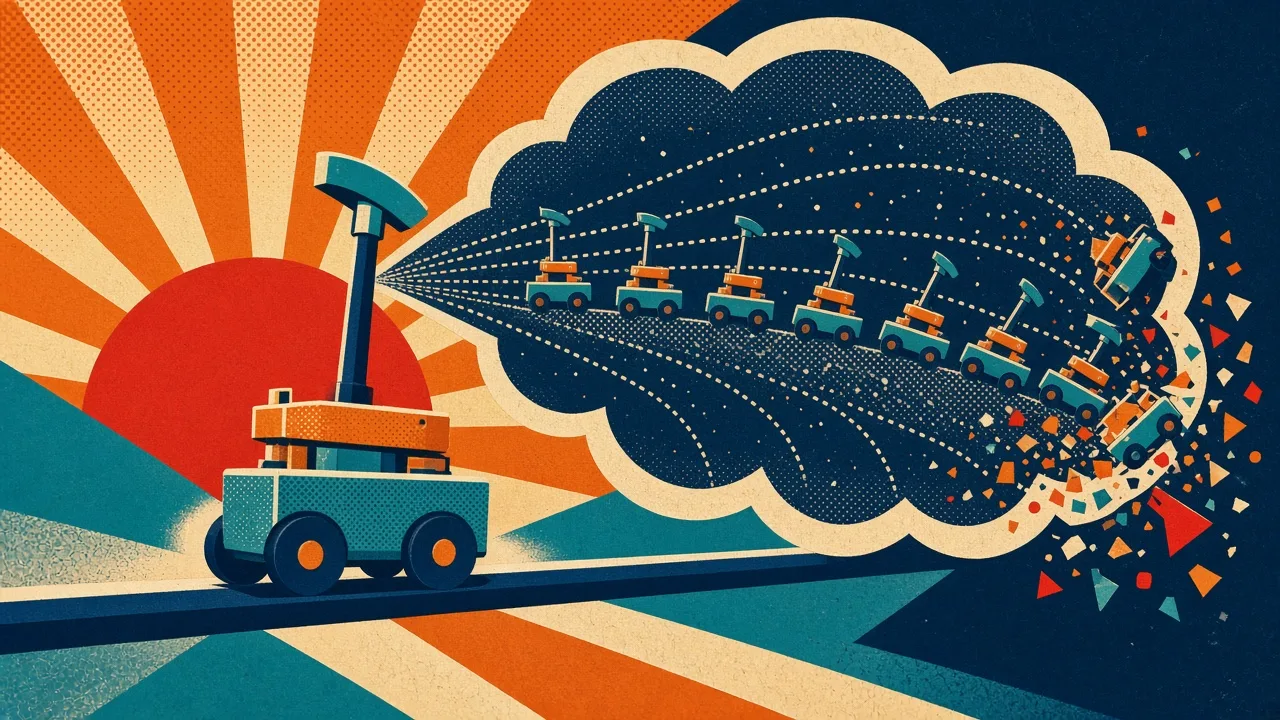
The recent surge of interest in world models, exemplified by the “Build Your First World Model: A Practical Python Guide” on Towards Data Science, underscores a pivotal shift in how we approach AI. The ability for an AI to construct and maintain an internal representation of its environment – essentially, to “daydream” and simulate – moves us beyond reactive systems towards agents capable of planning, reasoning, and adapting in complex scenarios. This isn't simply about improving performance on a single task; it’s about building a foundation for more generalized and robust AI. The CartPole example, while relatively simple, serves as a compelling illustration of this concept, allowing developers to observe and measure the fidelity of the model’s internal world and understand when its predictive power breaks down. This focus on measurable collapse, as the article highlights, is critical for debugging and iteratively improving these models. The underlying trend aligns perfectly with our vision of empowering users with accessible AI tools, moving away from black-box solutions and towards systems that offer greater transparency and control. As detailed in “AI-Powered Spreadsheets Empower Enterprises, Ema Secures $77M,” the enterprise adoption of AI is accelerating, and the demand for explainable and predictable AI will only increase.
The practical nature of the guide is particularly noteworthy. Historically, world model development has been confined to research labs, perceived as an esoteric area requiring significant expertise. This accessible introduction democratizes the field, allowing a wider range of developers to experiment and contribute. This parallels the evolution of spreadsheet technology itself, where initially complex functions have been progressively simplified and made available to a broader audience. The ability to build these models from scratch, as opposed to relying on pre-trained behemoths, offers a level of customization and control that is increasingly valuable. Furthermore, the challenges of accurately measuring when the "illusion collapses" highlights the importance of robust evaluation metrics – something we’ve consistently emphasized in our own development process. The need to understand *why* a model fails, not just *that* it fails, is essential for building trustworthy AI. This aligns with the need for streamlined processes, as highlighted in “Streamline Your Submission: Combining Paper and Supplementary Materials,” where clear and demonstrable results are paramount.
The broader significance of world models extends far beyond game environments like CartPole. Imagine a supply chain management system that can simulate the impact of disruptions, or a financial model that can forecast market volatility with greater accuracy. These are just a few examples of how world models can be applied to solve real-world problems. The shift towards more proactive AI, capable of anticipating and mitigating risks, is a critical step in realizing the full potential of the technology. Greece's PM, as noted in “Greece's PM: AI's Future Demands More Than Yesterday's Solutions,” correctly identifies the need for innovative approaches to address the complex challenges of the future; relying on yesterday's solutions simply won't suffice. World models represent a significant leap forward in that direction, offering a pathway to AI that is not only powerful but also adaptable and resilient.
Looking ahead, the evolution of world models will likely be shaped by advancements in areas like unsupervised learning and reinforcement learning. The ability to learn complex world representations from raw data, without explicit labels, will be crucial for scaling these models to real-world applications. Moreover, the integration of world models with existing AI tools, such as those found in spreadsheet environments, will unlock new possibilities for data analysis and decision-making. The question remains: how can we best equip users, regardless of their technical background, to harness the power of world models and leverage them to transform their workflows and achieve unprecedented levels of productivity?