proof
proof on Beyond Market Intelligence: a running collection of 4 stories we have gathered and hand-picked because they are worth your time. Every post here touches on proof in some way — the news, the analysis, the deep dives, and the occasional surprise find. Acme AI is the next-generation, AI-powered spreadsheet platform built to replace Excel and redefine how analysts, data scientists, and enterprise teams work with data. New stories are added to this page as we find them, so check back if you want to keep up with what is happening around proof, or subscribe to the RSS feed to get them as soon as they are published. Browse the collection below, or head back to the homepage to see everything Beyond Market Intelligence is covering right now.

OpenAI fought dirty on career-making math problem, says NYU mathematician
The pursuit of solving the Navier-Stokes existence and smoothness problem, a challenge carrying a substantial $1 million bounty, has taken a contentious turn. A prominent NYU mathematician alleges OpenAI employed questionable tactics in their attempt to claim a solution. This dispute highlights the intense competition surrounding breakthroughs in mathematical physics, particularly as AI tools like those explored in our article, "PINNStudio: A free, open-source no-code GUI for setting up, training, and visualizing PINNs," are increasingly leveraged to tackle these complex problems.
What is the general design of these new math solving systems? [D]
Emerging AI math-solving systems demonstrate a compelling design: they leverage large language models, often Aster, to iteratively generate LEAN code, a formal proof language. These systems then submit the code to a LEAN compiler for verification, incorporating successful statements as established facts. Evidence suggests a modular approach, constructing proofs piece by piece before final compilation, hinting at a sophisticated "fact" management process. As explored in "Astra vs. Fable 5.1," the hardware requirements for meaningful progress remain a significant consideration.
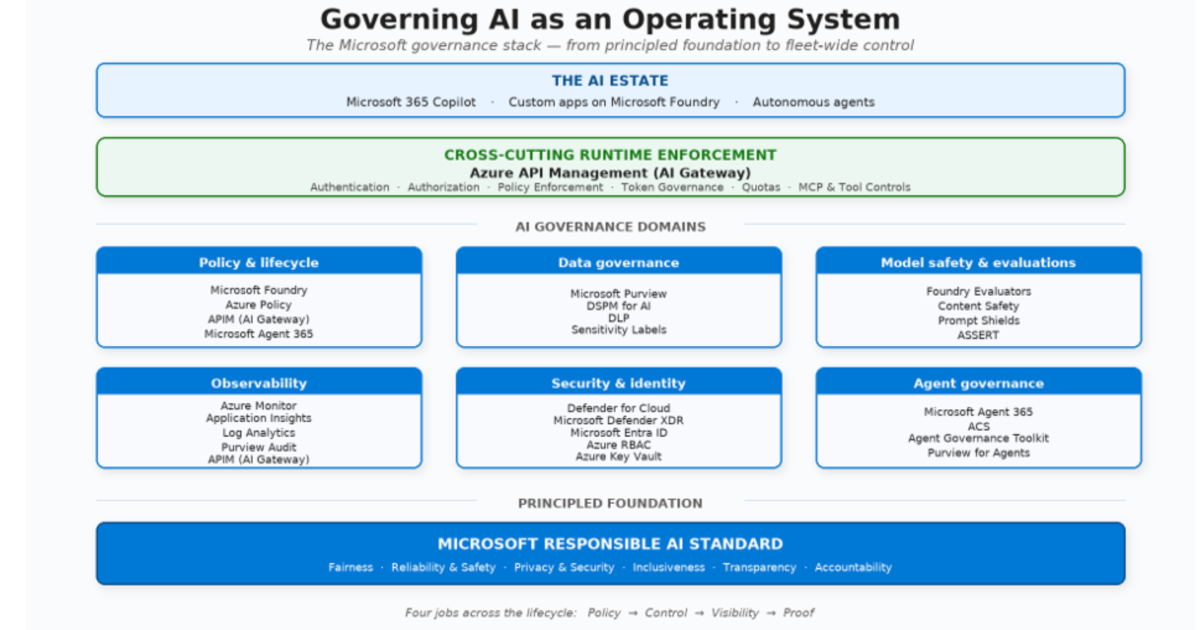
Microsoft Moves AI Governance From Policy to Runtime Enforcement
Microsoft is reshaping AI governance, moving beyond policy creation to runtime enforcement. Their new architecture, spanning nine domains and four core functions—policy, control, visibility, and proof—directly links governance requirements with real-world application operation. This approach ensures continuous evaluation, observability, and robust audit trails, empowering organizations to confidently verify AI compliance. As enterprises increasingly leverage AI agents, understanding this shift is critical; consider “Enterprises winning with AI agents are limiting how much the agents can do alone” for further insights.

A Simplified View of the Jacobian Conjecture
The Jacobian Conjecture, a notoriously complex problem in abstract algebra, initially appears impenetrable. However, a concrete counterexample exists: a readily visualizable 3D function. Our latest post offers a simplified view, explaining this counterexample using familiar geometric concepts and accessible algebra. Explore how this tangible demonstration illuminates a core challenge in field theory. For those interested in building systems that leverage knowledge, consider “How to Build a Context Layer and a Company Brain,” which details practical approaches to knowledge management.