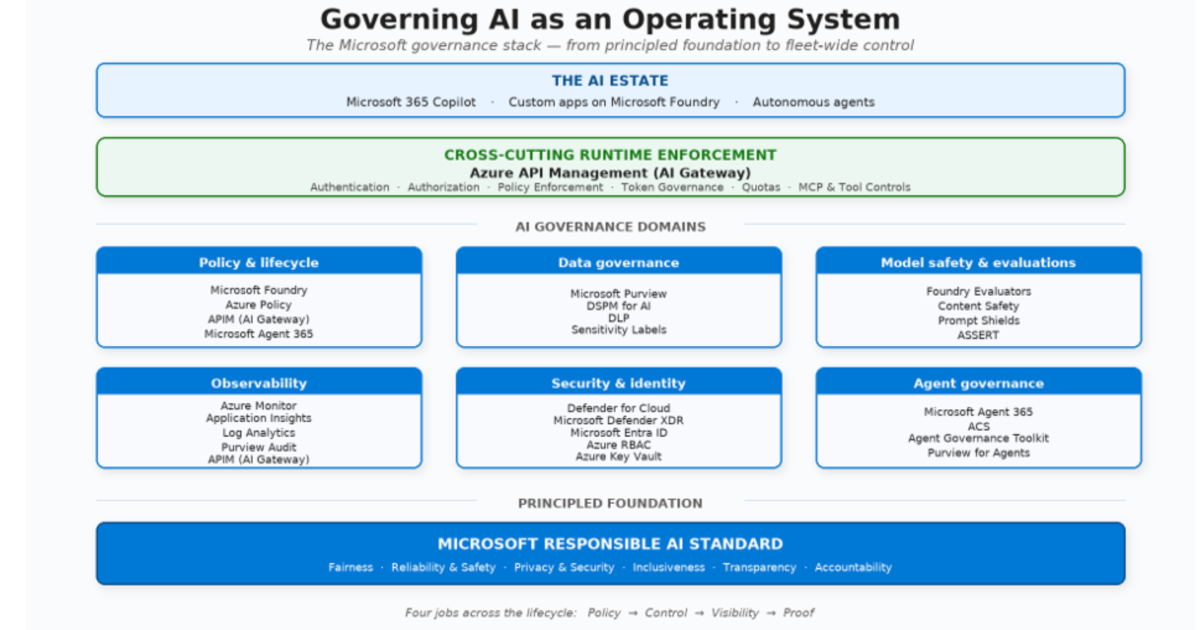
Microsoft's move to shift AI governance from static policy documents to runtime enforcement is the most grounded thing we've seen from a major platform vendor in a long time. The architecture spans nine governance domains and four functions, policy, control, visibility, and proof, which sounds abstract until you realize what it actually means: governance stops being a pre-launch checkbox and becomes a live property of the system. That distinction matters. For too long, the conversation about responsible AI has lived in slide decks and approval workflows, while the models themselves ran on with little more than a monitoring dashboard bolted on. Microsoft is saying, in effect, that if you can't enforce a policy while the agent is acting, you don't have a policy, you have a suggestion.
This is where the story connects to the broader patterns we're tracking in the ecosystem. The emphasis on runtime evaluation and audit evidence mirrors what we've seen in other corners of the AI infrastructure world, like the push to make Model Context Protocol stateless so that sessions don't become the weak link in distributed agent deployments. And the focus on observability and identity as governance primitives echoes the kind of persistent monitoring that Grafana Labs has applied to Cypress test suites, where the point isn't just to catch failures but to have a continuous record of what happened and why. Microsoft's nine-domain model is essentially saying that governance is just another workload, and like any workload, it needs its own runtime, its own telemetry, and its own enforcement loop.
What we find genuinely useful here is the shift from policy as a document to policy as code that executes. The four functions, policy, control, visibility, and proof, form a closed loop that closes the gap between intention and action. For our readers, the practical takeaway is direct: if you're building AI agents or applications that touch sensitive data or make consequential decisions, you need to design for governance the same way you design for uptime. That means wiring policy checks into the request path, logging decisions and their rationale, and having the evidence ready when a regulator or an internal auditor comes calling. It's not glamorous, but it's the difference between an AI system you can defend and one you can only hope to explain later.
The open question we'd flag is whether runtime enforcement can scale without becoming a performance bottleneck or a compliance theater where the checks are real but the thresholds are meaningless. Microsoft's architecture at least acknowledges the problem by tying identity and security into the governance loop, which forces teams to treat access control as part of the model's behavior, not an external layer. The specific thing we'll be watching is how this translates into developer experience. If the tooling makes it as easy to write a governance rule as it is to write a unit test, then we're onto something. If it requires a dedicated compliance team to operate, then the gap between policy and practice just moves down the stack. For now, the concrete point to internalize is this: governance is no longer a review stage you pass through, it's a runtime dependency you design for, and the teams that treat it that way will be the ones shipping AI that actually lasts.