qwen
Beyond Market Intelligence keeps qwen in one place: 9 stories so far. The section currently leads with “Transform an Open LLM Into a Fast Classifier by Swapping Its Head”, “Migrate Between Embedding Models Without Rebuilding Your Entire Corpus”, and “Upgrade your embedding model across a billion documents without downtime.”. Swapping a language-modeling head for a classification head turns a small Qwen LLM into a fast, single-pass text classifier. Backfilling a million vectors just to switch embedding models is the kind of cost that quietly stalls progress. Acme AI is the next-generation, AI-powered spreadsheet platform built to replace Excel and redefine how analysts, data scientists, and enterprise teams work… The list below is every qwen story on Beyond Market Intelligence, newest first.

Transform an Open LLM Into a Fast Classifier by Swapping Its Head
Swapping a language-modeling head for a classification head turns a small Qwen LLM into a fast, single-pass text classifier. That's a practical move, not a theoretical one. It makes open-source models more useful for real tasks without the overhead of full generation. We see this as a natural step toward focused, efficient AI tools. For deeper context on how calibrated models handle high-frequency decisions, our piece "Smart Graph Decisions at Scale" explores that territory. This is about building smarter workflows, not just faster ones.
Migrate Between Embedding Models Without Rebuilding Your Entire Corpus
Backfilling a million vectors just to switch embedding models is the kind of cost that quietly stalls progress. One developer found a smarter path: instead of re-embedding everything, pull a small set of documents from the old index and rerank them with the new model. With enough samples, retrieval quality matches native performance. In one test, just 50 documents closed the gap. That is practical, accessible innovation. The tooling supports Qdrant, pgvector, and FAISS, and it is ready to try.
Upgrade your embedding model across a billion documents without downtime.
Upgrading an embedding model usually means a brutal choice: serve stale vectors or spend 108 days on backfill. The team behind embedflow found a smarter path. By reranking just 50 documents from the old index against the new model, they matched native retrieval quality. That is a practical shortcut, not a theoretical one. They tested it across 63 migrations, and the results hold up. If you are wrestling with vector upgrades, this is worth exploring.
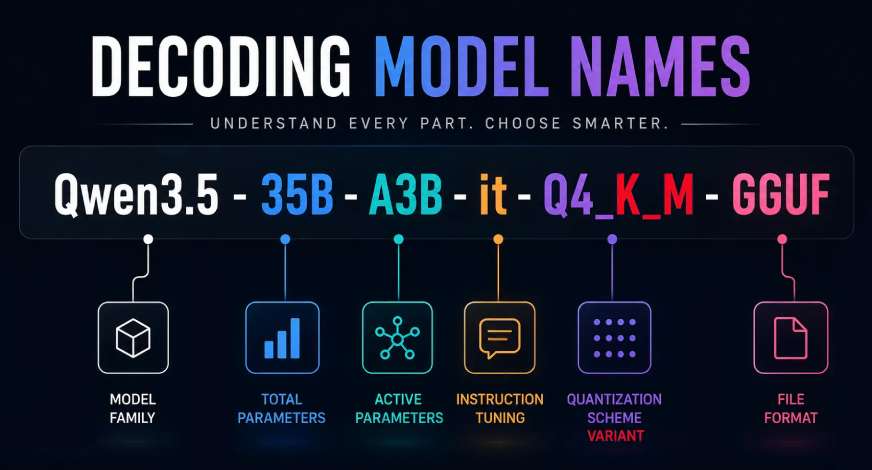
Decode Any LLM Model Name and Choose With Confidence
Qwen3.8-27B-A3B-It-2507-gguf-q2ks-mixed-AutoRound looks like random noise at first. It isn't. Each segment in that string tells you something concrete: model size, architecture, activation pattern, even quantization. That's the kind of clarity users need when choosing a local LLM. This guide breaks the shorthand down piece by piece, turning confusion into confidence. If you're also curious how models structure their thinking, our piece on exploring paragraph structure in token space pairs well with this. Start decoding, and make your next download an informed one.

Discover how one free AI model quietly earned developers' trust
A week ago, a mystery model called Ox Alpha appeared on OpenRouter, one entrant among 400, yet it stood out for being quietly good. Hobbyists pushed trillions of tokens through it daily, sparking a week of speculation. Then Z.ai revealed it was GLM-5.3-Flash, served entirely on Chinese chips. That fact changes the economics. At 57 on the intelligence index for nine cents a task, it forces a hard question: why pay 7.4x more for two extra points? The cost calculus just got sharper.

Perplexity brings its AI agent home, running locally on Nvidia hardware you own
Perplexity is taking its agentic platform off the cloud and onto your desk, and the move feels less like a stunt and more like a quiet turning point. Portable Computer, built with Nvidia, runs entirely on hardware you already own, starting with the DGX Spark and RTX-equipped Linux machines. The pitch is refreshingly direct: your files, your models, and your work stay local, and the credit counter stays parked at zero.
Shortening prompts costs more; asking for brevity saves.
Recent research definitively answers a critical question: does instructing an LLM to "be concise" actually save money? Across nine models—including GPT-4o and Claude Haiku—our analysis reveals a clear winner: prompting for shorter output consistently reduces costs by 1.5x on average (up to 3x in some cases) while maintaining accuracy. Conversely, shortening input prompts proved counterproductive, increasing costs and diminishing answer quality. This highlights a key insight: controlling output tokens is the most effective strategy for cost optimization, as demonstrated in our paper.

Nvidia's simple math cuts costly recomputation across AI models
Swapping models mid-session has always meant paying the full prefill tax again, until now. Nvidia's researchers found that a simple linear mapping can transfer a KV cache between compatible models, bypassing the expensive recomputation that bogs down multi-LLM agentic workflows. The math is refreshingly direct, not a heavyweight neural network. On tested pairs, this approach runs up to 25 times faster while keeping nearly all accuracy. It's a practical fix for a costly bottleneck, and it points toward leaner long-horizon AI systems.
Demystifying the math behind the algorithms powering modern LLMs
If you've been following the technical reports from Kimi, DeepSeek, Qwen, and GLM, you've likely noticed how much on-policy distillation and GRPO-style algorithms now power the frontier. That's why this deep dive is so timely. It unpacks the maths and code behind these methods, then connects them back to pretraining and supervised fine-tuning. It's a practical resource for anyone wanting to move beyond the hype and actually understand how modern LLMs are trained.