RAG (Retrieval-Augmented Generation)
RAG (Retrieval-Augmented Generation) at Beyond Market Intelligence is a file of 4 stories. The newest of them: “Move beyond basic RAG with four knowledge graph patterns for agentic AI.”, “A single filter closes the retrieval gap in Azure OpenAI email automation.”, and “VentureBeat expands enterprise AI analysis with new lead analyst hire”. Knowledge graphs are moving from the background to the backbone of agentic AI, and Cassie Shum is here to show you why. Closing an Azure OpenAI assistant's retrieval gap didn't require a new identity platform. Acme AI is the next-generation, AI-powered spreadsheet platform built to replace Excel and redefine how analysts, data scientists, and enterprise teams work… The list below is every RAG (Retrieval-Augmented Generation) story on Beyond Market Intelligence, newest first.

Move beyond basic RAG with four knowledge graph patterns for agentic AI.
Knowledge graphs are moving from the background to the backbone of agentic AI, and Cassie Shum is here to show you why. In her talk, she moves past basic retrieval to outline four practical architecture patterns that bring reasoning into production. It's a grounded, actionable look at building systems that don't just retrieve, but reason. For a broader perspective on how these ideas connect, our piece on bridging retrieval and action offers a useful parallel.

A single filter closes the retrieval gap in Azure OpenAI email automation.
Closing an Azure OpenAI assistant's retrieval gap didn't require a new identity platform. Cioffi added one query-time filter and narrowed the assistant's reach. The fix worked because he tested with a low-privilege account, not just clean evaluation scores. That two-account test exposed what his logs already hinted at: the agent answered with the indexer's permissions, not the requester's. It's a thirty-minute check that belongs before any deployment.
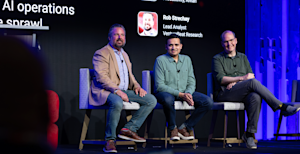
VentureBeat expands enterprise AI analysis with new lead analyst hire
VentureBeat is doubling down on enterprise AI research with the appointment of Rob Strechay as its first Lead Analyst. Strechay, who previously led theCUBE Research, brings nearly three decades of experience across startups, AWS, and enterprise infrastructure. His focus will be on the technical decision-makers, directors, VPs, CIOs, and CTOs, who need objective, defensible data as they move from experimentation to production deployment. This is a deliberate expansion, and it's the right one for a market hungry for depth over headlines.

Team memory alone can't fix AI agents that confidently get context wrong
Tencent's Team Memory lets a team of agents share one context hub, but the launch leaves a critical question open: what happens when the shared memory is wrong? A single bad fact no longer costs one user a repeated explanation, it propagates across every agent that reads the pool. That governance gap is exactly what practitioners flagged within hours. The access tiers handle who reads what, not how falsehoods get corrected or retired.