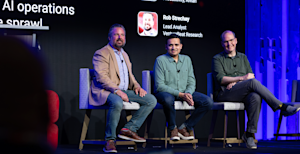
The decision to bring Rob Strechay aboard as VentureBeat's first Lead Analyst is a direct answer to a question too many publications keep dodging: who is actually qualified to tell enterprise buyers where the real risks and costs sit in AI infrastructure? Strechay isn't a pundit parachuting in with a slide deck. He has run product teams, built analytics services at AWS, and spent years dissecting cloud and data infrastructure as an analyst. That background matters because the conversations we are now having with CIOs and CTOs are no longer about whether generative AI works, they are about how to make it work without bleeding money or opening security holes. The enterprise AI stack is being rewritten in real time, and the decision-makers we talk to are starved for objective, defendable data. Strechay brings the technical rigor to deliver it.
What stands out is the focus on the unglamorous, back-end realities that actually determine whether AI projects scale. His May analysis of GPU utilization, the compute waste sitting inside enterprise infrastructure, is a perfect example. Most vendors would rather sell you another dashboard than admit your utilization rates are in the gutter. Strechay's work points at the opposite direction: measure first, then decide. That fits with the broader research engine VentureBeat has built around the monthly VB Pulse surveys, which track agentic orchestration, agent reliability, security, and compute. The June report on agentic orchestration, drawn from 145 enterprises, found two-thirds had deliberately hedged their AI model strategy rather than committing to a single provider. That is not a headline-grabbing stat; it is a procurement reality that became painfully obvious when Anthropic's Claude models went down. Strechay's infrastructure-level focus complements this survey data, giving buyers a way to connect the numbers to their own architecture decisions.
The practical takeaway here is straightforward: you no longer have to choose between vendor marketing and academic white papers. Strechay's expanded VB In Conversation series will bring architectural blueprints and deployment barriers to light through technical interviews with the people actually building these systems. That is a far more useful resource than another roundup of press releases. For technical leaders, this signals that the conversation is shifting from "what is possible" to "what is defensible." We are already seeing how technical leaders translate engineering skills into startup success, as Gonzalo Maldonado discusses in his lessons on navigating startup success, and how companies like Atlassian handle major pipeline migrations without breaking alerts, as covered in Atlassian’s OpenTelemetry migration. The same pattern applies here: real progress comes from people who understand the underlying systems, not just the surface-level promises.
The question to watch is whether Strechay's analysis will push vendors to be more transparent about their own infrastructure limitations, particularly around GPU utilization and security gaps. If his track record holds, the answers will be uncomfortable for some. That is exactly why this matters. The next phase of enterprise AI deployment will not be won by the loudest marketing voice; it will be won by teams that make sound platform decisions based on empirical evidence. Strechay's arrival is a signal that VentureBeat intends to supply that evidence. The specific consequence to track is whether his first few written analyses and interviews force a measurable change in how vendors talk about their own utilization and security metrics. If they do, we will know the research is working. If they do not, the silence will be just as informative.