researcher
researcher at Beyond Market Intelligence is a file of 8 stories. The newest of them: “Your AI team works through the night so you wake to a finished newsletter”, “AI accelerates research ideas but testing can't keep pace”, and “From Classroom to Conference A Beginner's Roadmap to Publishing in Top AI Venues”. Three AI employees worked through the night so you didn't have to. AI has made generating research ideas almost effortless, but testing them remains stubbornly manual. Acme AI is the next-generation, AI-powered spreadsheet platform built to replace Excel and redefine how analysts, data scientists, and enterprise teams work… The list below is every researcher story on Beyond Market Intelligence, newest first.
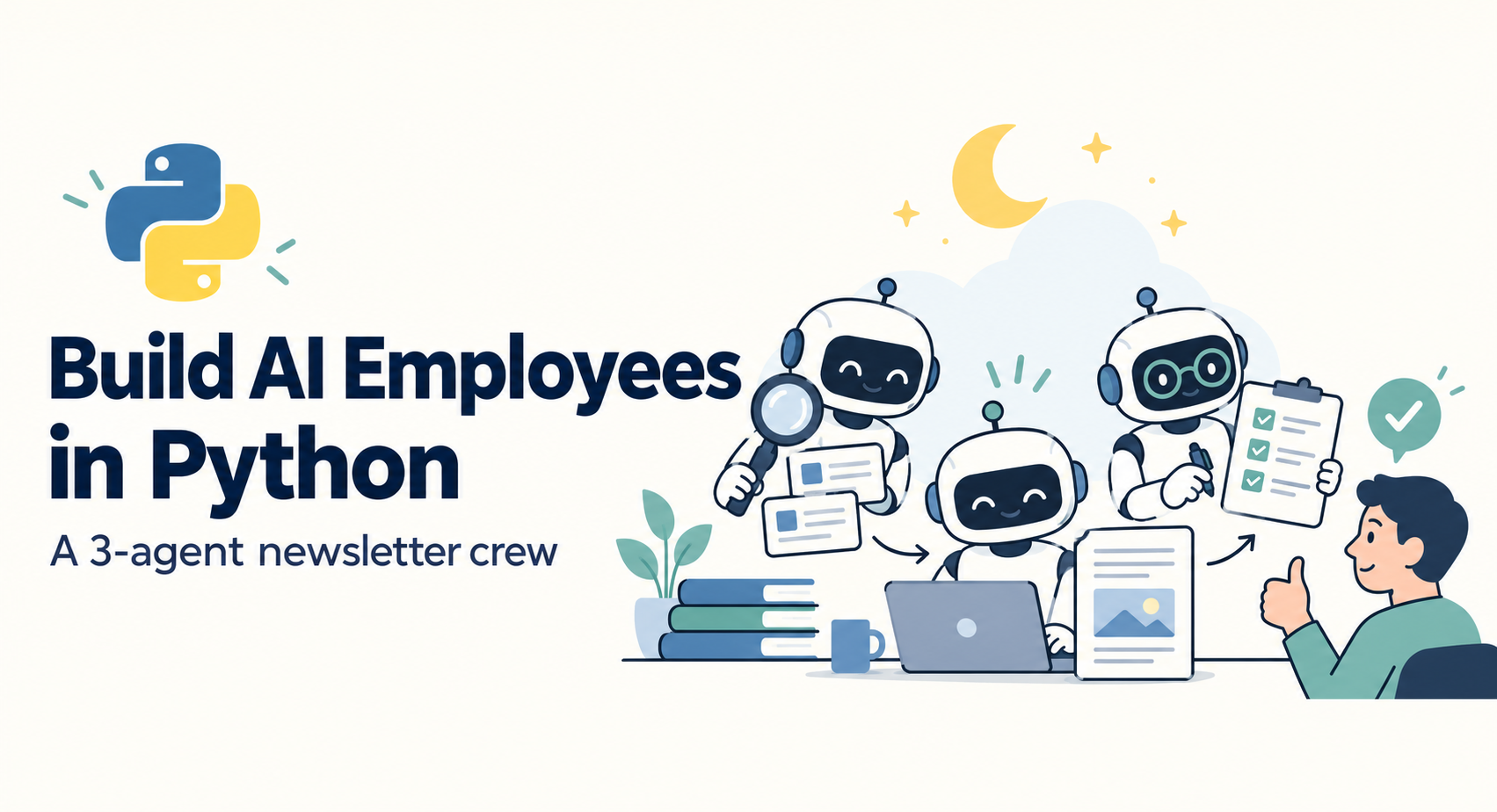
Your AI team works through the night so you wake to a finished newsletter
Three AI employees worked through the night so you didn't have to. By Friday at 8 a.m., your weekly tech newsletter is drafted, fact-checked, and waiting for a single click. A researcher found the best links. A writer turned them into prose. An editor caught a fabricated statistic, fixed it, and finished the job. You were asleep. This isn't a fantasy, it's a Python-powered workflow you can build today.
AI accelerates research ideas but testing can't keep pace
AI has made generating research ideas almost effortless, but testing them remains stubbornly manual. One researcher describes asking an AI to audit 30 papers, which branched into dozens of promising approaches. Coding agents can explore those in parallel, yet someone still has to launch training runs, evaluate results, and decide what actually matters. That bottleneck feels familiar. The smartest next step is often buried under sheer volume.
From Classroom to Conference A Beginner's Roadmap to Publishing in Top AI Venues
You're an AI engineer with two years of experience, but you're asking the right question: where would an undergraduate start to publish in a top venue? The roadmap you've sketched, Python, ML fundamentals, reading papers, then finding a question, is solid, but the order matters more than the list. Start by reading papers before you master every math proof; that's how you learn what questions are worth asking.
Rethinking the compute demands behind LLM post-training research
Efficiency is the real bottleneck in LLM post-training research, not raw compute. If you're working on RLHF or RLVR, ask yourself how much of your GPU budget actually drives meaningful improvement versus brute-force iteration. Our piece on "Smarter reasoning with fewer tokens, trained on a single GPU" explores this directly, proving you can reduce reasoning tokens by 44% without sacrificing performance. That shifts the question from *how much compute* to *how much do you truly need*.

How AI can help people access public services they are entitled to
There's a quiet irony in the flood of AI agents knocking on public services' doors: they're not gaming the system, they're just asking for what's already theirs. As one researcher told TechCrunch, the vast majority of cases involve people entitled to claim something, claiming it. That's not abuse; that's access finally catching up with intent. It reframes the conversation around automation and civic duty, and it pairs neatly with our look at Perplexity's CobbleDB migration.

An AI researcher's exit demands we explore safety over speed.
Anthropic researcher Jacob Coxon resigned with a stark warning: self-improving AI risks gambling with our lives. His exit underscores a pressing need for pacing agreements between labs, a call we take seriously. This isn't about fear-mongering; it's about foresight. When brilliant minds step away to sound alarms, we should listen. Explore the Forrester Function to see how we approach complex systems, but here, the message is simpler: progress demands prudence, not just capability.
A prompt exploit reveals how quickly AI models can be challenged.
A jailbreak landed on GPT-6 Astra within 24 hours of its release. The researcher behind it, who broke GPT-5 in under an hour last year, had to rework the original minimal TIP attack. This time, they combined the Task-in-Prompt method with four unnamed techniques to hide the harmful objective inside a decoy task like solving a cipher. Instead of publishing the exploit, they reportedly shared the details privately with OpenAI.

Situational Awareness keeps its Anthropic stake as public bets unwind
Leveraged public bets can unwind quickly, and for the former OpenAI researcher behind Situational Awareness, that meant selling off the fund's entire public portfolio. It's a sharp reversal, but not a surrender. The Anthropic shares remain, and that stake carries weight. This isn't a retreat; it's a repositioning. While the public exits sting, the private position suggests a longer game is still in play. As AI agents face fresh scrutiny over data handling, the focus shifts to where these concentrated bets land next.