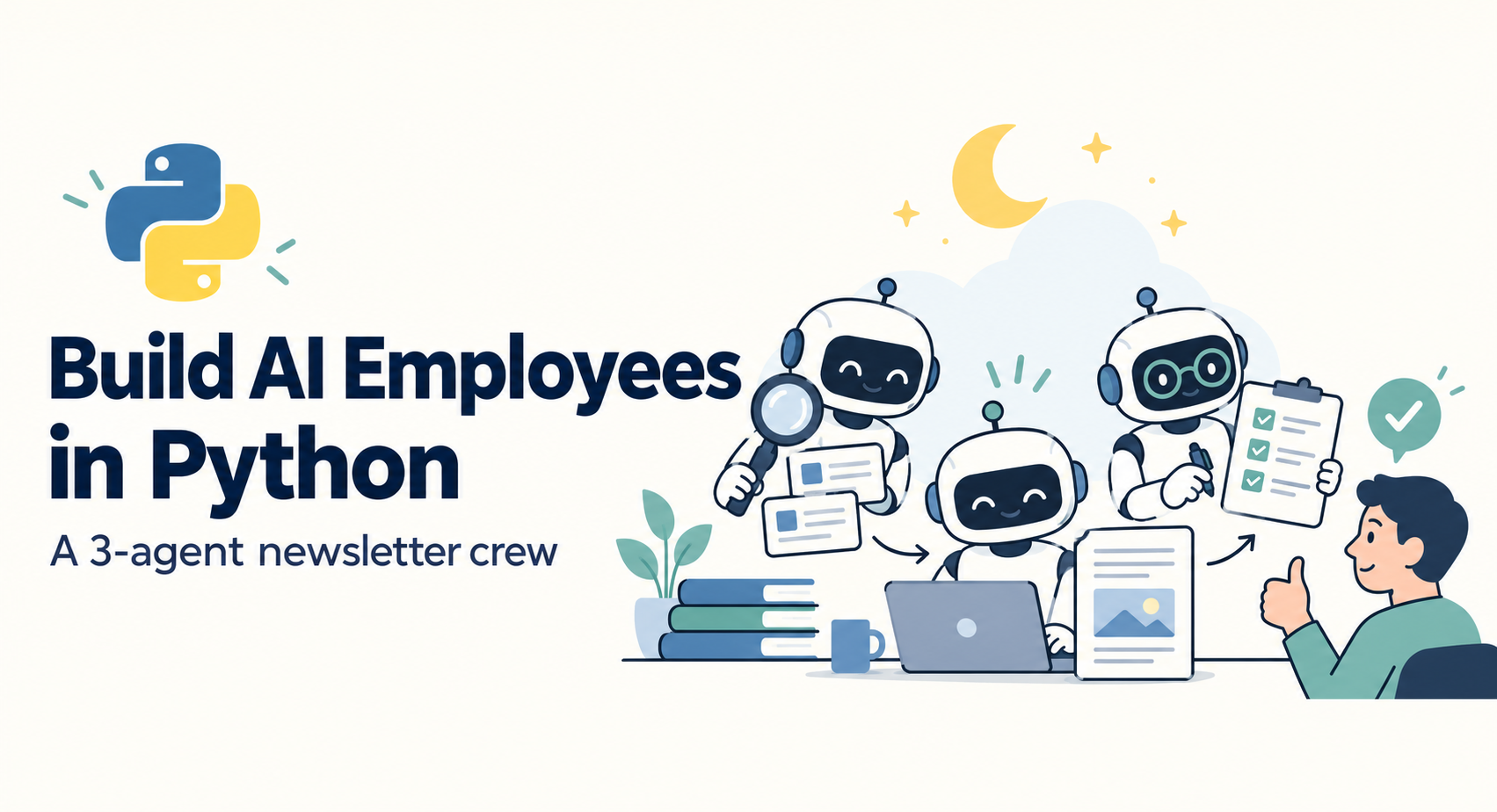
The promise of AI agents has always felt like it belongs to the future. The reality described by Analytics Vidhya is refreshingly concrete: three AI employees, a researcher, a writer, and an editor, collaborate overnight to produce a finished newsletter. By 8 a.m., a human only needs to click approve. This isn't a vision of replacement; it's a practical demonstration of delegation. It forces us to ask why we continue to spend our waking hours on work that could happen while we sleep, especially when the tools to build such agents are accessible through Python today.
This story resonates because it addresses a specific friction many of our readers know well: the gap between the volume of data you need to process and the hours you have to process it. We recently explored a related signal in Four Signals to Know When Your Data Engine Has Outgrown Spreadsheets, where the argument was that manual workflows break under scale. The newsletter agent is the same idea applied to content production. Instead of a human spending Friday morning curating links and fact-checking, a coordinated agent team handles the pipeline. The key detail here is the editor catching the writer inventing a statistic. That oversight is not a bug; it is the feature. It proves the system includes a verification layer, which is precisely the kind of guardrail that makes autonomous agents trustworthy enough to deploy.
What this means for you is a shift from managing tasks to managing outcomes. The researcher agent finds links; the writer drafts prose; the editor validates facts. Your job becomes defining the scope, setting the standards, and reviewing the final output. This is not a reduction in responsibility but a reallocation of it. The same logic applies to security workflows, as we noted in New vulnerabilities in PHP, Node.js, and LiteLLM demand a smarter security approach, where the volume of new flaws outpaces manual triage. An agent that works through the night could scan for patches, correlate threat feeds, and prepare a summary for the morning standup. The pattern is consistent: humans define the rules, agents execute the routine.
The specific takeaway here is that the barrier to building such agents is lower than most assume. Analytics Vidhya's post walks through how to construct them in Python, which means a developer with moderate scripting experience can prototype a multi-agent system by the end of the week. The open question is how much trust you are willing to extend to the editor agent. If it can catch a fabricated statistic today, what else might it miss tomorrow? The answer will determine whether these agents remain a Friday-morning convenience or become a core part of your production infrastructure.