resilience
resilience at Beyond Market Intelligence is a file of 13 stories. The newest of them: “Learning from failure is how great products are built”, “When health checks lie, high availability becomes a hollow promise”, and “Why Payment Systems Break Chaos Engineering's Core Rules”. Panay's point lands with real weight: failure isn't a dead end in product building, it's part of the path. Most system outages aren't caused by hardware failure. Acme AI is the next-generation, AI-powered spreadsheet platform built to replace Excel and redefine how analysts, data scientists, and enterprise teams work… The list below is every resilience story on Beyond Market Intelligence, newest first.

Learning from failure is how great products are built
Panay's point lands with real weight: failure isn't a dead end in product building, it's part of the path. Even catastrophic missteps can be recovered from, provided teams treat them as raw material for learning rather than reasons to retreat. That mindset separates organizations that stagnate from those that iterate toward something genuinely useful. For a deeper look at how leaders embrace this approach, our coverage of Figma opening its platform to agents is worth exploring.

When health checks lie, high availability becomes a hollow promise
Most system outages aren't caused by hardware failure. They're caused by control-plane dependencies, the invisible threads that tie your application to authentication services, DNS, or configuration stores that nobody remembers to test. Alexey Golev's article makes a clear case: high availability and resilience are not the same problem, and treating them as interchangeable leaves teams with a false sense of safety. Recovery capability erodes without explicit ownership.

Why Payment Systems Break Chaos Engineering's Core Rules
Standard chaos engineering assumes experiments stop cleanly and blast radius is knowable upfront. Payment systems break all three rules. Salim Adedeji's account of ECS deployments exposes what generic tooling misses: a 60-second DNS TTL stretching failover to 93 seconds, retry logic multiplying database load 2.4x, and AZ rebalancing loops that spiral. That's the gap between theory and production reality. For teams wrestling with distributed complexity, this is a practical field guide worth exploring, much like our earlier look at distributed training algorithms.

Zone redundancy arrives on Azure API Management Standard v2
Azure API Management's Standard v2 tier now supports zone redundancy, a capability that arrived on Premium v2 back in December. That is a meaningful step for teams wanting resilient API infrastructure without the premium price tag, especially since Standard v2 starts at $700 monthly versus $2,801 for Premium. The trade-off is a 99.95% SLA against 99.99%, which suits many production workloads. Just note, you configure zone redundancy at creation time, so plan accordingly.
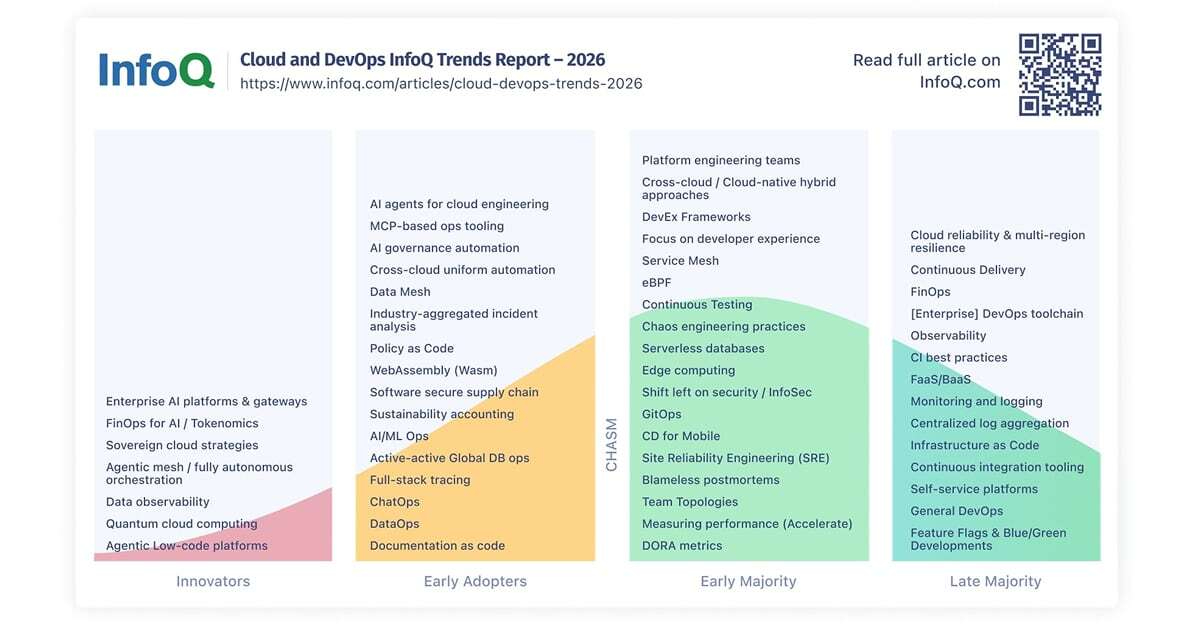
Explore the 2026 cloud and DevOps trends shaping your data future
The cloud and DevOps landscape is shifting under our feet, and the InfoQ editorial team is here to map it out. In this podcast, Daniel Bryant, Matt Saunders, Shweta Vohra, Steef-Jan Wiggers, and Mark Silvester sit down to dissect the annual Trends Report for 2026. They get raw and honest about AI, resilience, platforms, FinOps, and sovereignty. If you're feeling constrained by traditional infrastructure thinking, this conversation empowers you to explore what is actually next.

From NASA to nanosecond data: Direct-access Valkey cuts latency and cost.
Dumanshu Goyal doesn't just tweak a database; he rethinks the path data takes. His talk, *From ms to µs*, draws a sharp lesson from NASA's Space Shuttle: every layer of proxy adds hidden CPU costs and widens tail latencies. The fix is direct-access Valkey architectures, which deliver microsecond responses while shrinking both risk and infrastructure bills. It's a practical, no-hype case for simplifying your data layer.

Explore how internal platforms reduce cognitive load for microservices teams.
Microservices deliver real value only when teams can sustain their pace, and Chris Richardson's presentation gets straight to that challenge. He pairs Team Topologies with internal platforms to cut through complexity, focusing on six concrete patterns, from security to deployment, that keep stream-aligned teams moving. The payoff is a clear strategy for shrinking cognitive load while sidestepping the usual platform traps. It's a practical, grounded take on acceleration. For more ways to simplify technical workflows, our guide, "Unlock ChatGPT for Work," offers a useful parallel.

How one founder house proves balance fuels better work
Inside the London hacker house taking a stand against founder burnout, the bet is simple: work-life balance can outpace exhaustion. This isn't a rejection of ambition but a smarter route to sustainable building. We're watching a founder house challenge the default grind, and that's worth exploring. For more on how founders are reshaping their approach to growth, check out our piece on Wahlberg and Lee to Discuss Investing, Entrepreneurship at Disrupt 2026.

Nscale acquires Anyscale to expand its AI compute capabilities
Nscale's move to acquire Anyscale signals a clear intent to own more of the AI compute stack. This isn't just another acquisition; it's a deliberate step toward simplifying how companies scale their AI workloads across data centers and servers. We see a British neocloud making a confident play for deeper infrastructure control. For teams wrestling with complexity, this could mean more accessible paths forward. If you're questioning how AI reshapes your own workflows, our piece on talking to an AI clone offers a useful counterpoint.

Power demands from data centers test grid capacity for the first time.
Grid operators just made a hard call: temporary power cuts for data centers on the largest US grid to prevent blackouts. It's a pragmatic move, born from the breakneck pace of construction outpacing generation. We see the tension clearly, growth is only sustainable if the grid can carry it. This isn't about slowing innovation; it's about steadying the foundation. For a deeper look at how infrastructure strains shape tech decisions, our piece on Cloudflare's EmDash migration offers a useful counterpoint.

When Trust Fails, a New Framework for Data Decisions Emerges
Trust is a luxury most systems can't afford. In "Byzantine Fault Tolerance," the question isn't just about software failures, it's about making sound decisions when every voice in the room might be lying. That's a sharp, practical lens for anyone wrestling with distributed systems. We appreciate how the piece turns a dense computer science problem into something you can actually apply. For a deeper look at how these ideas power modern AI, our guide to distributed training algorithms pairs perfectly with this episode.

Physics-Based Computing Offers a New Path for AI's Energy Challenge
Analog chips are making a comeback, and it's about time we paid attention. The promise is real: computing with physics instead of digital logic could ease AI's energy hunger. But here's the catch, noise nearly killed this idea once before. That's the tension this piece explores with the clarity we need. It's a smart, grounded look at whether analog can finally deliver, or drown in its own signal.

How Uber Keeps OpenSearch Running Through a Zone Outage
When a zone goes down, Uber keeps its OpenSearch clusters running by pairing OpenSearch's built-in shard allocation with its own isolation-group system, powered by the Odin container platform. That approach protects both query and ingestion, which is no small feat. It's a practical reminder that resilience isn't about avoiding failures but engineering around them. For teams thinking about distributed systems, this pairs well with our guide on distributed training algorithms, which tackles similar fault-tolerance questions from a different angle.