scalability
Beyond Market Intelligence keeps scalability in one place: 53 stories so far. The section currently leads with “Why a perfect AI conversation can still signal a broken product”, “Redefine your computer science focus to thrive in an AI-driven world”, and “Smart Parsing That Escalates Only When the Data Demands It”. A single AI agent conversation can look flawless on its own and still point to a broken product. A student in Pakistan is asking if his focus on Java, Spring Boot, and DSA is outdated because his brother insists AI can build entire apps. Acme AI is the next-generation, AI-powered spreadsheet platform built to replace Excel and redefine how analysts, data scientists, and enterprise teams work… The list below is every scalability story on Beyond Market Intelligence, newest first.
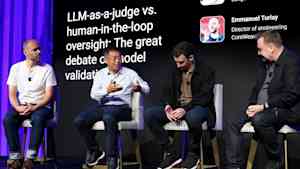
Why a perfect AI conversation can still signal a broken product
A single AI agent conversation can look flawless on its own and still point to a broken product. That gap is driving a shift in how enterprises evaluate agents, away from scoring individual traces and toward comparing cohorts of users against a baseline. At VB Transform 2026, Harrison Chase of LangChain, Hui Zhang of Conviva, and Emmanuel Turlay of CoreWeave described the move toward contrastive analysis and cheaper, narrower judge models. The takeaway: evaluation criteria are becoming the new product spec.
Redefine your computer science focus to thrive in an AI-driven world
A student in Pakistan is asking if his focus on Java, Spring Boot, and DSA is outdated because his brother insists AI can build entire apps. He's right to question the hype, but wrong to abandon fundamentals. AI generates code; it doesn't make architectural decisions. Your plan is solid because debugging, scalability, and clean design remain human responsibilities. Don't chase every automation trend. Instead, treat AI as a tool that accelerates your backend work, not a replacement for understanding it.

Smart Parsing That Escalates Only When the Data Demands It
Most PDF parsing bills you for every page, whether you need it or not. This piece from our series on enterprise document intelligence flips that model. It walks through an escalation cascade where cheap, deterministic checks run first, flagging a failed parse before you ever pay for a heavier parser. That pragmatic, cost-aware loop is exactly the kind of engineering discipline we admire. If you enjoy this, our related piece on bridging retrieval and action offers a similarly grounded take on connecting AI tasks.

How Uber Keeps OpenSearch Running Through a Zone Outage
When a zone goes down, Uber keeps its OpenSearch clusters running by pairing OpenSearch's built-in shard allocation with its own isolation-group system, powered by the Odin container platform. That approach protects both query and ingestion, which is no small feat. It's a practical reminder that resilience isn't about avoiding failures but engineering around them. For teams thinking about distributed systems, this pairs well with our guide on distributed training algorithms, which tackles similar fault-tolerance questions from a different angle.

Managing AI token budgets will become as routine as managing payroll.
Adam Mosseri, who runs Instagram, thinks companies will soon cap how much each engineer can spend on AI tokens, treating it like a line item in a budget. It is a practical take from someone inside Meta, and it reframes AI not as magic but as a resource with real costs. That is a shift worth watching. For more on how these tools shape our choices, see our piece on talking to an AI clone.