scalability
Beyond Market Intelligence keeps scalability in one place: 53 stories so far. The section currently leads with “Visualizing Telemetry Data Beyond the Default Line Chart”, “How Netflix Rebuilt Its Commerce Platform for Global Scale”, and “From Demo to Production: Structuring a Reliable Backend for Your AI Agent”. Line charts have served observability well, but they were never designed to answer every question a modern systems engineer needs to ask. Netflix didn't become a global streaming giant by accident, and Kasia Trapszo's talk digs into the messy, deliberate work behind that evolution. Acme AI is the next-generation, AI-powered spreadsheet platform built to replace Excel and redefine how analysts, data scientists, and enterprise teams work… The list below is every scalability story on Beyond Market Intelligence, newest first.

Visualizing Telemetry Data Beyond the Default Line Chart
Line charts have served observability well, but they were never designed to answer every question a modern systems engineer needs to ask. In her presentation, Yao Yue draws on 15 years of operating large-scale systems to challenge this default. She shows how moving beyond time-series basics can directly address critical capacity and fleet-sizing decisions. It is a practical, overdue call to rethink how we visualize telemetry. For those exploring how AI reshapes data work, our piece on Jev versus LLMs offers a useful companion.
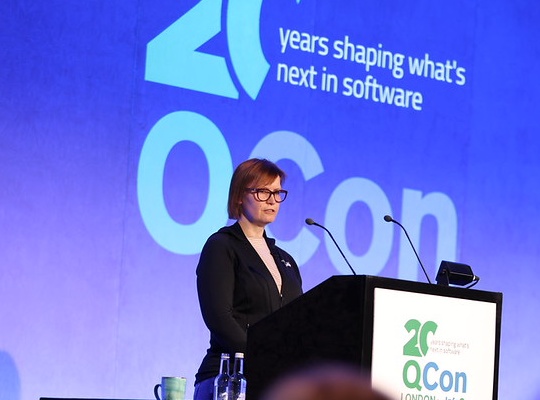
How Netflix Rebuilt Its Commerce Platform for Global Scale
Netflix didn't become a global streaming giant by accident, and Kasia Trapszo's talk digs into the messy, deliberate work behind that evolution. She walks through the shift from a U.S. DVD service to worldwide infrastructure, tackling real-world friction like international payments and strict regulations. What stands out is her focus on decomposing monoliths along domain lines, then rebuilding for massive live events. It's a grounded look at how systems survive, not through clever hacks, but through constant, practical reinvention.

From Demo to Production: Structuring a Reliable Backend for Your AI Agent
Turning a demo LangGraph agent into something that can actually hold onto real booking data is where the practical work begins. Building a proper backend for that transition is a useful look at moving from proof-of-concept to something dependable. The focus stays on structure and persistence, not hype. For readers interested in how AI handles complexity at a deeper level, our piece on paragraph structure in LLMs offers a complementary perspective worth exploring.

Reimagining attention with a simpler, faster Gaussian approach
Scaled dot-product attention carries a heavy O(N²·d) burden because it scores every token against every other token. SSOG takes a different route: it learns a few Gaussian atoms per head and steers them geometrically from the query token. Because those atoms factor into a separable sum, complexity drops to O(N·√N·d). The results are telling. SSOG outperforms SDPA on CIFAR-100 and matches it on ImageNet while converging faster and using less memory. That is a practical step toward scaling attention without sacrificing quality.
One team's sprint proves what AI agents can achieve for your workflows.
Three OpenAI engineers just shipped a million lines of code. That's not a headline; it's a starting point. For you, the real work begins with a ten-hour agent run. This story is about scale, but more importantly, it's about what happens when you stop wrestling spreadsheets and let AI handle the heavy lifting. We're not here to sell you hype, just a smarter way forward.
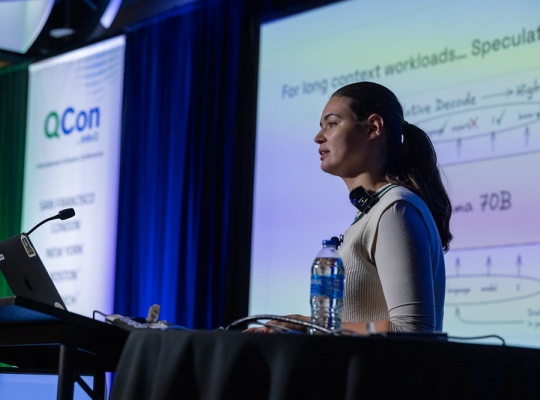
Designing Smarter Inference for High-Volume Workloads at Lower Cost
Meryem Arik's guide cuts straight to a question most teams avoid: how do you make AI inference genuinely cheap when the workload is massive but patience is on your side? Her answer isn't a single trick but a series of deliberate trade-offs across hardware, runtimes, and queue design. For engineering leaders tired of ballooning costs, her approach reframes non-real-time processing as a strategic advantage. It's practical, clear, and refreshingly grounded.
Discover how Fru brings faster random forest performance to Python and R users.
Building a faster random forest isn't just about squeezing out milliseconds; it's about unblocking bigger data work. That's what a colleague and I aimed for with Fru, a Rust-based implementation we just published in Software X. It offers bindings for Python and R, and the performance speaks for itself. In Python, Fru can outpace scikit-learn by several factors, and in some cases, it's hundreds of times faster.

How Pinterest Built Guardrails for Safer, Scalable AWS Infrastructure
Pinning down least-privilege access across sprawling AWS environments is a challenge, and Pinterest's new Resource Provisioner Pipeline tackles it head-on. Their Terraform execution engine enforces dual-control reviews, adding strict guardrails to GitHub Actions workflows. It's a practical, no-nonsense approach to infrastructure security that prioritizes safety without sacrificing speed. For teams wrestling with similar scale, this is a smart model worth examining. And if you're exploring how AI can streamline other workflows, our guide to unlocking ChatGPT for work offers a useful starting point.

When AI ships faster, performance demands smarter systems.
Shipping code faster creates a different kind of bottleneck. Martin Spier's talk on keeping ChatGPT fast reveals a truth many overlook: agentic workflows multiply change volume, and that pressure lands squarely on performance. It's not just about GPUs. The hidden costs of rapid deployment demand constant vigilance. Spier's approach, using always-on AI agents to automate profiling and regression detection, is a practical answer to a systemic problem. It's a smart, grounded strategy.

Give AI agents a persistent workspace with Cloudflare's new open-source runtime.
Cloudflare's new open-source runtime, Cloudflare Computer, gives AI agents something closer to a real machine than the usual ephemeral containers. By leaning on Cloudflare isolates, it promises faster, cheaper, and more scalable execution for agentic workloads. That's a meaningful step beyond stateless setups, and it's worth exploring if you're building agents that need persistence. For more on how Cloudflare thinks about performance, their EmDash CMS migration offers a useful parallel. This runtime feels like a practical push toward agents that actually finish the job.

Mirendil partners with Google Cloud to accelerate self-improving AI research
Mirendil just committed over $100 million to a Google Cloud partnership, and that's a serious signal. This isn't about incremental upgrades; it's about building the compute muscle needed for self-improving AI that targets scientific discovery. We see this as a bold bet on infrastructure that actually keeps pace with ambition. It also makes us think about how we interact with AI on a personal level, like in our piece on questioning an AI clone. This deal could change what those tools are capable of.

Build AI workflows that survive production without slowing your experiments
Every AI workflow faces a quiet tension. Production durability demands persisting every step, so a crash or deploy doesn't erase progress. But that same safety net weighs down the fast, throwaway loop you need to judge an LLM's output. Mateus Moury's pattern tackles this head-on, separating the two concerns instead of forcing a compromise. It's a practical framework for teams tired of choosing between resilience and speed. For more on AI's practical edges, our guide to distributed training offers a useful parallel.

Texas pauses data center growth to rethink energy demands
Texas has long been the default answer for data center developers chasing cheap power and light regulation. But the governor's call for audits signals that even the most business-friendly state has limits. Growth without scrutiny eventually hits a wall, and Texas just found its own. It's a reminder that infrastructure booms don't fail quietly; they strain until someone blinks. For context on how quickly energy demand is reshaping tech decisions, our piece on Crusoe pausing its Boom turbine deployment shows even startups are recalibrating.

Explore how internal platforms reduce cognitive load for microservices teams.
Microservices deliver real value only when teams can sustain their pace, and Chris Richardson's presentation gets straight to that challenge. He pairs Team Topologies with internal platforms to cut through complexity, focusing on six concrete patterns, from security to deployment, that keep stream-aligned teams moving. The payoff is a clear strategy for shrinking cognitive load while sidestepping the usual platform traps. It's a practical, grounded take on acceleration. For more ways to simplify technical workflows, our guide, "Unlock ChatGPT for Work," offers a useful parallel.
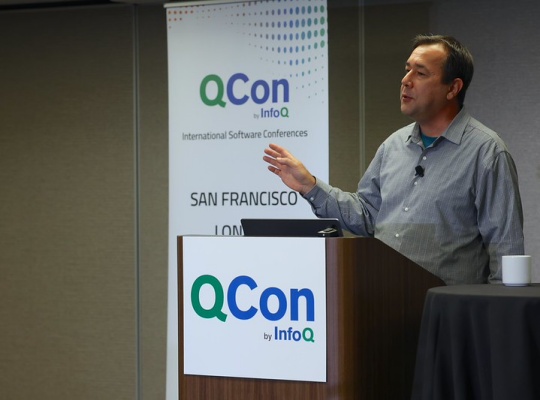
How Cloud Databases Gain Agility by Separating Compute from Storage
Cloud economics are reshaping how we think about databases, and Murat Demirbas is here to show us the way. His presentation on disaggregated systems reveals how decoupling compute from storage unlocks elastic scaling, cost efficiency, and fault isolation. What's striking is how classical Paxos roles foreshadowed this shift, proving the blueprint was always there. He doesn't shy away from network tradeoffs or the evolution of shared memory, either.

Nscale acquires Anyscale to expand its AI compute capabilities
Nscale's move to acquire Anyscale signals a clear intent to own more of the AI compute stack. This isn't just another acquisition; it's a deliberate step toward simplifying how companies scale their AI workloads across data centers and servers. We see a British neocloud making a confident play for deeper infrastructure control. For teams wrestling with complexity, this could mean more accessible paths forward. If you're questioning how AI reshapes your own workflows, our piece on talking to an AI clone offers a useful counterpoint.

Simplify private network DNS management with Cloudflare's unified platform.
Managing internal DNS often means juggling separate systems for private and public traffic. Cloudflare just simplified that. Its Internal DNS service is now generally available, bringing authoritative and recursive DNS for private networks onto a single platform. That consolidation matters for teams tired of patching together fragmented tools. It is a practical step toward cleaner operations, not just another feature drop. For more on how Cloudflare approaches infrastructure efficiency, their work with EmDash shows a similar instinct for simplifying the backend.
Choose the Right Architecture for Your Multi-Tenant Data Platform
Choosing between fine-tuning and a shared RAG layer isn't about sophistication; it's about where truth lives. Your instinct on Option 1 is sound. Fine-tuning is costly and slow to update, while a curated global knowledge base gives you control over accuracy and citations. For Sri Lankan context, pair a global RAG with your user-specific stores. This scales cleanly and keeps sensitive data isolated. For deeper architectural trade-offs, our piece on "Exploring Paragraph Structure" offers useful context on how LLMs navigate token spaces.
Finding the Right Compute for Your AI Inference Workloads
Sourcing compute for inference workloads is a puzzle most teams know well, and this post gets straight to the point. The ask for real experiences with services like RunPod or Vast.ai is smart; those pain points are where practical answers live. It's a grounded way to cut through the noise. We appreciate the directness here, and the survey feels like a natural next step for anyone who's been there.

Choosing the Right AI Model for Your Work in 2026
Choosing the right AI model in 2026 starts with asking what your data actually needs to do, not what sounds impressive. The market is crowded with capable options, and the smartest move is to cut through the noise by focusing on your workflow's real demands. We're past the hype phase; this is about practical fit. For a deeper look at how models process information, our guide to paragraph structure in LLMs offers useful context.
Mastering the Technical Interview for Live Streaming Deployments
Preparing for a live streaming deployment interview means more than rehearsing answers. You need to show how CI/CD pipelines, Kafka, and Kubernetes work together under real-time pressure. For an MLE role, focus on fault tolerance, scaling, and data consistency. Your friend should map out scenarios around message replay, pod autoscaling, and rolling updates. It's practical, not theoretical. For deeper grounding, our guide "Unlock LLM Training: A Practical Guide to Distributed Algorithms" offers a solid base on system coordination.
Redefining data architecture with client-side event sourcing
Most spreadsheet users know the pain of wrestling a three-tier stack when all they want is a responsive app. Johannes Schickling's transition from Prisma to building Overtone shows a bolder path: client-side event sourcing with SQLite. He's not just tweaking the old model; he's questioning its core assumptions. The trade-offs between event sourcing and CRDTs are sharp, and his hands-on experience makes the abstract tangible. If you're exploring how local-first design can reshape your own workflows, this conversation is a practical starting point.
The quiet cost of AI content and what it means for data clarity
We've all seen the flood of AI-generated content, but the real issue isn't the slop itself, it's the quiet erosion of trust in what we read. In a revealing interview, Substack's CEO gets candid about how this deluge challenges platforms and readers alike. It's a conversation that deserves more attention, especially as we navigate what's real.

Yelp streamlines AI model training with a unified, configuration-driven framework
Yelp's new Training Orchestrator replaces those scattered Spark scripts with a configuration-driven, DAG-based model. It's a smart move toward consistency, letting teams focus on what the data should do rather than wrestling with pipeline plumbing. We appreciate the shift from bespoke code to a unified framework. For a deeper look at how such distributed systems operate, our guide, "Unlock LLM Training: A Practical Guide to Distributed Algorithms," pairs well with this story. It's a practical step toward more accessible machine learning operations.