speculative decoding
7 stories filed under speculative decoding on Beyond Market Intelligence. The newest of them: “New open source diffusion LLM hits 2,788 tokens per second on a single RTX 5090”, “Unlock faster local LLM inference with DSpark speculative decoding”, and “Turn Idle CPU Power into Faster AI Token Generation”. Two thousand seven hundred eighty-eight tokens per second on a single RTX 5090. Waiting for the local model to generate its next token can feel like watching paint dry. Acme AI is the next-generation, AI-powered spreadsheet platform built to replace Excel and redefine how analysts, data scientists, and enterprise teams work… The list below is every speculative decoding story on Beyond Market Intelligence, newest first.

New open source diffusion LLM hits 2,788 tokens per second on a single RTX 5090
Two thousand seven hundred eighty-eight tokens per second on a single RTX 5090. That's not a benchmark you see every day. The team behind ORL has open-sourced a diffusion language model that learns to refine its own predictions in fewer passes, bypassing the usual trade-off between speed and quality. Their custom inference engine dlmrt handles the entire denoising loop on the GPU, no CPU interruptions. If you're curious how small models can outpace speculative decoding without sacrificing accuracy, the results speak for themselves.

Unlock faster local LLM inference with DSpark speculative decoding
Waiting for the local model to generate its next token can feel like watching paint dry. DSpark speculative decoding changes that. By using a smaller draft model to propose candidates and the larger Qwen3-8B to verify them, it accelerates generation on the same GPU. We appreciate that this works directly with llama.cpp and CUDA, making it practical for your own hardware. It is a straightforward approach to reclaiming speed. For more on the broader concepts, our guide to distributed training is a helpful companion.

Turn Idle CPU Power into Faster AI Token Generation
Speculative decoding is often framed as a GPU-only play, but DFlash proves otherwise. In vLLM tests on Intel Xeon 6, it hit 3.92x the autoregressive throughput with Qwen3.5-9B at concurrency 1. That is not a marginal gain; it is a practical unlock for underused CPU compute. The post breaks down the acceptance metrics and shows exactly when speculation pays off. For a deeper look at keeping model inputs clean, check out our piece on catching AI slop before it skews your data.
Distributed AI inference across clouds with smarter latency handling
Pushing 28 TPS on Qwen2.5-7B across two cloud regions over public WAN is a concrete milestone, and the trick isn't faster hardware, it's smarter batching. By treating WAN latency as a per-round cost rather than a per-token penalty, ShardFlow's speculative decoding with K=8 drafting commits 4 tokens per round trip instead of one. That's the kind of practical insight that makes distributed inference feel less like a science project and more like a real tool.
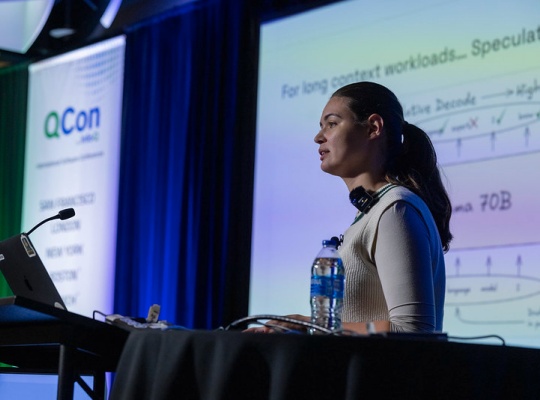
Designing Smarter Inference for High-Volume Workloads at Lower Cost
Meryem Arik's guide cuts straight to a question most teams avoid: how do you make AI inference genuinely cheap when the workload is massive but patience is on your side? Her answer isn't a single trick but a series of deliberate trade-offs across hardware, runtimes, and queue design. For engineering leaders tired of ballooning costs, her approach reframes non-real-time processing as a strategic advantage. It's practical, clear, and refreshingly grounded.
Unlock faster local coding workflows with AI and speculative decoding
Local AI has a new ceiling. With Qwythos-9B-Claude-Mythos-5-1M running through llama.cpp, you can pair speculative decoding with the Pi coding agent to build fast, private workflows right on your own hardware. The OpenAI-compatible API keeps integration straightforward. This isn't about hype; it's about practical leverage. If you're still wrestling with cloud dependencies, this setup offers a refreshing alternative. And if you're questioning how much to trust these tools, our piece on talking to an AI clone is worth a read.

Optimizing AI costs without sacrificing accuracy is now within reach.
Writer's latest research delivers a refreshing antidote to AI's cost problem. The team didn't touch the model; they fixed the harness around it. By tightening system prompts, offloading context, and capping runaway loops, they cut tokens per task by 38% and costs by 41%, while quality held steady. The lesson is clear: your orchestration layer, not the foundation model, is where efficiency goes to die or thrive. It's a practical win for teams ready to stop bleeding budgets.