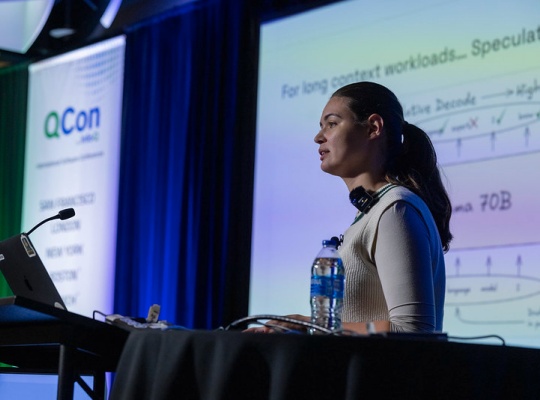
Meryem Arik's presentation lands at a moment when the conversation around AI has drifted toward scale for its own sake, as if bigger models and faster responses are the only metrics that matter. Her focus on high-volume, non-real-time workloads is a welcome correction. Too often, we treat every inference as if it demands a split-second reply, when the reality is that a large share of practical AI work, batch summarization, background document processing, report generation, doesn't need that urgency at all. The opportunity she outlines isn't about squeezing performance from a single request; it's about rethinking the entire pipeline so that cost per token drops by an order of magnitude. That is a different kind of innovation, and arguably a more useful one for most teams.
The practical implications here are significant, especially for software architects who have been told that AI integration requires a budget that only large enterprises can stomach. Arik's approach, which involves deliberate trade-offs across hardware selection, inference runtimes, speculative decoding, and queue reordering, suggests that the path to affordability is not a single silver bullet but a series of intentional compromises. This aligns with a broader shift we've been tracking in the industry. For instance, Talking to My AI Clone Taught Me to Question the Tech highlights how the human element in AI interactions remains unresolved, while Arik's work reminds us that the technical foundation matters just as much as the experience it enables. Similarly, Verify Your AI's Understanding: A Simple Check for Tax Season underscores the importance of validation, a theme that carries over to cost engineering, because a cheaper model that produces unreliable output isn't a bargain, it's a liability.
What stands out is that Arik isn't asking teams to accept lower quality. She's asking them to be more precise about when and how they deploy compute. That's a more mature conversation than the usual hype cycle, and it's one that speaks directly to the confusion many engineers feel when they see job postings demanding both software engineering skills and AI expertise, a tension explored in Navigating AI/ML Job Requirements: A Shift in Expected Skills. The takeaway for our readers is straightforward: you don't need to wait for cheaper GPUs or a breakthrough in model efficiency to make AI viable at scale. You need to be deliberate about your architecture, and you need to start with the assumption that not every task deserves the same level of investment.
The question Arik's talk raises, and leaves open, is whether most organizations are ready to make those trade-offs. It requires a level of discipline that's often missing when teams are under pressure to ship something, anything, with AI. But the ones that do will find themselves with a significant advantage. The specific detail to watch is how queue reordering, the practice of batching similar requests to maximize hardware utilization, evolves as more tools emerge to automate this process. If that becomes a default feature rather than a manual optimization, the cost curve for AI could flatten even further. That's the kind of practical progress we should be paying attention to, not the next flashy demo.