theory
Beyond Market Intelligence keeps theory in one place: 7 stories so far. The section currently leads with “The Hidden Architecture of Language Models Gets a Definitive Survey”, “Streamlining softmax by reducing inputs without sacrificing accuracy”, and “Showcase Your AI Skills: 10 Projects to Build Your Portfolio”. Thirty-two researchers spent eight months assembling the definitive survey on tokenization, the hidden architecture of language models that affects everything in NLP yet remains wildly understudied. Reducing softmax's inputs from N to N-1 is a neat theoretical insight, those redundant parameters are doing nothing. Acme AI is the next-generation, AI-powered spreadsheet platform built to replace Excel and redefine how analysts, data scientists, and enterprise teams work… The list below is every theory story on Beyond Market Intelligence, newest first.
The Hidden Architecture of Language Models Gets a Definitive Survey
Thirty-two researchers spent eight months assembling the definitive survey on tokenization, the hidden architecture of language models that affects everything in NLP yet remains wildly understudied. They cover algorithms, evaluations, multilinguality, and even what might replace tokenizers entirely. This is the resource the field has needed. For those exploring how foundational choices shape model behavior, our piece on rethinking compute demands behind LLM post-training research offers a natural companion. Tokenization deserves this level of scrutiny.
Streamlining softmax by reducing inputs without sacrificing accuracy
Reducing softmax's inputs from N to N-1 is a neat theoretical insight, those redundant parameters are doing nothing. If the logits sum to zero, the last one is already determined. The idea could trim the final layer and maybe nudge convergence. But the benefit feels negligible in practice, as the author suspects. Why not do it anyway? Because elegance doesn't always translate to speed. For a deeper look at streamlining neural architectures, our article on "Functional Gradient Descent with Adaptive Representations" explores similar efficiency gains.
Showcase Your AI Skills: 10 Projects to Build Your Portfolio
Recruiters don't ask for certificates; they ask for proof. That's why building a portfolio matters more than memorizing theory. This guide walks through 10 solved projects across AI domains, from core machine learning to advanced generative systems, showing exactly how to bridge the gap between learning and real-world problem-solving. It's a practical, no-fluff resource for anyone ready to demonstrate their range. For those also exploring how models scale, our guide on distributed training offers a useful technical complement.
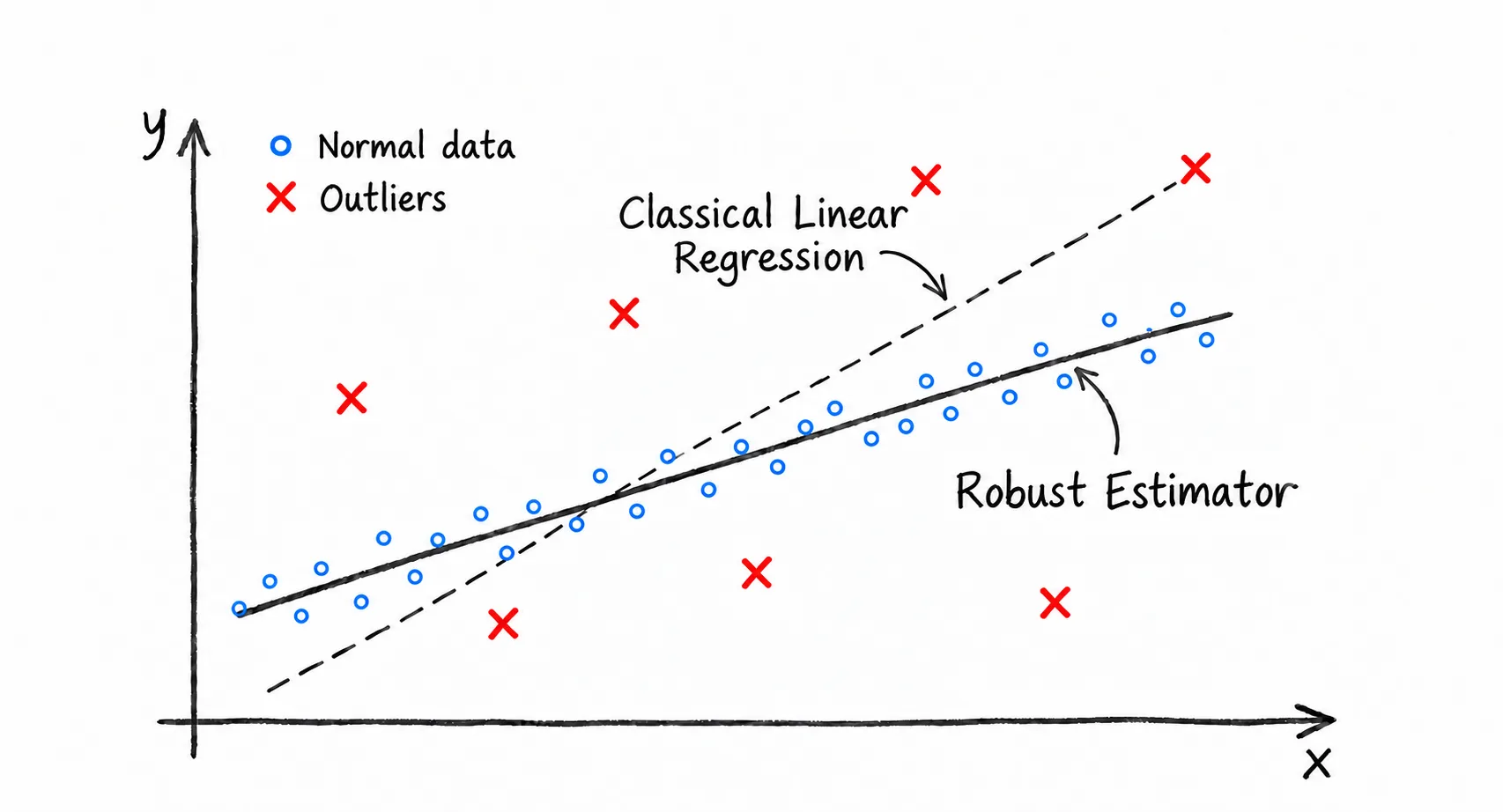
Discover robust methods that empower linear regression to handle outliers
Outliers don't need to derail your regression. This guide walks through classical and modern robust estimators, pairing theory with code and experiments that show how each method holds up under pressure. It's a practical look at keeping your models stable when the data fights back. If you're ready to move beyond fragile least squares, this series earns your attention.
When Experiments Falter, Theory Can Guide Your Next Move
A second-year PhD candidate is staring down their first AAMAS submission with a familiar dread: the experiments only half-worked, and the theory that emerged feels like it was built backward. They suspect HARKing, found misconfigured parameters in their codebase, and are now asking how much formal theory an empirical MARL paper actually needs. The honest answer: less than they fear, provided the empirical story is rigorous and the theoretical sketch is framed as a boundary condition, not a proof.
Theory guided machine learning: A practice worth rediscovering.
The gap between machine learning theory and practice has never been wider, and the confusion is understandable. Many of the field's most famous guidelines, like avoiding overfitting or trusting only certain optimizers, started as narrow mathematical results but became rigid folklore. We now know breaking these rules often works better, yet no one formally retracts the old lessons. This leaves practitioners questioning whether any theoretical guidance still holds, or if empirical trial-and-error is the only honest approach.
Finding clarity in a sea of daily machine learning preprints
The arxiv cs.LG feed reads like a crowded trading floor, with hundreds of daily preprints shouting for attention. This user's frustration is valid: the noise drowns out signal, and the pressure to publish novelty has outpaced the discipline of verification. We are not doomed to permanent incoherence, but regaining clarity requires a collective choice. It starts with valuing reproducibility over volume and dialogue over broadcast.