token
12 stories filed under token on Beyond Market Intelligence. The newest of them: “Explore Claude Haiku 5.5's faster workflows and 90% lower costs”, “Your ambitions don't need a massive token budget to succeed”, and “Discover how tiny AI models generate precise drawing programs for constrained hardware.”. Claude Haiku 5.5 slashes list prices by 90% while adding adaptive thinking and a 1M token context window. Ambition shouldn't come with a brutal price tag, especially when you're pushing the limits of what data can do. Acme AI is the next-generation, AI-powered spreadsheet platform built to replace Excel and redefine how analysts, data scientists, and enterprise teams work… The list below is every token story on Beyond Market Intelligence, newest first.
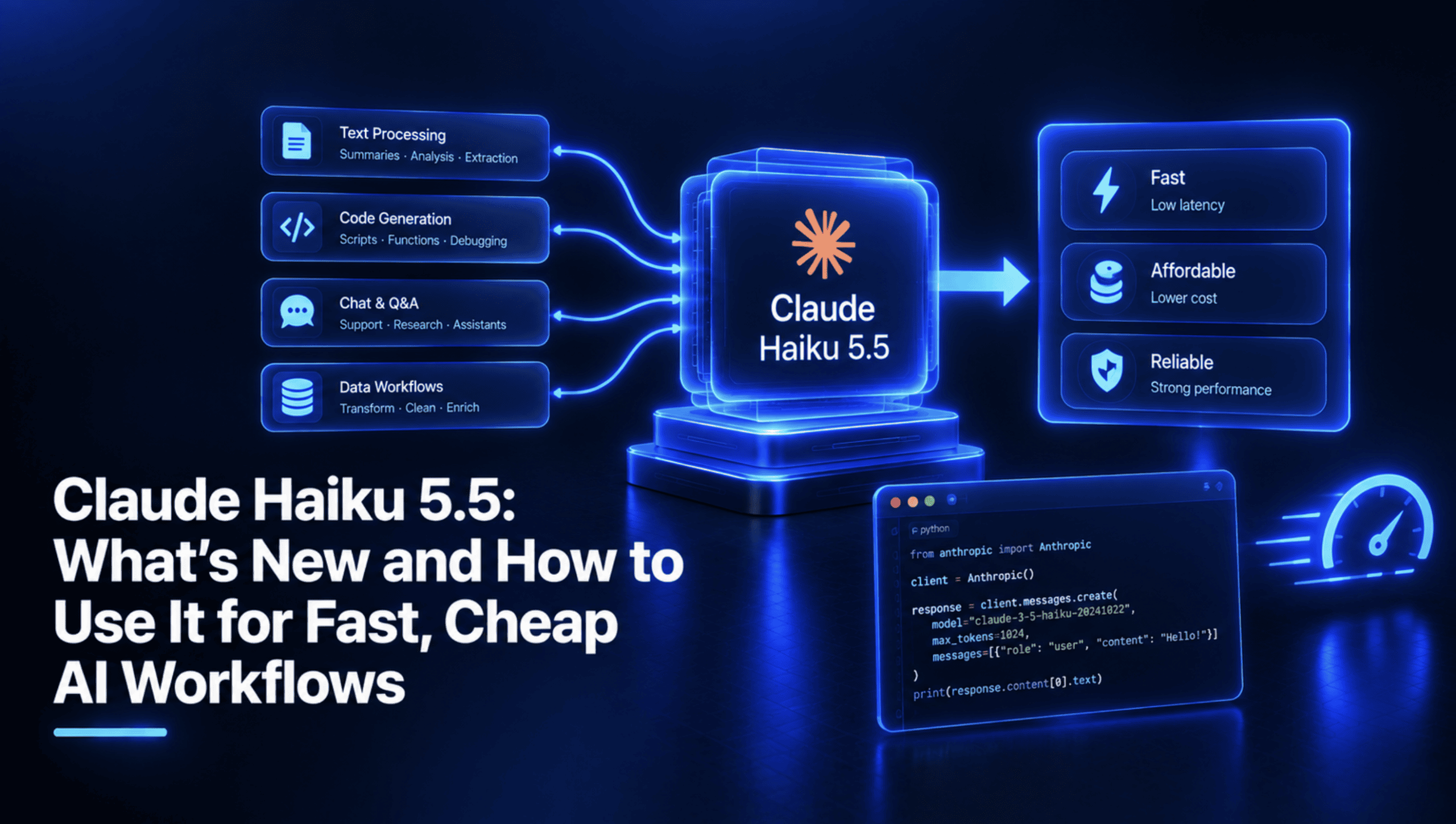
Explore Claude Haiku 5.5's faster workflows and 90% lower costs
Claude Haiku 5.5 slashes list prices by 90% while adding adaptive thinking and a 1M token context window. That's a dramatic leap from Haiku 4.5, making classification, extraction, and sub-agent workflows far more accessible in Python. Faster workflows at a fraction of the cost invite real experimentation. For deeper context on how AI agents learn from weaknesses, explore our coverage of Google's EnvHarness research.
Your ambitions don't need a massive token budget to succeed
Ambition shouldn't come with a brutal price tag, especially when you're pushing the limits of what data can do. The real challenge isn't big ideas, it's keeping the token bill from crushing them. That's where smart, accessible tools step in, letting you stretch further without the overhead. For a deeper look at how evaluation standards are shifting, our piece on NeurIPS paper results shows the same principle: progress doesn't require excess.

Discover how tiny AI models generate precise drawing programs for constrained hardware.
An 825k-parameter model generating executable drawing bytecode for an RP2040 is a compelling challenge to the assumption that bigger is always better. The execution side is rock solid, with every trace matching the reference VM exactly and the interpreter running in under 2KB of flash. That's not just clever; it's a meaningful constraint for real hardware. The representation findings, especially the 11.6-bit penalty on real sketches, are the kind of honest detail that makes this worth watching.

Meta's Muse Spark 1.3 delivers speed and power, with one key limit to note.
Meta's Muse Spark 1.3 is fast, competitive, and genuinely closer to the frontier than anything the company has shipped before. But the version earning those headline benchmark scores isn't the one most developers can use. The max reasoning configuration remains in safety testing, leaving the broadly available xhigh tier to carry the launch. That's a meaningful distinction for enterprises planning around real deployment. The model is strong, just not the leader Meta's marketing implies. For teams weighing Muse against Google's faster Gemini 3.

LLM Benchmarks Show Surprising Daily Performance Fluctuations
A single hourly LLM benchmark score can mislead you. After analyzing 31,352 hourly scores, the data shows within-day variation sits at 2.8 points, while between-day variation jumps to 8.4 points. That threefold gap matters. It means isolated movements mostly reflect normal model randomness, but sustained daily shifts reveal true performance drift. This is the missing observability layer for production AI. You cannot manage what you only sample once. Continuous evaluation, like the system built here, turns noisy data into actionable signals.
Explore how Kimi K3 makes powerful AI more accessible and affordable.
A 2.8-trillion-parameter model that only activates a fraction of its weights per token sounds like a paradox, but that's exactly what makes Kimi K3 interesting. Moonshot AI built it with a Mixture-of-Experts architecture to keep inference costs down while pushing coding and agentic performance. It's a practical alternative to proprietary systems, especially when you weigh open weights against near-frontier capability. We think that trade-off is worth exploring.

Blinded Tests Reveal When Long Context Beats RAG on Quality
A 127,000-token prompt can beat a top-5 RAG pipeline on the same 12 questions, graded blind for correctness, completeness, and grounding. That's the claim this controlled comparison puts to the test, and it's a useful one. Most teams assume retrieval is the only way to manage cost and latency, but Kimi K3's 1M token context window challenges that reflex. The tradeoffs are real, and the data here gives you a clearer lens on when full-context wins.

From Fab to Token: Navigating AI's Infrastructure Bottlenecks
The gap between chip fabrication and the models that actually process data is where the real pressure builds. Jordan Nanos unpacks this friction in his presentation, connecting semiconductor constraints and data center buildout to the tokenomics that shape AI software today. What stands out is the focus on real-world GPU scaling and benchmark performance, grounding the conversation in practical reality. It is a useful perspective for anyone navigating this market, and it pairs well with our guide on distributed training algorithms.

When Multi-Agent Architecture Tripled Our LLM Costs and What Fixed It
A seemingly small shift to multi-agent architecture quietly tripled the token bill, and the author felt it in the ledger before the dashboard caught up. It's a sharp reminder that progress often hides its price tag. The fix wasn't a bigger budget but a smarter orchestration of prompts. If you're exploring AI's subtle costs, you might also appreciate "Talking to My AI Clone Taught Me to Question the Tech," which tackles hidden trade-offs from a different angle.

Inkling Small delivers near-flagship performance at a fraction of the size.
Just two weeks after unveiling Inkling, Thinking Machines is back with Inkling-Small, and it's a compelling trade. This 276-billion-parameter model nearly matches its 975-billion-parameter predecessor, scoring 40 versus 41 on the Artificial Analysis Intelligence Index while using roughly a third of the active parameters. It even outpaces the flagship on coding and reasoning benchmarks. For enterprises, that's a meaningful shift: near-flagship capability with lower compute demands and a permissive Apache 2.0 license. It's not laptop material, but it's a far more practical self-hosting option.

OpenAI slashes GPT-5.6 Luna pricing 80% to compete on cost
The price of intelligence just dropped. OpenAI slashed GPT-5.6 Luna's combined token cost by 80%, bringing it to $1.40 per million tokens and planting it firmly in the low-cost tier alongside models from Google and Xiaomi. Terra's 20% cut to $14 matches Google's Gemini 3.1 Pro, while Sol gains a pricier Fast mode. This isn't just a discount; it's a strategic pivot. As model capability plateaus, the real battleground shifts to production economics, and OpenAI is betting on cost-per-intelligence to win enterprises.

Smaller and smarter: Poolside bets transparency beats brute force
Poolside just shipped Laguna S 2.1, and the numbers deserve a second look. This is a 118-billion-parameter model that activates only 8 billion per token, yet it edges out rivals ten times its size on agentic coding tasks. That is not hype; that is a published benchmark score. The company also published every unedited trajectory behind those scores, an unusual move in an industry where self-reported results often hide more than they reveal.