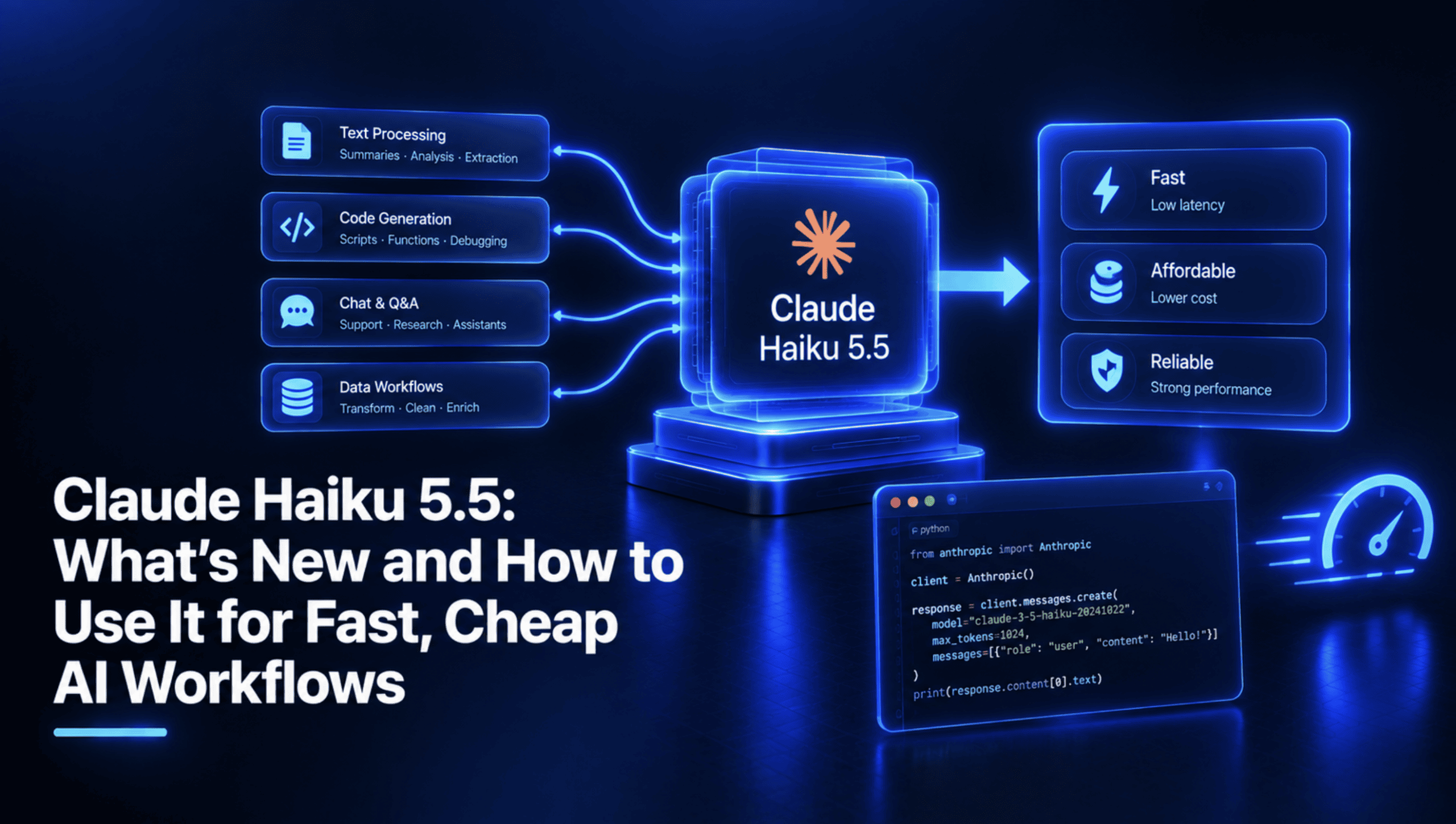
The 90% price cut on Claude Haiku 5.5 is the kind of move that forces a real conversation about what we've been tolerating from AI pricing. For too long, the cost of capable models has been treated as an unavoidable tax on innovation, something you pay to get good results, even if it eats into the margin of every workflow you build. Anthropic just broke that assumption. A model that drops list prices by an order of magnitude while adding adaptive thinking and a 1M token context window is not a minor refresh. It is a signal that the economics of AI-native tools are shifting faster than most organizations have planned for.
The practical implications land directly on anyone building classification pipelines, extraction systems, or multi-agent workflows. At the old pricing, you made trade-offs: smaller context windows, less reasoning depth, or fewer calls per dollar. Haiku 5.5 removes much of that friction. Adaptive thinking means the model can allocate more computation to harder steps without you manually tuning prompts or fallback logic. The 1M context window means you can feed entire documents, or even multiple documents, into a single call without chunking strategies that introduce errors. For teams already using Python to orchestrate sub-agent architectures, this model changes the cost calculus of how many agents you can run and how much context each one can hold. The question is no longer whether the model can handle the task, but whether you can afford to scale it. Now the answer is yes.
This development also puts pressure on the broader ecosystem in productive ways. Consider how Google Moves Python Type Checking Forward With Pyrefly represents a similar willingness to replace legacy tooling with something more performant and open. Pyrefly didn't just improve speed; it changed what developers expect from a type checker. Haiku 5.5 does the same for inference pricing. Meanwhile, Explore How Adaptive Training Environments Help AI Agents Learn from Weaknesses shows that the research community is already building frameworks that dynamically adjust training difficulty based on agent performance. Haiku 5.5's adaptive thinking applies a similar principle at inference time, not training the agent, but adjusting how much reasoning it applies to each step. These aren't isolated trends. They converge on a single idea: the next generation of tools will be cheaper, smarter, and require less manual configuration.
The specific takeaway for anyone building production systems is this: re-run your cost estimates. If you built a pipeline six months ago that depended on a cheaper, less capable model to stay within budget, Haiku 5.5 likely outperforms it at a comparable or lower cost. The model that used to be your fallback is now your primary option. The one detail worth watching is how Anthropic handles the transition from Haiku 4.5. Breaking changes in API behavior can stall adoption faster than any price cut can accelerate it. If the migration path is clean, this release redefines what "affordable AI" actually means for production workloads.