ViTs
3 stories filed under ViTs on Beyond Market Intelligence. The newest of them: “From spatial math to edge deployment: your four-stage path to computer vision mastery”, “How Frontier AI is quietly reshaping robot learning from demonstration”, and “Where AI learns the physics of teamwork and competition.”. Mastering computer vision isn't about memorizing frameworks, it's about building a foundation that scales with the technology. Roboticists in Learning-from-Demonstrations and Behavioral Cloning are asking a timely question: are frontier LLMs reshaping their field, or is it charting its own course? Acme AI is the next-generation, AI-powered spreadsheet platform built to replace Excel and redefine how analysts, data scientists, and enterprise teams work… The list below is every ViTs story on Beyond Market Intelligence, newest first.
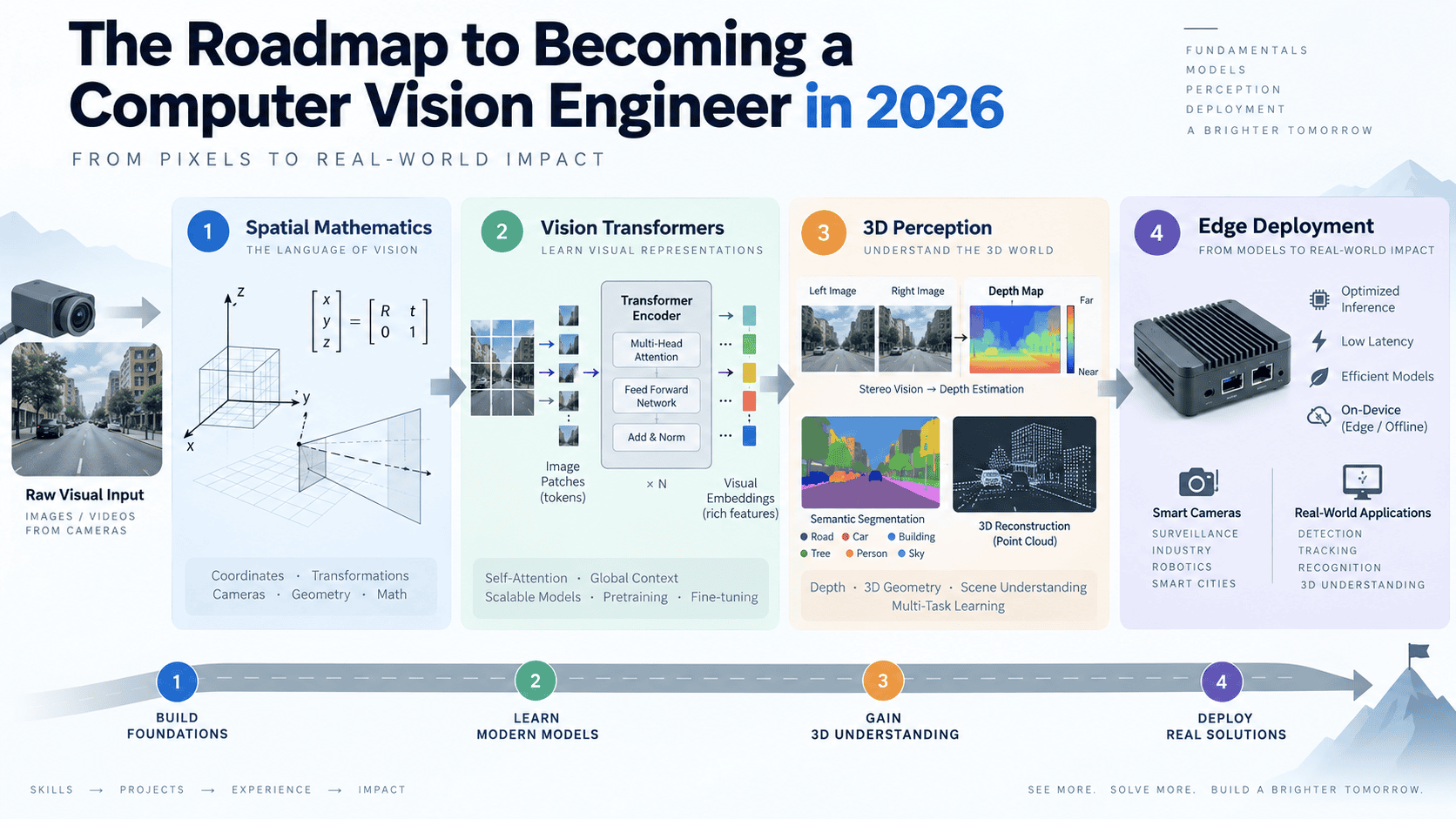
From spatial math to edge deployment: your four-stage path to computer vision mastery
Mastering computer vision isn't about memorizing frameworks, it's about building a foundation that scales with the technology. This four-stage roadmap takes you from spatial mathematics and vision transformers through 3D neural rendering, then lands on edge deployment optimization. It's a practical path for engineers who want depth without losing sight of real-world performance. For those exploring how AI models move from theory into production, our piece on transformer architecture offers a useful hands-on complement.
How Frontier AI is quietly reshaping robot learning from demonstration
Roboticists in Learning-from-Demonstrations and Behavioral Cloning are asking a timely question: are frontier LLMs reshaping their field, or is it charting its own course? The answer is nuanced. These models are influencing how demonstrations are encoded and generalized, yet core LfD principles remain independent. ViTs and VLAs are creeping into pipelines, offering new perceptual grounding. For a deeper look at how distributed systems underpin such training, our guide, *Unlock LLM Training: A Practical Guide to Distributed Algorithms*, is worth exploring.

Where AI learns the physics of teamwork and competition.
The Agentic World Cup asks a sharp question: what happens when LLMs stop crunching numbers and start playing soccer? The team behind it sees sports as the proving ground for embodied intelligence, a space where agents must react, adapt, and outmaneuver in real time. It's a clever reframing of the "embodiment gap," and the format is refreshingly direct: pick a model, coach it through prompts, and let it compete.