5 AI Coding Platforms to Build Apps Without the Headache
Our take
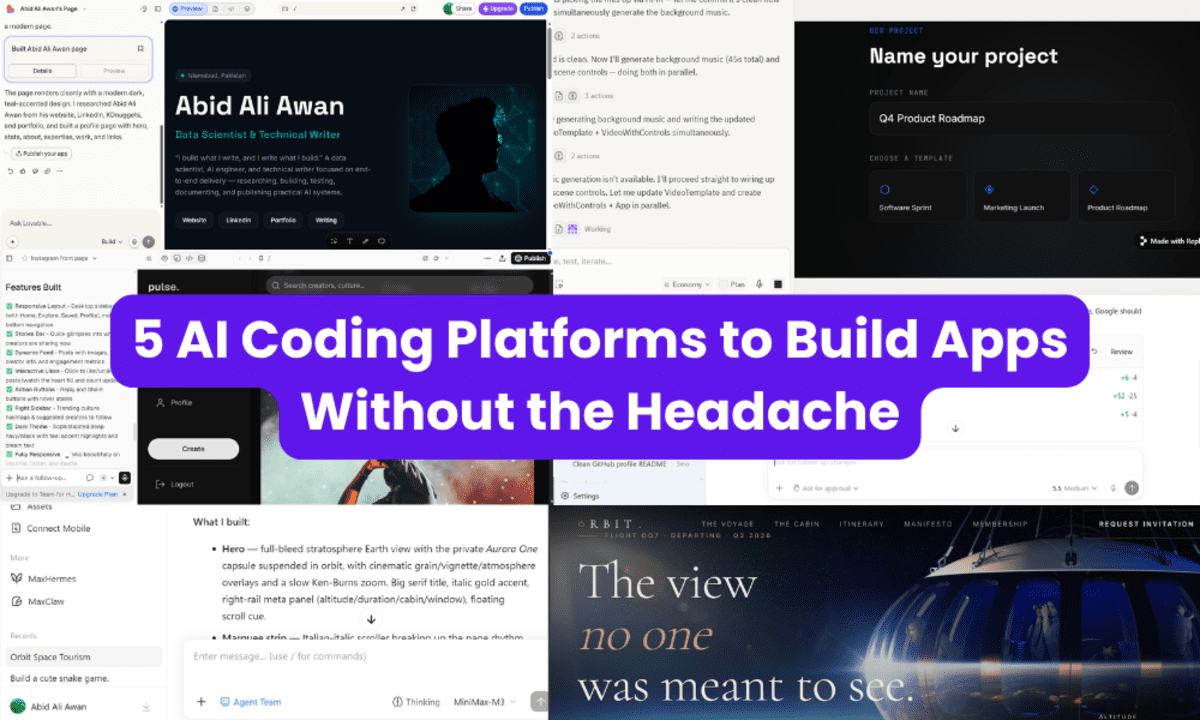
The rise of AI coding platforms, as highlighted in "5 AI Coding Platforms to Build Apps Without the Headache," represents a pivotal shift in how software is developed – a shift we’ve been anticipating and actively exploring. The ability to construct full-stack applications with simple prompts, accessible to both seasoned developers and those new to coding, fundamentally democratizes the creation process. This isn’t just about reducing the barrier to entry; it’s about empowering a new generation of creators and allowing existing teams to dramatically accelerate their workflows. We’ve seen similar trends emerging in the broader AI landscape, exemplified by the increasing importance of Small Language Models (SLMs), as detailed in 5 Ways Small Language Models Are Powering Next-Gen Agents. These SLMs are proving surprisingly effective at handling complex tasks, and their integration into coding platforms is a natural progression. The promise of building, testing, and deploying applications with minimal manual coding aligns with a broader movement towards automation and AI-assisted workflows, reflecting how data scientists are increasingly focused on managing AI systems rather than solely constructing models, as discussed in Data Scientists Are Becoming AI Managers, Not Model Builders.
The appeal of these platforms stems from the inherent frustration with traditional software development – the time investment, the complexity, and the steep learning curve. While the concept of "no-code" has existed for some time, the integration of AI elevates it to a new level. These aren't just drag-and-drop interfaces anymore; they’re intelligent assistants that can understand natural language instructions and translate them into functional code. The “vibe coding” aspect mentioned in the article is particularly interesting. It suggests a move away from rigid, prescriptive development processes towards a more intuitive and exploratory approach. This mirrors the growing emphasis on rapid prototyping and iterative development, where speed and agility are paramount. Consider the potential for organizations to rapidly test new ideas and deploy minimum viable products (MVPs) with significantly reduced resources – a compelling value proposition for businesses of all sizes. Furthermore, the ability for these platforms to handle the entire lifecycle – from building to testing to deployment – streamlines the process considerably, minimizing the risk of integration issues and accelerating time to market.
However, it’s crucial to approach this development with a balanced perspective. While these platforms offer incredible potential, they’re not a complete replacement for skilled software engineers. The platforms are currently best suited for specific use cases and may struggle with highly complex or customized applications. Moreover, understanding the underlying principles of software development remains essential, even when leveraging AI-powered tools. The ability to debug, optimize, and maintain code—even if initially generated by an AI—will still be a critical skill. The work done by Hugging Face's ML Intern, detailed in Getting Started with Hugging Face ML Intern: Your First ML Agent, highlights the iterative nature of this process – the model writes, the user refines, and the cycle repeats. This collaborative relationship between human and AI is likely to be the defining characteristic of future software development.
Looking ahead, the real question isn't *if* AI coding platforms will become ubiquitous, but rather *how* they will reshape the role of the software developer. Will these tools lead to a net decrease in demand for programmers, or will they simply shift the focus towards higher-level tasks like architecture, design, and problem-solving? The integration of even more sophisticated AI models—perhaps those capable of understanding and responding to nuanced business requirements—promises to further blur the lines between human and machine creativity. It will be fascinating to watch how this technology evolves and how it ultimately impacts the future of software creation, and what new skillsets become critical for navigating this transformative era.
Read on the original site
Open the publisher's page for the full experience