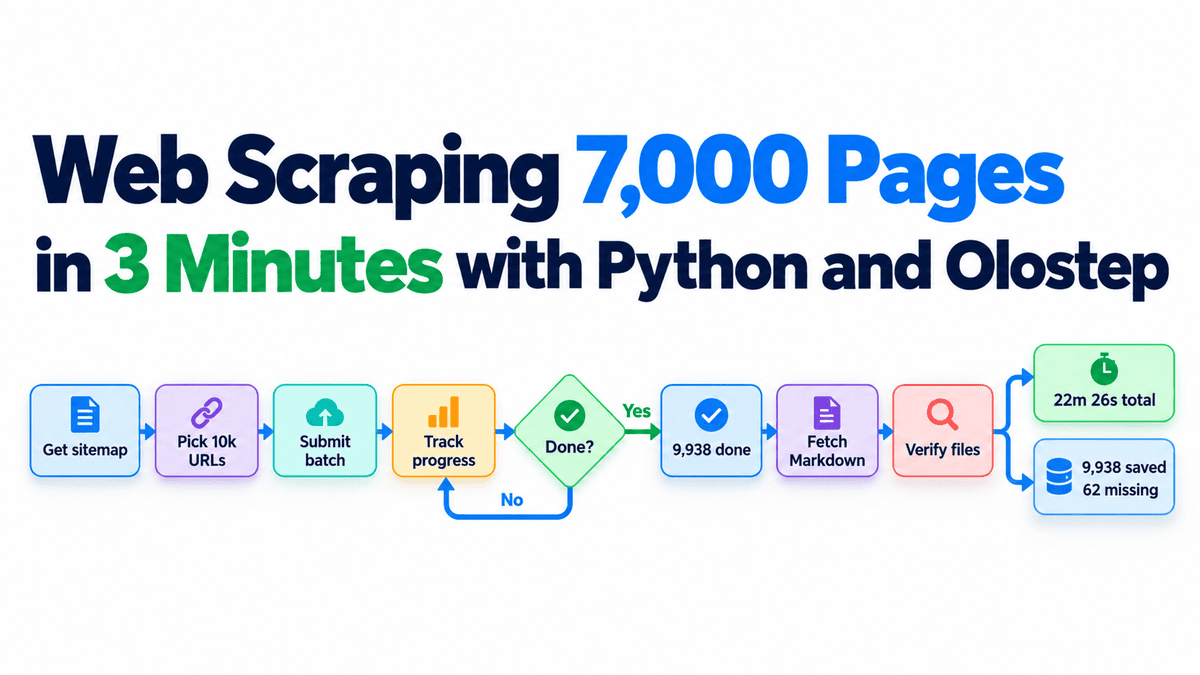
The promise of scraping thousands of pages in minutes is the kind of capability that sounds too good to be true until you see it work. Olostep's batch API delivers exactly that: upload a list of URLs, let the service crawl and extract content, and download the results as clean Markdown. What makes this interesting is not just the speed, it is the honesty baked into the output. You get a clear measurement of what actually finished, which means no guessing whether your data set is complete or riddled with silent failures.
This matters because the gap between "I need this data" and "I have this data" has been the bottleneck for too many projects. Traditional scraping approaches require constant babysitting, handling captchas, rotating proxies, parsing broken HTML. Olostep abstracts that complexity away. For anyone who has spent a weekend writing a scraper that breaks the moment the target site changes its layout, this is a practical relief. It aligns with a broader shift we see in how tools are becoming more accessible without sacrificing depth. Consider how Leapwork Play Delivers Enterprise Governance for Portable Test Automation wraps governance around test automation, or how From sketch to GIF in seconds, Images 2.6 expands how you create turns rough ideas into polished visuals. In each case, the underlying technology is sophisticated, but the user experience is straightforward. Olostep follows the same principle: you do not need to become a scraping expert to get expert results.
The batch API also solves a trust problem. When you scrape at scale, partial failures are common, a site times out, a page redirects, a rate limit kicks in. Most tools either hide those failures or bury them in logs you have to dig through. Olostep reports exactly what completed and what did not, giving you a verifiable audit trail. That is the kind of detail that matters when the data feeds into a report, a model, or a business decision. It turns scraping from a black box into a transparent process.
What we want to see next is how the batch API handles dynamic content, pages that load data via JavaScript or require authentication. The current story focuses on static page extraction, which covers a wide range of use cases, but the real test will come when users need to scrape modern web applications. If Olostep can handle that with the same clarity and reliability, it will become an essential tool for anyone who works with web data at scale. For now, the takeaway is simple: if you have ever hesitated to scrape a large site because of the time and complexity involved, this is worth exploring.