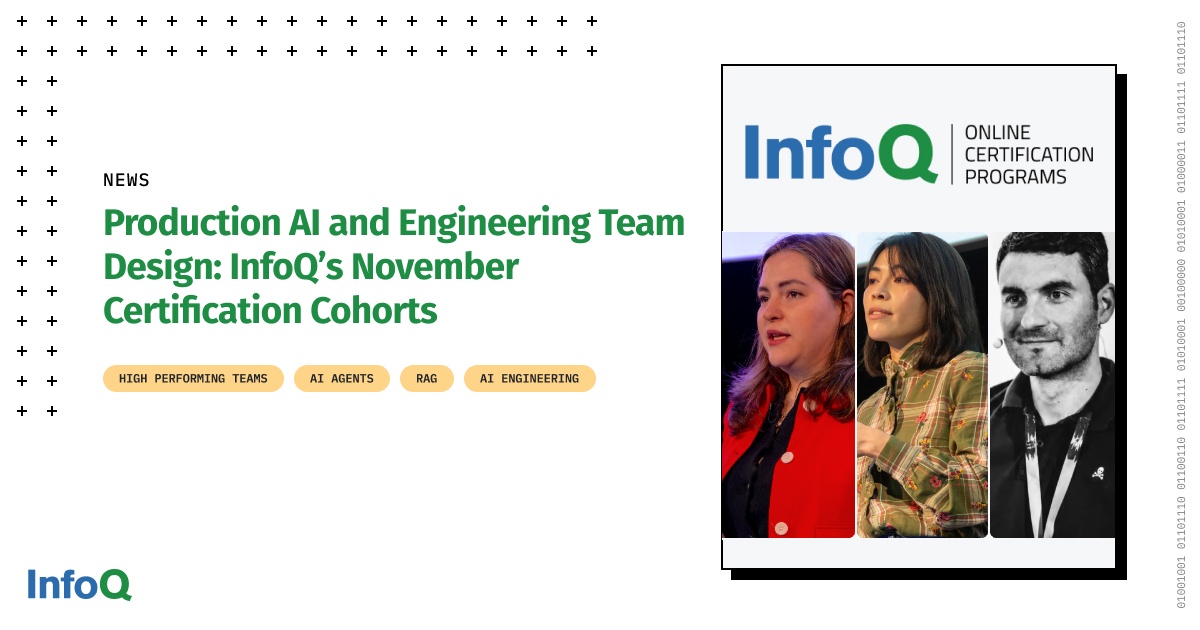
Practical AI certifications are rarely about learning a tool; they are about learning where a tool stops being useful. InfoQ's three November cohorts, led by Adi Polak, Lan Chu, and Olimpiu Pop, take that distinction seriously by focusing on production AI systems, retrieval and agent design, and engineering team flow. That is the right framing, because the hardest part of AI adoption is not the model, it is the surrounding workflow. Teams do not fail because they picked the wrong framework; they fail because they never defined what a successful outcome looks like, and that ambiguity is exactly what Token counts won't tell you which AI coding tool your team needs exposes in its conflicting benchmarks.
The most valuable piece of this November lineup is the explicit attention to measurement and roles. Most certification programs teach you how to build a system, but almost none teach you how to staff it or how to know if it is working. Lan Chu's cohort on AI roles and measurement addresses a gap that is becoming urgent. As production AI systems move from pilot to core infrastructure, the question is no longer "can we build this?" but "who owns it, and what does good look like?" That shift is practical, not philosophical. The same logic applies to the recent PingCAP Cyberattack Exposes Customer Data and Source Code, where the breach was not a failure of AI but a failure of operational discipline. Certifications that treat deployment, retrieval, and team design as separate concerns miss the point; these systems fail at the seams between them.
Adi Polak's production AI systems cohort and Olimpiu Pop's engineering team flow cohort are smart complements. One addresses the technical runtime, the other addresses the human runtime. That pairing matters because production AI is not a solo endeavor. It requires a pipeline, a review process, and a definition of done that is shared across roles. The related PHP Patches Two Critical Flaws Four Days After Attackers Struck story is a reminder that even mature technologies need constant vigilance; AI systems, which are younger and less standardized, need even more deliberate maintenance. A certification that teaches you how to design an agent but not how to monitor it in production is incomplete.
Our take is straightforward: if you are responsible for deploying AI in a team setting, skip the hype-driven model tutorials and look for programs that force you to define roles, metrics, and failure modes. The November cohorts are worth exploring for that reason. They are not about making you a better coder; they are about making you a better decision-maker. The specific takeaway is to attend with a concrete problem in mind, not a general curiosity. Bring your current production bottleneck, whether it is retrieval quality, agent reliability, or team throughput, and evaluate the cohort against that problem. The value will be in the questions you are forced to answer, not the slides you are shown. Watch how each facilitator handles the measurement session; that will tell you more about the program's rigor than any syllabus.