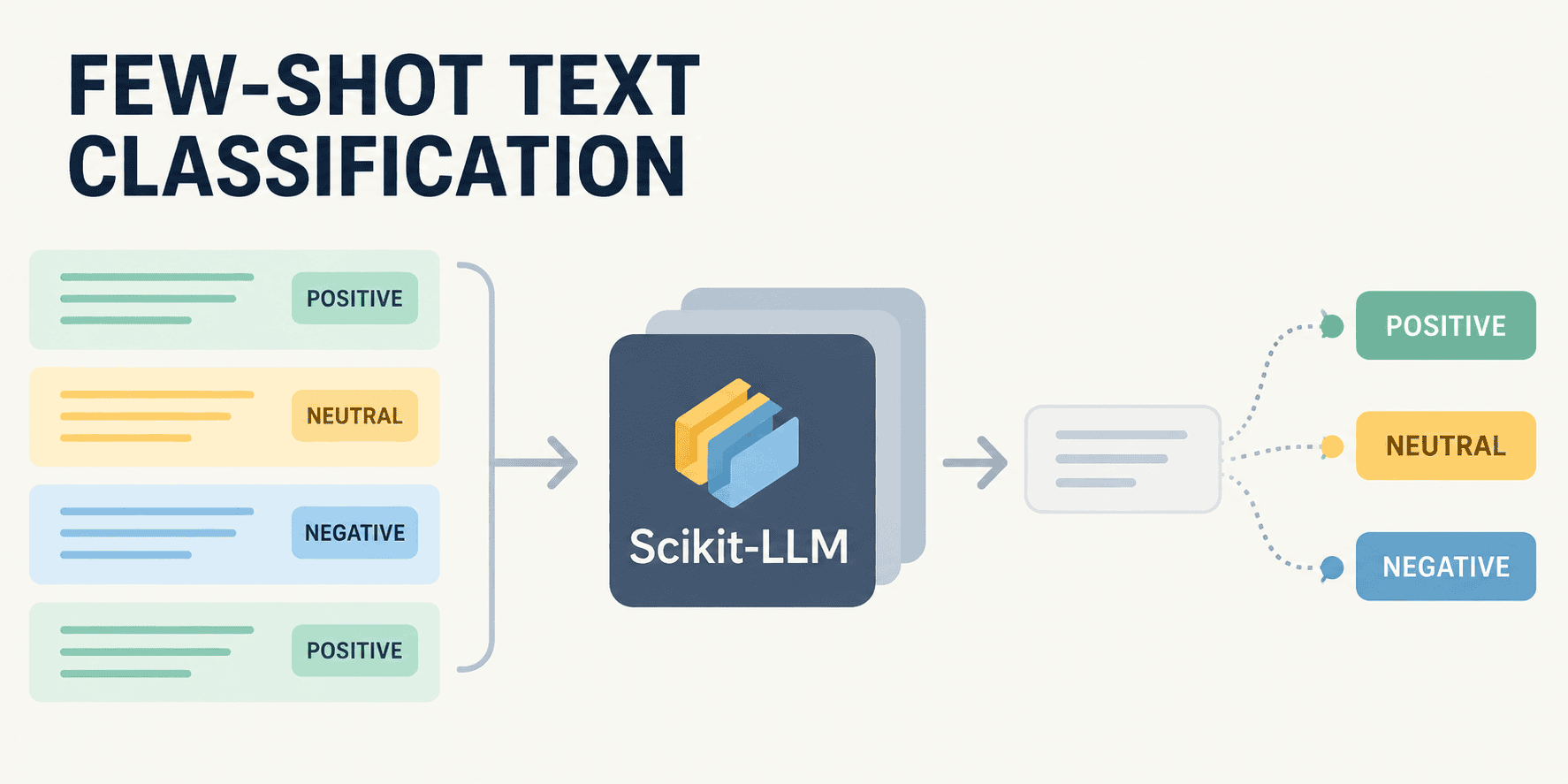
Few-shot text classification is the kind of task that sounds deceptively simple until you try it. You have a handful of labeled examples, maybe a few dozen, and you need a model to sort new data with confidence. Traditional approaches force you into a tradeoff: either hand-engineer features that don't generalize, or fine-tune a large model that demands far more data than you actually have. Scikit-LLM sidesteps that trap by wrapping large language models in a familiar, pragmatic interface. Our take is that this isn't just a convenience; it's the right way to approach the problem, because it treats the model as a reasoning tool rather than a statistical artifact you have to coax into compliance.
The practical appeal is immediate. Instead of training a classifier from scratch, you're essentially prompting an LLM with a few examples and letting it infer the pattern. That's not a shortcut; it's a structural advantage. The model brings prior knowledge about language and categories, so your few examples serve as calibration rather than the entire foundation. This matters for teams that are constantly asked to label new types of content, support tickets, product feedback, internal documents, where the taxonomy shifts and the data is scarce. Scikit-LLM makes that workflow feel less like a research project and more like a routine engineering task. It also connects neatly to the broader idea that embeddings map meaning into vector space, which we explored in Explore How Word Embeddings Map Meaning Into Vector Space. Both approaches rely on the same underlying insight: semantic similarity is a usable signal, and you don't need thousands of labels to exploit it.
There's a deeper lesson here about how we should think about model ensembles and selection. Scikit-LLM works because it leverages a model that already knows a great deal about the world, and your few-shot examples are just steering it. That's a different philosophy from the one behind Stacking Only Wins When Your Models Disagree, where success depends on combining models that fail in different ways. Here, the value comes from a single model's breadth, not from committee diversity. Both are valid, but they answer different questions. If you have a rich dataset and diverse error patterns, stacking makes sense. If you have sparse labels and a changing domain, few-shot prompting with something like Scikit-LLM is the more direct path. The choice isn't about which technique is superior; it's about matching the method to the data reality you actually face.
The one detail worth watching is how Scikit-LLM handles the boundary between "classification" and "generation." A large language model can always produce an answer, but it may not produce a stable one. Few-shot classification works best when your categories are distinct and your examples are clean. If your labels overlap or your examples are ambiguous, the model will faithfully reflect that ambiguity, which can be frustrating. That's not a flaw in the tool; it's a reminder that AI-native spreadsheets and workflows still require human judgment about what you're asking. The takeaway is concrete: adopt Scikit-LLM for tasks where your categories are crisp and your examples are representative, and you'll get usable results with minimal effort. Push it into messy, ill-defined taxonomies, and you'll spend more time debugging your prompts than you saved on labeling. That's the practical line, and it's worth drawing before you commit.