How DoorDash Built an AI Shopping Assistant That Doesn’t Rely on the LLM Alone
Our take
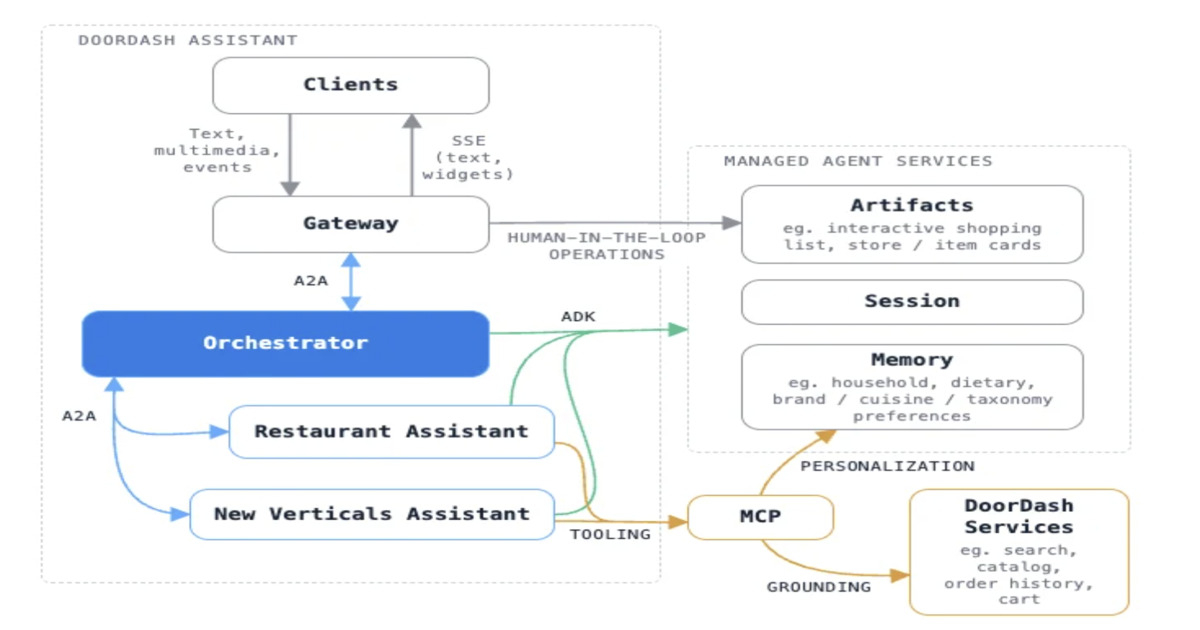
DoorDash’s recent unveiling of Ask DoorDash, their AI shopping assistant, offers a compelling case study in moving beyond the hype surrounding Large Language Models (LLMs) to build genuinely useful and effective AI-powered tools. The article details a sophisticated architecture that smartly combines LLMs with specialized AI agents, Multi-Cloud Pipeline (MCP) tooling, and a crucial intelligence layer featuring persistent consumer memory and live backend data integration. This isn't just another chatbot; it’s a carefully constructed system designed to deeply understand user intent within a specific, transactional context. The impressive early results – a 24% increase in checkout conversion and 17% larger basket sizes – underscore the potential of this approach. It reinforces a broader trend we're seeing: the realization that LLMs alone, while powerful, often require significant scaffolding to deliver practical, business-critical value. The challenges of data ownership and control, discussed in [The Path to Sovereign Data: Challenges and Priorities in Local-First Computing], become even more relevant when considering the sensitive data involved in personalized shopping experiences like this.
What’s particularly noteworthy is DoorDash’s rejection of a purely LLM-driven solution. Many companies are rushing to bolt conversational interfaces onto LLMs, hoping for a quick win. However, this approach often results in unpredictable behavior, hallucinations, and a frustrating user experience. DoorDash’s strategy, in contrast, demonstrates a thoughtful layering of different AI capabilities. The specialized agents handle specific tasks – like understanding menu items or suggesting alternatives – while the LLM provides the conversational fluency. The MCP tooling likely streamlines the integration of these components, allowing for rapid iteration and scalability. This echoes the exploration of specialized models and tuning techniques described in [Obtaining Irregular Learning Curves with Hyberband Tuned ANN model for Price Prediction [P]], where focused optimization yielded superior results compared to general-purpose approaches. Moreover, the emphasis on persistent consumer memory is a key differentiator. Unlike many chatbots that treat each interaction in isolation, Ask DoorDash retains context across sessions, leading to a more personalized and efficient shopping experience – a higher level of sophistication than what’s typically seen. The ability to measure and refine similarity in product recommendations, as explored in [How to Measure Video Similarity: 6 Techniques I Tested (and the One I Shipped)], demonstrates a commitment to detailed analysis and optimization that is crucial to success.
The broader significance of DoorDash’s work lies in its demonstration of a pragmatic approach to AI implementation. It highlights the importance of moving beyond the “LLM-first” mentality and focusing instead on building solutions that solve specific user needs. This involves carefully selecting the right AI tools for the job, integrating them effectively, and grounding them in real-world data. It also underscores the value of persistent memory and contextual understanding in creating truly personalized experiences. We’re seeing a shift from viewing AI as a single, monolithic entity to recognizing its power when deployed as a modular and integrated system. The success of Ask DoorDash isn't about showcasing the largest or most advanced LLM; it's about demonstrating how AI can be harnessed to improve a specific business outcome—in this case, driving sales and enhancing the customer shopping journey.
Looking ahead, the integration of live backend data is a particularly promising area. As Ask DoorDash matures, it will likely become even more proactive, anticipating user needs and offering personalized recommendations based on real-time inventory and delivery conditions. The challenge will be to maintain user trust and privacy while leveraging this data effectively. The question worth watching is whether other companies in similarly transactional industries – retail, travel, hospitality – will follow DoorDash’s lead and adopt a more modular, AI-integrated approach to conversational commerce, or if the pursuit of ever-larger LLMs will continue to dominate the landscape.
DoorDash details the architecture behind Ask DoorDash, its AI-powered conversational shopping assistant, combining LLMs, specialized AI agents, MCP-based tooling, and an intelligence layer with persistent consumer memory and live backend data. Early results show up to 24% higher checkout conversion, 17% larger baskets, and improved intent accuracy using memory-backed sessions.
By Leela KumiliRead on the original site
Open the publisher's page for the full experience