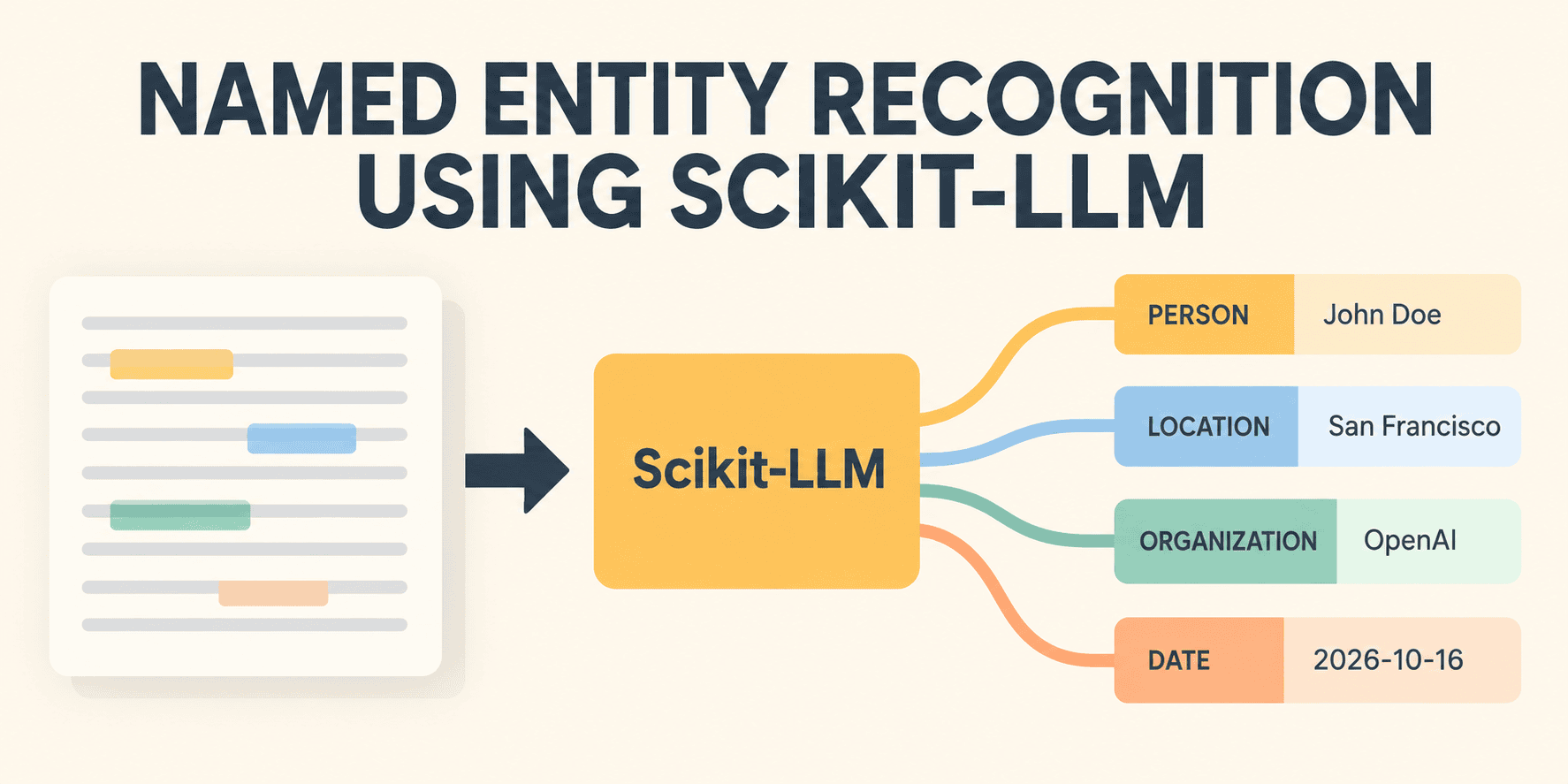
Named entity recognition has long been one of those tasks that feels simple in concept but punishing in practice. You need labeled data, domain expertise, and a willingness to iterate through model after model. So when we saw a workflow that lets you build standardized custom NER pipelines using LLM reasoning in just a few steps, we had to stop and ask what that actually changes for the people doing this work every day. The answer is straightforward: it removes the grunt work without removing the control.
The approach described here turns the LLM's reasoning capability into the engine for extracting entities, which means you no longer need to train a separate model for every new category or document type. Instead, you define your schema, feed in your text, and let the model reason about what fits. That is not just faster; it is more adaptable. When your data shifts, you update your prompt, not your pipeline. This matters because most teams do not have the luxury of retraining models weekly. They need something that works now and still works next quarter. Discover how AI is translating the hidden electrical language of plants shows how far we have come in teaching machines to interpret signals that were once unintelligible. NER pipelines built on reasoning are another step in that same direction: making previously manual or brittle processes feel fluid.
Of course, relying on an LLM for structured extraction introduces its own questions. Consistency matters in production, and LLMs are not deterministic by nature. The workflow addresses this by standardizing the pipeline, which is a practical hedge. You still get the flexibility of natural language reasoning, but you wrap it in a repeatable process that does not leave you guessing. That balance between power and predictability is exactly what we think the next wave of AI tools needs to strike. How to choose the right AI tool by asking what keeps your LLM in check makes a similar point: the real value is not in raw capability but in the guardrails that keep that capability reliable. This NER workflow applies that logic in a concrete, repeatable way.
The practical takeaway here is that if you are still hand-labeling data or maintaining separate NER models for different document types, you are spending time you do not need to spend. The combination of LLM reasoning and a standardized pipeline lets you get to accurate extraction faster, and it adapts when your needs change. The question worth watching is how far this approach scales. As documents grow longer and entity lists grow denser, will reasoning alone hold up, or will you need to blend in more traditional methods? That is the edge case to track. For now, the path to a custom NER pipeline just got shorter, and that is a concrete improvement worth exploring.