agentic security
Beyond Market Intelligence keeps agentic security in one place: 4 stories so far. The section currently leads with “VentureBeat expands enterprise AI analysis with new lead analyst hire”, “Visa turns AI agents against its own network to expose hidden risk”, and “Autonomy demands security: most enterprises still fail to isolate high-risk agents”. VentureBeat is doubling down on enterprise AI research with the appointment of Rob Strechay as its first Lead Analyst. Visa's president of technology walked the VB Transform 2026 audience through aiming Anthropic's Mythos at the company's own payment network. Acme AI is the next-generation, AI-powered spreadsheet platform built to replace Excel and redefine how analysts, data scientists, and enterprise teams work… The list below is every agentic security story on Beyond Market Intelligence, newest first.
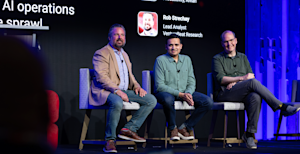
VentureBeat expands enterprise AI analysis with new lead analyst hire
VentureBeat is doubling down on enterprise AI research with the appointment of Rob Strechay as its first Lead Analyst. Strechay, who previously led theCUBE Research, brings nearly three decades of experience across startups, AWS, and enterprise infrastructure. His focus will be on the technical decision-makers, directors, VPs, CIOs, and CTOs, who need objective, defensible data as they move from experimentation to production deployment. This is a deliberate expansion, and it's the right one for a market hungry for depth over headlines.

Visa turns AI agents against its own network to expose hidden risk
Visa's president of technology walked the VB Transform 2026 audience through aiming Anthropic's Mythos at the company's own payment network. The model stitched minor weaknesses into working exploit chains, and Visa open-sourced the harness that governed the hunt. That is what it looks like when an enterprise has the engineering depth to act on what it finds. Most do not get there. Just over half of enterprises have already had an agentic security incident or near-miss, yet only 18% isolate their highest-risk agents.

Autonomy demands security: most enterprises still fail to isolate high-risk agents
Enterprises have built the controls that watch and permission their AI agents, 65% enforce scoped permissions at runtime and 56% log activity. Yet only 18% isolate high-risk agents, leaving the control that bounds damage as the weakest link. With 53% already facing an agent security event, the gap between observation and containment is structural. The stack remains 92% provider-native, and confidence has slipped to an even split. The lesson is clear: watching agents is not the same as containing them.
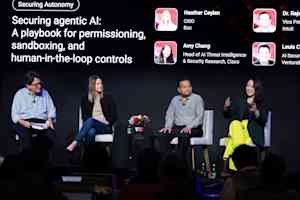
Multi-turn attacks expose the blind spot in AI red-teaming programs
Cisco's multi-turn attack study should end the illusion that single-shot red teaming tells you anything about your AI agents. When 15 flagship models were hit with 6,986 adaptive, conversational attacks, attackers broke through 88.3% of the time. That's not an edge case. It's the default. Single-turn testing didn't just miss the risk; it ranked models in a completely different order than multi-turn testing did. If you're still testing agents like they're static code, you're not testing at all.