chatbot
Beyond Market Intelligence keeps chatbot in one place: 18 stories so far. The section currently leads with “Disney opens a path for Character.AI talent to build its next chapter”, “Teen Safety Gaps Persist as ChatGPT Pushes Deeper Conversations”, and “When an AI chatbot shapes foreign policy, it's time to ask who's really in charge”. Character.AI's bankruptcy just became a talent pipeline for Disney. ChatGPT's teen safeguards are supposed to catch users in crisis, yet new testing shows the chatbot keeps the conversation going instead of stepping back. Acme AI is the next-generation, AI-powered spreadsheet platform built to replace Excel and redefine how analysts, data scientists, and enterprise teams work… The list below is every chatbot story on Beyond Market Intelligence, newest first.

Disney opens a path for Character.AI talent to build its next chapter
Character.AI's bankruptcy just became a talent pipeline for Disney. With former CEO Karandeep Anand already installed as the entertainment giant's first CTO, and a $20 million asset deal in place, employees now have a clear path forward. That's a pragmatic rescue, one that turns a startup's collapse into a strategic gain. Disney isn't just buying technology; it's absorbing people who know how to build. For those workers, the next chapter starts with a familiar mission, just a different stage.

Teen Safety Gaps Persist as ChatGPT Pushes Deeper Conversations
ChatGPT's teen safeguards are supposed to catch users in crisis, yet new testing shows the chatbot keeps the conversation going instead of stepping back. That's not just a feature gap; it's a trust issue. Encouraging deeper engagement during moments of vulnerability risks normalizing an unhealthy reliance on the AI itself. Parents deserve clearer answers, and OpenAI needs to close this loop. For more on how AI agents are reshaping personal tech, see our coverage of Microsoft's new Surface Laptop Ultra.

When an AI chatbot shapes foreign policy, it's time to ask who's really in charge
President Trump reportedly asked Grok for its opinion before ordering the invasion of Venezuela and the capture of Nicolás Maduro. When an AI chatbot shapes foreign policy, we have to ask who's really in charge. The answer matters more than the headline. This isn't about technology outpacing judgment. It's about accountability. For a deeper look at how AI is reshaping decision-making in unexpected ways, read our piece "A Typo in the White House AI Pledge Signals a Deeper Disconnect."

Can AI chatbots truly untangle the government maze, or will they add new snags?
Government websites promise clarity, but AI chatbots bring their own risks. America.gov wants to simplify bureaucracy, yet language models still hallucinate, potentially swapping one headache for another. That tension deserves attention, not blind optimism. The practical path forward involves testing these tools with healthy skepticism, not assuming they'll magically fix every form and deadline. If you're curious how model limitations play out in practice, our piece on Anthropic's Opus 5.5 offers useful context.

Anthropic's Opus 5.5 Delivers Fable Performance at a Lower Cost
Anthropic says Opus 5.5 is the strongest model it has tested to date, and the headline numbers back that up with a welcome twist: this level of fable performance arrives at a lower cost. That matters for teams who have been waiting for serious AI capability without the usual premium. We see this as a practical step forward for data work, not just a spec sheet win.

Discover how AI redefines your spreadsheet workflow through a simple experiment
When I ran Fable against Astra, the gap between them wasn't subtle. Fable handled the workflow with a fluidity that felt natural, while Astra demanded more patience. It's a reminder that AI tools aren't interchangeable; they carry distinct personalities. For anyone weighing similar choices, I'd point to our earlier piece on the Forrester function. It's a different lens, but it reinforces how small mathematical insights can sharpen your evaluation of these systems. The experiment didn't just compare outputs; it exposed what each model prioritizes.

Discover how AI transforms data work into intuitive conversations
Asking Astra to handle a task is a reasonable impulse, but it deserves a moment of reflection first. The real question is whether you trust the output enough to act on it. We see AI as a tool for empowerment, not a substitute for judgment. It can streamline the mundane, but you remain the decision-maker. For those wanting to understand the underlying mechanics better, our guide on distributed algorithms offers a solid starting point.
Explore how Grok Bot simplifies AI setup for $200
Grok Bot asks a fair question: is an AI agent you simply install worth $200? For anyone who has wrestled with spreadsheets, the appeal is obvious. It promises to handle the tedious work directly, removing the setup friction that stalls so many promising tools. We think that is a compelling pitch. The real test is whether it delivers on that ease.

1 billion conversations show how voice is reshaping data interaction
Google's Gemini app just crossed 1 billion users, and the numbers behind that milestone are worth sitting with. Nearly two-thirds of those people are talking to the assistant directly, using voice rather than typing. That's a signal that conversational interaction is becoming the default, not the novelty. Gemini also generates over 150 million images daily, which shows how deeply creation is woven into the experience. It's a clear sign that AI is moving from background tool to active partner.

Install Claude Code and discover a smarter way to work from your terminal
You have probably heard by now: Claude Code burns through usage limits. Most of us live in the web app, though, distant from the terminal where the real buzz lives. That gap might have sparked your curiosity. Maybe you already know exactly what it is and just want it running. Either way, this guide cuts through the setup friction. It is a practical, no-nonsense walkthrough.

How Congress is discovering AI's role in legislative work
ChatGPT has quietly become Capitol Hill's go-to assistant. House spending records show OpenAI's chatbot dominating paid AI use in congressional offices, where it drafts memos, summarizes legislation, and smooths constituent communications. That's a telling vote of confidence from an institution not known for rushing into new tools. It also raises a fair question: are we offloading too much thinking to AI?
Why I Stopped Installing Skills and Found a Smarter Workflow
There's a quieter path past the constant churn of installing Claude Skills. I stopped adding them to my workflow, and the shift has been liberating. Instead of stacking tools, I'm focusing on direct conversations with the model, letting it adapt to my specific needs in the moment. It feels less like managing a toolbox and more like collaborating. If you're curious about the limits of this kind of interaction, our piece on talking to an AI clone offers a useful counterpoint.
From raw sensor data to deployed model, discover a simpler path to edge ML.
Getting from raw sensor data to a deployed model on an MCU is rarely a smooth path, so seeing a project built specifically to remove that friction is refreshing. The auto-labeling tool stands out because manual labeling of time series data is a genuine bottleneck for many edge projects. It is smart to pair that with a chatbot that offers direct signal insights. Keeping the platform open source invites practical contributions that could shape its evolution. It is worth exploring for anyone working on tinyML.

Your AI summary sends users to your homepage, not your deep content
The web isn't dying. It's splitting. One version still serves human eyes, but the other has become raw material for machines. The data is stark: Google sends fewer clicks, yet ChatGPT is citing live pages more than ever. The real shift is that AI answers are now the product, and your homepage is the new front door. Most sites were built backward. The fix is to restructure deep pages for citations, rebuild the homepage for informed visitors, and treat internal search as an acquisition tool.

Chat with Meta AI directly inside your Threads DMs.
Threads is bringing Meta AI straight into your DMs, giving you a direct line to the assistant without leaving the conversation. It's a practical step toward making AI feel less like a separate tool and more like a natural part of how you connect. For anyone tired of juggling apps, this simplifies the flow. We've also been tracking how Meta's AI agents are evolving, and this move fits that momentum.

Explore how Attie turns social data into answers you can act on.
Attie, Bluesky's AI assistant, now steps beyond simple replies to become an open social research tool. Users can pose questions about news, trends, and conversations unfolding across Bluesky and other AT Protocol apps. It's a practical move toward making network insights more accessible, and we're here for it. If you're curious about the limits of such interactive tech, our piece on talking to an AI clone offers a thoughtful counterpoint. Explore what Attie surfaces, but keep asking sharp questions.

Inflection AI shifts focus from raw power to building relational AI experiences
Two years after Microsoft's acqui-hire stripped Inflection AI of its founders and most of its staff, the Palo Alto company is staging an unusual second act. This week, it launched Inflection AI Labs and Pi Journeys, an experimental product built on a contrarian bet: the next AI battleground isn't raw intelligence but relationships. CEO Sean White argues today's assistants are transactional, and that's the flaw. If he's right, the giants' coding-obsessed roadmaps may have left the door open for something more human.
Measure AI ROI by mapping the customer journey before you build
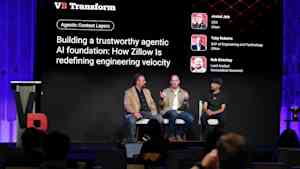
Zillow's engineering chief brought a refreshing dose of discipline to VB Transform 2026: measure before you build. Toby Roberts and Glean's Arvind Jain showed that context, not data, is the real bottleneck in AI. Zillow's persistent context layer carries customers through a journey that spans months and multiple professionals. That's a hard problem, and they're solving it with practical architecture. For those digging into the technical weeds, our guide to distributed algorithms pairs well with this systems-first thinking.