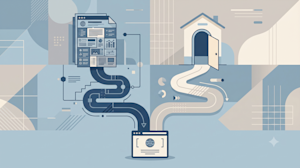
The web isn't dying. The click economy is, and those are two very different things. When Pew data shows users clicking traditional results just 8% of the time when an AI summary is present, and cited links inside those answers faring even worse at 1%, we have to stop mourning the loss of the old model and start confronting what the data actually tells us: the machine has become the audience. Talking to My AI Clone Taught Me to Question the Tech made us reflect on how these systems mediate our reality, and this shift is the most concrete example yet. Navigating AI/ML Job Requirements: A Shift in Expected Skills shows a similar reordering in the talent market, where the old job descriptions no longer match the new tasks. The same principle applies here: the roles we optimized for, the deep-linked article that ranks, the headline that earns the click, are being replaced by a different set of rules.
The real story is the split that every independent dataset confirms. Similarweb shows 65% of ChatGPT-cited URLs sit two or three folders deep, while 58.8% of referral traffic lands on homepages. Ahrefs found more than 80% of its AI referral traffic goes to its homepage, product pages, and free tools, not its editorial content. And Previsible's analysis of 6.77 million sessions found 28.8% of ChatGPT referrals land on internal site search pages. That last number is the one that should stop you cold. Internal search, the neglected backwater of web design, is now an acquisition surface. Your homepage is no longer a front door; it's a landing pad for someone who has already done the research and has arrived with intent. The old playbook of funneling people from a search result to a specific article to a product page is inverted. The AI does the navigating. Your job is to make the destination obvious. Verify Your AI's Understanding: A Simple Check for Tax Season touches on a similar theme: you cannot just assume the system understands you. You have to structure for it.
So what do we actually tell you to do? Stop treating this as an SEO problem and start treating it as an architecture problem. The pages that get cited are not the pages that get visited. That means your deep content, the benchmarks, the documentation, the comparisons, must be written to be quoted by machines: specific claims, clear headings, natural-language URLs. But your homepage must be rebuilt for a visitor who already knows you have what they need. Get them to it faster than they can ask. And invest in internal search like your revenue depends on it, because it now does. This is not a theoretical suggestion. The data from Ahrefs is stark: pages with natural-language slugs get cited at 89.78% versus 81.11% without. That is a 10% swing in citation likelihood based purely on URL structure. That is the kind of edge you can act on today.
The uncomfortable question no one wants to sit with is whether the open web survives this, or whether it becomes a machine-readable substrate where human traffic is a byproduct, not the goal. Google is cannibalizing its own click economy because it has to, and its share of U.S. search advertising is projected to fall below 50% for the first time in two decades. The new competition is not for the query; it is for the conversation. Sponsored results in ChatGPT conversations doubled in a month, and they are targeted on context, not keywords. That is a fundamental transfer of value away from the page and toward the interaction. The takeaway that matters is this: if 67% of ChatGPT's most-cited sources are things you cannot influence, like Wikipedia, then your only strategic lever is to become the thing it cites when it needs your specific expertise. Audit your logs. Find where the machines quote you versus where they send humans. If those two pages are different, and they almost certainly are, you have one clear job: make the quoted page quotable and the landing page actionable. The click is gone. The visit is not. But only if you rebuild for the visitor who arrives with context, not curiosity.