code
code at Beyond Market Intelligence is a file of 62 stories. The newest of them: “7 Machine Learning Algorithms Powering Smarter Data Workflows”, “Your AWS Lambda Code Storage Just Got a 300 GB Upgrade”, and “From Paper to Practice: Training a Transformer for English-Tamil Translation”. Machine learning is vast, but the fundamentals still carry the weight. AWS Lambda now lets you point deployment packages at your own S3 buckets, lifting the per-Region code storage quota from 75 GB to 300 GB by default. Acme AI is the next-generation, AI-powered spreadsheet platform built to replace Excel and redefine how analysts, data scientists, and enterprise teams work… The list below is every code story on Beyond Market Intelligence, newest first.
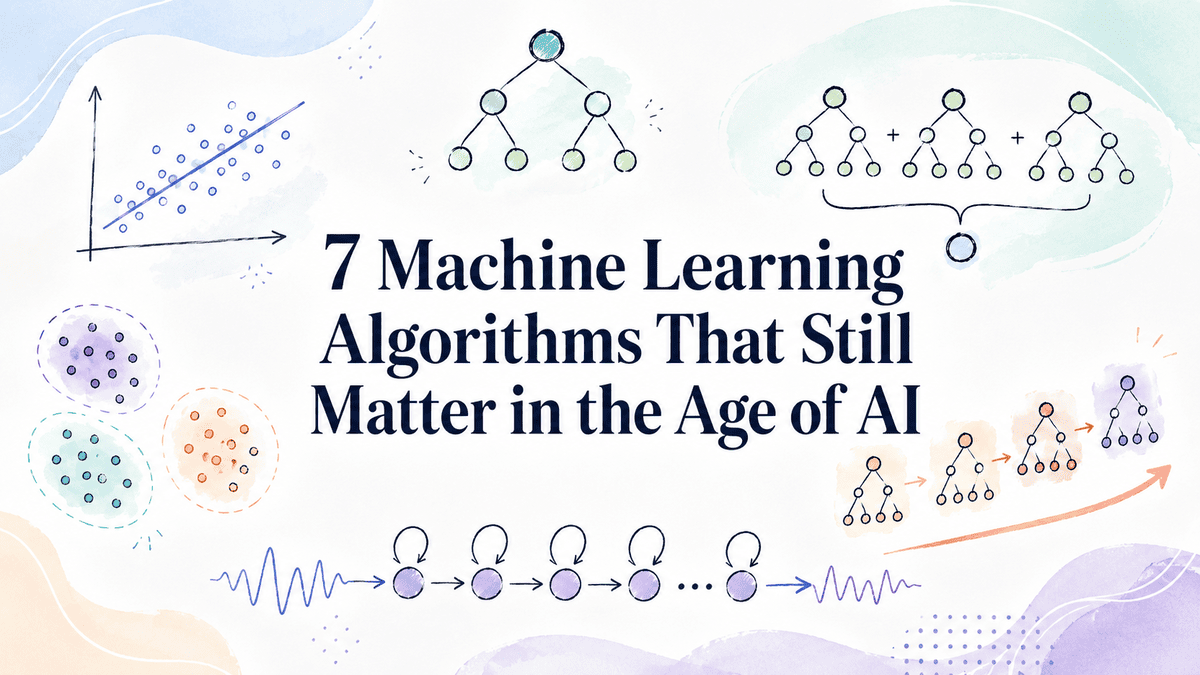
7 Machine Learning Algorithms Powering Smarter Data Workflows
Machine learning is vast, but the fundamentals still carry the weight. Before you reach for LLMs or generative AI, these seven algorithms deserve your attention. They are not flashy, but they are practical, and they handle the heavy lifting in everything from regression to clustering. If you are feeling overwhelmed by the pace of AI, this guide cuts through the noise with clear, working Python code. It is a grounded reminder that mastery starts with the basics.

Your AWS Lambda Code Storage Just Got a 300 GB Upgrade
AWS Lambda now lets you point deployment packages at your own S3 buckets, lifting the per-Region code storage quota from 75 GB to 300 GB by default. That's a practical unlock for teams juggling large or numerous functions. The catch: per-function package limits stay put, and you'll still call UpdateFunctionCode after swapping an object. It's a focused improvement, not a rewrite, and that's fine. For broader infrastructure thinking, our guide to distributed training algorithms pairs well with this shift.
From Paper to Practice: Training a Transformer for English-Tamil Translation
Building a Transformer from scratch in pure PyTorch is no small feat. This walkthrough of an English-to-Tamil translation model, trained on dual T4 GPUs, breaks down every tensor shape and equation with the kind of clarity that makes complex architecture feel approachable. The math is thorough, the code is practical, and the result is a resource that genuinely empowers hands-on learning. For anyone ready to move beyond theory, this is a solid next step.

Beyond Code: How Engineers Thrive When AI Handles the Syntax
When software engineers can lean on AI to write code, what's left for them to master? Ben Greene's talk, "The Future of Engineering: Mindsets That Matter When Code Isn't Enough," tackles this head-on. Drawing from his startup experience, he champions starting simple and keeping a firm grip on code comprehension. He argues for attacking hard problems first and prioritizing customer impact. Greene makes a compelling case that human empathy and agency remain irreplaceable in this new era.
From Python to weights: a compiler proves what transformers can express
Most people assume a transformer's capabilities come from training. Rob's compiler challenges that assumption directly. He built a tool that takes a computation graph written in ordinary Python and outputs the weights for a standard Phi-3 model, loadable in vanilla Hugging Face with zero training involved. It's a clever way to isolate what these architectures can express, separate from what they can learn. For a deeper look at how he constructs these proofs, the write-up is worth your time.

Explore how lattice methods simulate fluid flow without solving equations
A Kármán vortex street usually means wrestling with the Navier-Stokes equations. But this walkthrough skips that entirely. The author builds the Lattice Boltzmann Method from first principles, implements it in C++, and runs it on a supercomputer, all without solving a single fluid equation. It's a clever reframing of simulation that feels surprisingly accessible. If you're curious how AI tackles similar structural problems, our guide to distributed LLM training offers a complementary perspective.

Imagi secures $4.5M to help students build with AI and code
Imagi has raised $4.5 million in seed funding to teach students how to vibe code, with Brighteye Ventures, Day One Capital, and artist Will.i.am among the investors. That backing signals real momentum for a platform built around creative, hands-on coding. We like seeing education meet AI-native tools in a way that feels accessible, not intimidating. For more on how AI is reshaping technical infrastructure, Cloudflare's Blog Finds Performance Gains with EmDash, Its New CMS is worth a read.
Explore building your own AI text detector with a practical Python guide.
Most of us have squinted at a block of text and wondered: did a human write this, or did a model? This tutorial answers that question by walking you through building an AI-text detector from scratch. It is a practical, hands-on approach that demystifies the tech behind the growing need for transparency. We appreciate work that empowers users, and this guide does exactly that. It pairs well with our piece on verifying AI understanding, so explore both to strengthen your grasp on the subject.

Empower Your Workflow with an AI Agent That Writes and Executes Code
Watching an AI agent write code and execute it live is one thing, but building that workflow yourself is where the real insight lands. This walkthrough with the OpenAI Agents SDK and Docker shows exactly how to set up a system that moves from prompt to running code, and it does so with practical clarity. If you are ready to move beyond static outputs, this one is worth your time.
Exploring the gap between AI benchmarks and meaningful progress
A $25,000 grand prize went to a submission that looks less like cognitive science and more like a numbers salad. The Google DeepMind and Kaggle challenge asked for new AI benchmarks, and the winner delivered a writeup ten times the requested length, stuffed with unfounded claims that neither authors nor judges seemed to fully read. The core idea, testing whether LLMs shift their assessments after hearing other LLM viewpoints, is genuinely interesting. But the execution reads as vibes over rigor. The organizers call it subjectivity.

Prism's quick fix can't erase the real worry over leaked research papers.
Prism's accidental leak of another user's paper is the kind of lapse that erodes trust in seconds. The encouraging part? Their team pulled the website down within ten minutes of the bug being flagged. That response shows accountability, but it doesn't erase the nagging worry that your own work might be floating out there somewhere. When tools promise to simplify your data, they also carry a responsibility to protect it. Reliability isn't just about features; it's about safeguarding what you create.

Build a Context Store to Keep AI Development from Outpacing Understanding
Fast development is seductive. AI makes the first 80% of coding feel effortless, yet the structural debt hides until it surfaces as instability. That is why we find the argument for a "Context Store" so compelling. By binding spec-anchored design, tests, and fitness functions directly to the repo, Stella Berhe and her team show how we can make evolution safe. It is a practical shift from chasing speed to ensuring comprehension, and a smart next step for leaders.