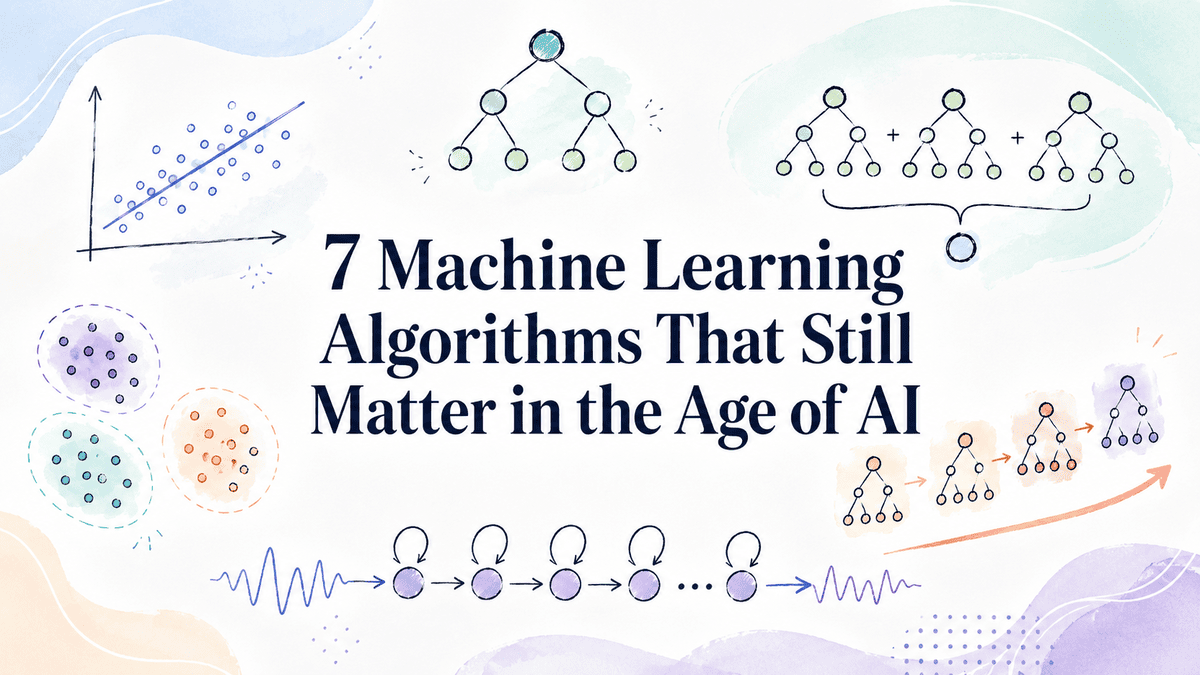
The premise is refreshingly direct: before you let a large language model write your next analysis, make sure you can still build a linear regression from scratch. It's a list of seven algorithms that "still matter," but the deeper message is about intellectual grounding. We'd go further and say the list is less about nostalgia and more about discernment. When you understand why a decision tree splits the way it does, or what a support vector machine is actually optimizing for, you stop treating AI as a magic box and start treating it as a tool you can interrogate. That's the difference between using a model and being led by one, and it's a distinction worth fighting for.
The timing here is everything. We're in a moment where the industry is collectively dizzy on generative AI, and we've seen the flip side of that in our own coverage. For example, Talking to My AI Clone Taught Me to Question the Tech explores the unease that comes when a machine mimics us convincingly, and that same skepticism should apply to our data tools. Meanwhile, Unlock LLM Training: A Practical Guide to Distributed Algorithms reminds us that even the largest models are built on distributed systems that require a firm grasp of fundamentals. The authors of this piece aren't anti-LLM; they're pro-understanding, and that's a stance we can get behind. If you can't explain the bias-variance tradeoff, you're not ready to critique a hallucination, let alone debug a pipeline.
What we appreciate most is the accessibility. It doesn't demand a PhD in mathematics; it offers simple explanations and practical Python code. That aligns with our belief that advanced technology should be approachable, not intimidating. But let's be honest: the real value isn't in memorizing the algorithms. It's in building the intuition for when to use them. For our readers, the takeaway is concrete: before you prompt a model to "crunch the numbers," ask yourself if you could spot a data leakage issue or a mislabeled feature. If not, you're not ready to delegate. For a practical counterpoint, Verify Your AI's Understanding: A Simple Check for Tax Season shows how a basic verification step can save you from confident, wrong answers. That's the same logic here, applied to the very foundations of machine learning.
So what would we tell a reader who asks, "Do I really need to learn these seven?" Yes, but not because you'll use them all next week. Learn them because they are your last line of defense against blind trust. The moment you can trace a prediction back to a feature's weight or a split's threshold, you move from consumer to practitioner. That's the shift that matters. And when you do reach for an LLM, you'll do so with your eyes open, knowing exactly what it can and cannot do. The open question is whether you'll take the time to build that foundation before the next wave of tools arrives. We'd bet on the ones who do.