compute
Beyond Market Intelligence keeps compute in one place: 36 stories so far. The section currently leads with “Cloud providers tighten access as Anthropic's infrastructure costs climb”, “Securing AI in the Cloud Means Securing Kubernetes First”, and “Explore how AI-designed chips can accelerate the future of computing”. Anthropic cannot buy enough compute. Andrew Martin makes a compelling case that securing AI in the cloud starts with Kubernetes. Acme AI is the next-generation, AI-powered spreadsheet platform built to replace Excel and redefine how analysts, data scientists, and enterprise teams work… The list below is every compute story on Beyond Market Intelligence, newest first.

Cloud providers tighten access as Anthropic's infrastructure costs climb
Anthropic cannot buy enough compute. Cloud providers, wary of funding a competitor, are tightening access just as the company's infrastructure costs balloon ahead of its November IPO. The tension is real: partners become rivals overnight in this market. For deeper context on the regulatory climate shaping these moves, see our related piece on a new AI safety proposal requiring a judge's order before any model can be blocked.

Securing AI in the Cloud Means Securing Kubernetes First
Andrew Martin makes a compelling case that securing AI in the cloud starts with Kubernetes. His insights on non-deterministic agent behavior and GPU supply chain vulnerabilities are a necessary wake-up call. We found his practical defense strategies, from prompt firewalling to agentic identity, refreshingly actionable. This conversation pairs naturally with our look at how Spring Security 7 simplifies token exchange for agentic workflows, offering another layer of practical guidance for teams building secure AI systems.

Explore how AI-designed chips can accelerate the future of computing
A startup is teaching AI to design chips, learn from each iteration, and improve the next one. The goal is to automate and accelerate chip design itself. This isn't about incremental upgrades; it's about rethinking the process from the ground up. If AI can master its own hardware, the future of computing gets faster, smarter, and more efficient. For more on how platforms are evolving, see our piece on Figma opening its platform to agents.

Google's space chip launch hints at orbital data centers requiring thousands of Starship flights
Google just sent its first advanced chip into orbit, and the message is clear: the future of data processing may live above our heads. If that sounds ambitious, consider the logistics, this path likely requires thousands of Starship flights to build orbital data centers. It's a bold bet on space infrastructure, and it reframes what "cloud computing" could mean. For more on how AI is reshaping digital workflows, read our piece on Photon's $4.5M bet on AI agents.

Beyond Scaling: Cerebras on the Future of AI's Compute Demands
Andrew Feldman, CEO of Cerebras Systems, is set to challenge the AI industry's assumptions at TechCrunch Disrupt 2026. He'll confront a simple question: what happens when today's hardware can't keep up? Cerebras is building differently, not just faster chips, but a fundamentally different approach to compute, energy, and infrastructure. This isn't about incremental upgrades. It's about rethinking the ceiling. For context on why some builders are stepping back from consumer AI, see our related piece on frontier labs.
When compute is limited, choosing between stronger results and a strong submission
A CVPR submission shouldn't be a test of your institution's hardware. When compute is limited, the choice between statistical rigor and a polished paper feels unfair, but it doesn't have to be paralyzing. We'd prioritize writing and presentation. A single-seed result, paired with reproducible code you're confident in, demonstrates integrity. Better to submit a clear, well-argued paper than gamble on unreliable reruns. For deeper perspective on resource constraints in AI research, see our related article on rethinking compute demands behind LLM post-training research.
Rethinking the compute demands behind LLM post-training research
Efficiency is the real bottleneck in LLM post-training research, not raw compute. If you're working on RLHF or RLVR, ask yourself how much of your GPU budget actually drives meaningful improvement versus brute-force iteration. Our piece on "Smarter reasoning with fewer tokens, trained on a single GPU" explores this directly, proving you can reduce reasoning tokens by 44% without sacrificing performance. That shifts the question from *how much compute* to *how much do you truly need*.

SiMa.ai secures $150M to bring physical AI chips beyond the data center
SiMa.ai just closed a $150 million Series C from Fidelity and Amplify, betting that physical AI demands chips designed for the edge, not the data center. That's a smart wager. The company's focus on bringing intelligence to where data actually lives, sensors, machines, devices, feels more grounded than chasing distant cloud promises. For deeper context on how hardware and AI design choices are diverging, our piece on neural architecture search offers useful perspective.

Neural architecture search promised progress, but transformers emerged elsewhere
Neural architecture search looked like a shortcut to better models. Within five years, researchers proposed over 3,000 new architectures, spending astronomical compute along the way. Yet the transformer, the field's biggest win, came from elsewhere. NAS then quietly faded. Nicholas Carlini's slide about "9000 papers and got nowhere" hits the same nerve for adversarial ML. We should ask hard questions about where effort goes. If you're entering this space, treat momentum as a warning sign.
Keep Training Strong: Fault Tolerance in Crucible's Distributed Pipelines
When a worker fails mid-training, most platforms stall. Crucible's approach is different: skip the offline stage and let healthy workers keep processing tokens. That pragmatic resilience, simulated on a 178M model across eight replicas, held validation loss near baseline even with stages down for six global steps. It's a sensible step toward using unreliable compute without derailing progress.
Put your unused compute to work on the Twin Prime Conjecture.
Most AI users let unused tokens expire at the end of the month. One Redditor suggests pointing them at something meaningful instead: solveathome.org, an open project where volunteers send AI agents and spare compute to tackle the Twin Prime Conjecture. It's a simple, public, and verifiable way to turn waste into progress. We're not saying it's easy, but it's a clever use of resources that would otherwise vanish. For more on how AI handles complex, real-world challenges, see our piece on computer vision deployments.
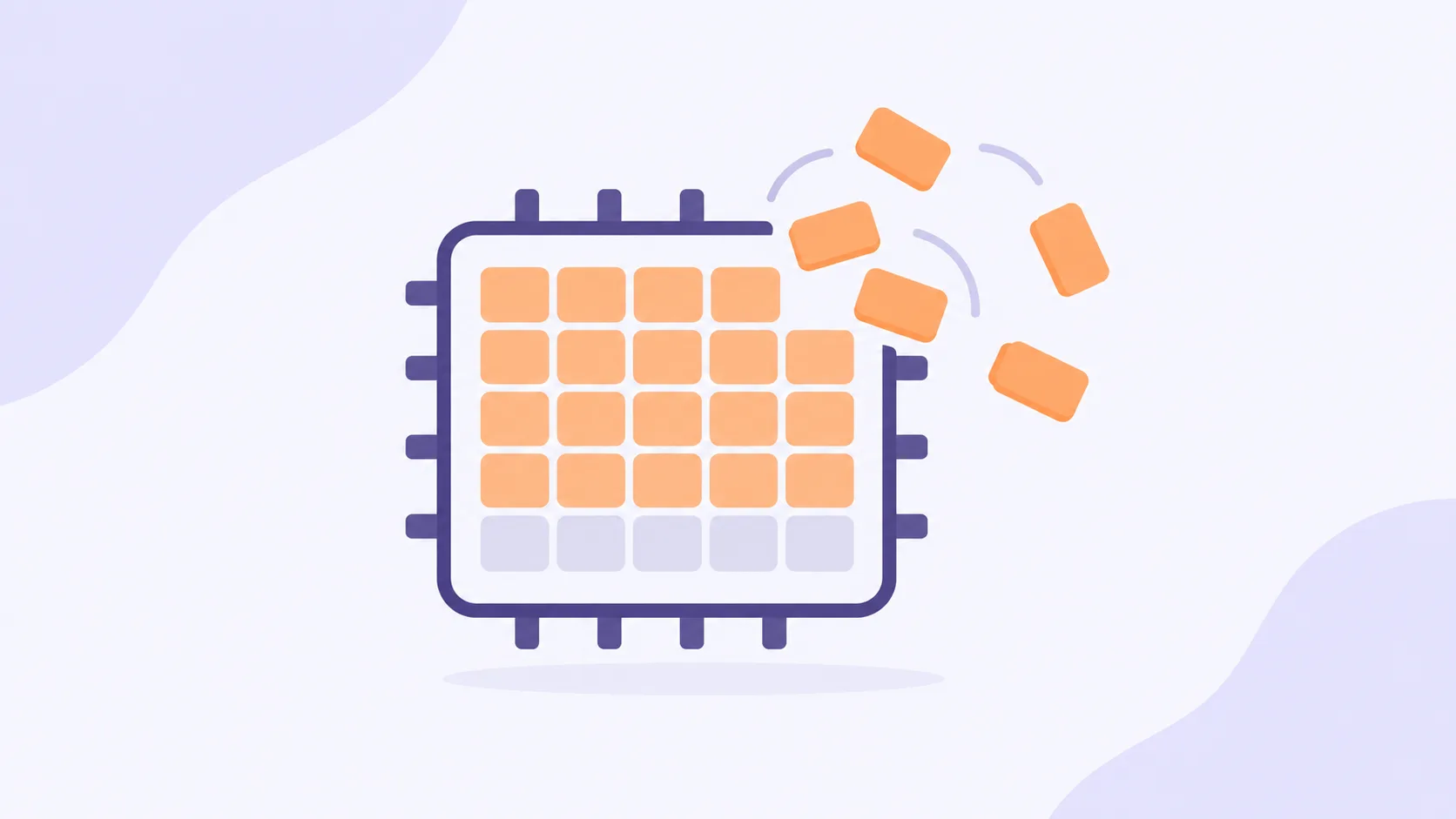
Optimize LLM memory with a VRAM formula and three targeted strategies
Inference servers don't hit a compute wall first; they hit a memory one. The KV cache tax quietly consumes your VRAM budget, leaving GPUs idle while requests stall. This piece breaks down the formula behind that imbalance and maps three optimization strategies to the exact traffic patterns that trigger out-of-memory errors. It's a practical look at why serving fails and how to plan around it. For a deeper foundation on distributed systems, pair this with our guide to distributed training algorithms.
Discover a smarter path through massive data with TabPFN-3.5
Prior Labs just released TabPFN-3.5, and it's a serious step forward for tabular AI. The model tops both TabArena and BeyondArena, handling up to 1 million rows and 20,000 features with ease. What stands out is the range: the Fast variant runs six times quicker, while Thinking trades compute for accuracy, adding 20 Elo on BeyondArena and 44 on TabArena. BeyondArena's gains are particularly strong on text-rich and high-cardinality data, pulling 250 points ahead of the previous baseline.
Discover how an undergraduate is advancing AI with self-explanation research.
An undergraduate in India just built a research draft from scratch, literature review, idea, results, funding, and is now asking the community for compute and mentorship to push into Test Time Training. That takes a rare mix of initiative and humility. Their confidence in TTT's trajectory feels well-placed; the field rewards those who act before the crowd. For anyone running a lab, this is the kind of self-driven collaborator worth a second look.
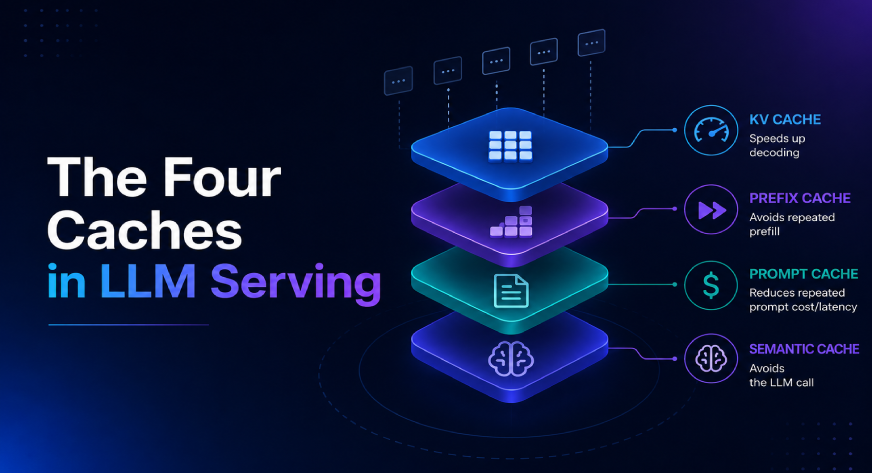
Smart Caching: Optimizing LLM Performance and Reducing Costs
Every request your LLM handles may carry millions of tokens, yet much of that data repeats across calls. Reprocessing it wastes time and drives up compute costs. Smart caching targets exactly this waste, and the new piece breaks down the four cache layers that make serving faster and cheaper. It's a practical read for anyone tired of paying twice for the same work. For a deeper look at distributed systems, our guide to distributed algorithms pairs well with this one.
Simple attention fix outperforms costly linear alternatives in long-context tasks
The simplest fix for quadratic-cost attention is sliding-window attention with sinks, and a new arXiv preprint argues it outperforms linear-attention variants by 2 to 10 times on long-context reasoning tasks like Needle-in-a-Haystack and BABILong. The authors, including Alexia Jolicoeur-Martineau, claim post-training linear models have been benchmarked against the wrong baseline. Their recommendation is direct: switch to SWA. It requires no post-training, runs fast, and keeps memory low. That's a compelling challenge to a costly trend.

Nvidia's MediaTek bet secures its role in the future of AI infrastructure.
Nvidia's $3.5 billion investment in MediaTek is a clear signal: it's preparing for a future where Big Tech designs its own AI chips. Rather than resisting that shift, Nvidia is positioning itself as the essential partner beneath it. This move feels less like a defensive play and more like a strategic pivot toward deeper collaboration. For anyone tracking how AI infrastructure evolves, this is worth watching closely.

Explore how hardware investment is shaping AI's next frontier.
a16z is putting $1.1 billion behind a simple bet: the next wave of AI runs on more than software. The firm, long associated with code-first startups, is now funding the physical infrastructure that keeps pace with model growth. That is a meaningful signal for anyone building in the space. If you are navigating how these systems actually train and scale, our guide to distributed algorithms offers a practical starting point. The hardware story is just beginning.

Meta's Custom AI Chip Targets Smarter, Faster Recommendation Models
Meta's move to build MTIA 300, its first in-house accelerator for ranking and recommendation models, signals a deliberate step beyond compute and into networking. It's a smart evolution for a company that understands how much latency shapes user experience. By owning more of the stack, Meta isn't just chasing efficiency; it's reducing dependence on off-the-shelf parts. That kind of control tends to pay off.

Android apps face memory limits as AI demand reshapes hardware
Google is drawing a line in the sand for Android memory use, and it's a direct response to the hardware squeeze AI data centers have created. Lower-cost phones are feeling the pinch first, which makes this a practical move, not a flashy one. We see this as a necessary constraint that could actually push developers toward smarter, leaner apps. It's a trade-off worth watching.

Anthropic deepens its infrastructure bet with a $45B Nscale partnership.
Anthropic just committed another $45 billion to Nscale, extending a compute-buying spree that shows no signs of cooling. It's a bold bet, and one that makes sense for a company racing to train increasingly capable models. But raw scale alone won't secure the future of AI; how that power translates into practical, human-centered tools matters just as much. If you're curious about the trade-offs behind such massive investments, our piece on questioning AI clones offers a thoughtful counterpoint.

Apple's M5 Ultra and M6 arrive with a new Mac Mini and Mac Studio.
Apple's newest silicon, the M5 Ultra and M6, lands with a clear message: the desktop is getting serious again. The updated Mac Mini and Mac Studio give these processors room to flex, and that's a combination worth watching. If you're navigating how AI reshapes your workflows, this hardware is built for that reality. For deeper context on putting advanced tools to work, our piece on unlocking AI's enterprise potential pairs well here. Explore what this means for your next upgrade.

Jalapeño delivers faster inference with greater energy efficiency
OpenAI's Jalapeño chip isn't just fast; it's fast where it counts. Tested on SemiAnalysis' InferenceX benchmark, it delivered more tokens per user and higher throughput per kilowatt than any currently available model. That's the kind of efficiency that turns experimental AI into practical tooling. We're eager to see how this reshapes deployment decisions, especially for teams tired of trading speed for cost. For a closer look at how AI performance impacts real-world judgment, our piece on questioning an AI clone offers a useful counterpoint.

Turn Idle CPU Power into Faster AI Token Generation
Speculative decoding is often framed as a GPU-only play, but DFlash proves otherwise. In vLLM tests on Intel Xeon 6, it hit 3.92x the autoregressive throughput with Qwen3.5-9B at concurrency 1. That is not a marginal gain; it is a practical unlock for underused CPU compute. The post breaks down the acceptance metrics and shows exactly when speculation pays off. For a deeper look at keeping model inputs clean, check out our piece on catching AI slop before it skews your data.