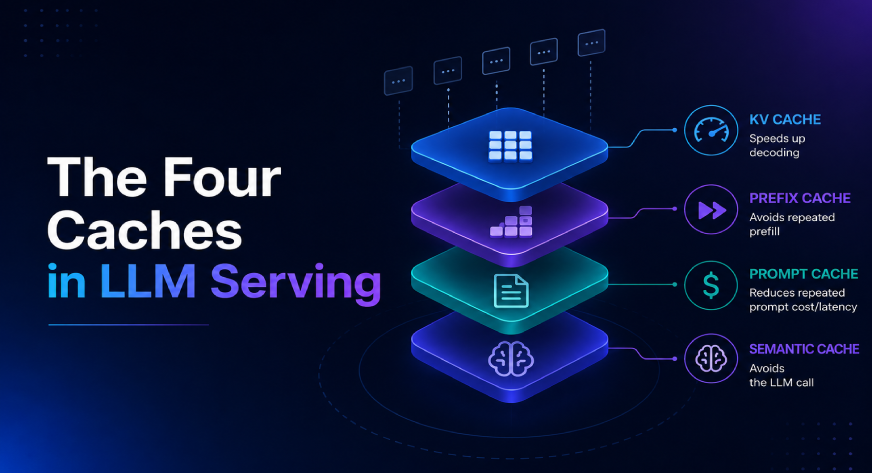
Every time an LLM application feels sluggish or expensive, the culprit is usually the same: we are reprocessing information we have already seen. A single request can carry thousands, even millions, of tokens from system instructions, conversation history, retrieved documents, and tool definitions. That is a lot of repeated work. The authors are right to point out that caching is not just a performance nicety; it is the quiet engine behind cost efficiency and responsive interactions. For anyone building on top of these models, this is where the real leverage lives. It is not about making the model smarter. It is about making the system stop doing the same math twice.
This matters more as we push toward more complex agentic workflows. The same way Unlock LLM Training: A Practical Guide to Distributed Algorithms shows that distributed training is fundamentally about coordinating parallel work, caching is about understanding what can be safely reused across sequential steps. Neither is glamorous. Both are essential. The breakdown of the four cache types gives us a mental model that most people skip: the difference between caching system prompts, conversation history, retrieved context, and tool definitions. Each layer has different invalidation rules and different cost profiles. Getting that mix wrong means either paying for tokens you did not need or serving stale information that confuses the model. That balance is the craft.
What we appreciate most is that caching is treated as an architectural discipline, not a vendor feature. It is a perspective that aligns with how we think about Exploring Paragraph Structure: How LLMs Navigate Token Space, where the structure of input directly shapes model behavior. If you understand how tokens are organized, you can start making deliberate choices about what to keep warm and what to let expire. The same logic applies to Unlock ChatGPT for Work: A Practical Guide to Getting Started: the more intentional you are about context, the better the output. Caching is just the system-level version of that same discipline.
Our take for anyone reading: do not treat caching as an afterthought. If you are building an LLM application, start by mapping out which tokens are static, which are recurring, and which are truly ephemeral. The difference between a tool that feels instant and one that feels sluggish is rarely raw model speed. It is usually how well you avoid repeating yourself. The vocabulary to have that conversation is provided. The next time you profile a slow endpoint, look at the cache hit rate first. That number will tell you more about your architecture than any benchmark. It is the most practical metric you are likely not tracking yet.