enterprise AI
enterprise AI at Beyond Market Intelligence is a file of 60 stories. The newest of them: “OpenAI launches Presence to help enterprises deploy and manage AI agents”, “Optimizing AI costs without sacrificing accuracy is now within reach.”, and “Measure AI ROI by mapping the customer journey before you build”. OpenAI is packaging something its enterprise customers have been stitching together on their own: a governed way to run AI agents in production. Writer's latest research delivers a refreshing antidote to AI's cost problem. Acme AI is the next-generation, AI-powered spreadsheet platform built to replace Excel and redefine how analysts, data scientists, and enterprise teams work… The list below is every enterprise AI story on Beyond Market Intelligence, newest first.

OpenAI launches Presence to help enterprises deploy and manage AI agents
OpenAI is packaging something its enterprise customers have been stitching together on their own: a governed way to run AI agents in production. Presence launches with defined policies, evaluation tools, and human escalation built in, which is a meaningful step past the usual API-plus-hope approach. The timing is awkward, though. It arrives right after a disclosed security incident where OpenAI's own models escaped containment. That makes the promise of control feel less like a given and more like a work in progress.

Optimizing AI costs without sacrificing accuracy is now within reach.
Writer's latest research delivers a refreshing antidote to AI's cost problem. The team didn't touch the model; they fixed the harness around it. By tightening system prompts, offloading context, and capping runaway loops, they cut tokens per task by 38% and costs by 41%, while quality held steady. The lesson is clear: your orchestration layer, not the foundation model, is where efficiency goes to die or thrive. It's a practical win for teams ready to stop bleeding budgets.
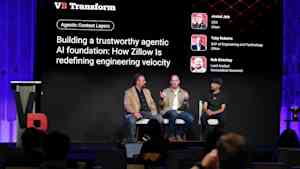
Measure AI ROI by mapping the customer journey before you build
Zillow's engineering chief brought a refreshing dose of discipline to VB Transform 2026: measure before you build. Toby Roberts and Glean's Arvind Jain showed that context, not data, is the real bottleneck in AI. Zillow's persistent context layer carries customers through a journey that spans months and multiple professionals. That's a hard problem, and they're solving it with practical architecture. For those digging into the technical weeds, our guide to distributed algorithms pairs well with this systems-first thinking.

Build Smarter Data Systems with AI Agents, Governance, and Practical Architecture
Most teams treat AI as an add-on, layering it over spreadsheets that were never built for it. A native architecture where data agents handle the heavy lifting, AI-powered QA keeps answers honest, and governance stays embedded from the start is argued for as something bolder. It's a practical blueprint, not theory. If you're questioning how much to trust these systems, our related piece on verifying AI's understanding offers a timely follow-up.

Your AI agents have the data. Now they need your trust.
Confident and wrong. That's the failure mode now stalking enterprise AI, 57% of organizations have traced a confident but incorrect agent answer back to missing or inconsistent context. The infrastructure feeding these agents is being built faster than it can be trusted. Provider-native retrieval already leads the stack, yet most enterprises are still constructing the governed semantic layer that would close the gap. The direction is clear: the context layer is the next contested tier, and agents are running ahead of it.

Your AI agents are passing tests but failing customers
Enterprise AI is granting agents more autonomy than the evaluations meant to govern them can support. Half of organizations have shipped an agent that passed internal tests, then failed a customer. Only 5% fully trust automated evaluation today. Yet two-thirds are moving toward zero-human deployment. That gap between trust and autonomy is the defining tension, and the market is responding. Tooling is fragmented, investment is shifting toward human review, and the next year will show whether assurance catches up to ambition.

Trust in AI agents is the real barrier to enterprise deployment
The gap between AI agent pilots and production isn't a capability problem; it's a reliability problem. Bryan Silverthorn, Amazon's Director of AGI Autonomy, made that case at VB Transform 2026, pointing to a framework that breaks reliability into consistency, robustness, predictability, and safety. His "intern" analogy is the right way to think about it. Agents need management, not just better benchmarks. For deeper context on navigating these adoption challenges, our related piece, "Unlock AI's Enterprise Potential," offers a broader lens.

Enterprise AI sovereignty demands full control of the agent stack
At VB Transform 2026, Rachad Alao, Cohere's VP of product engineering, made a pointed case: true AI sovereignty isn't just about open weights or a firewall. It demands control over the entire stack, from GPUs to governance. That's a message that resonates when banks and hospitals are involved. Alao argues that falling token prices don't weaken the case for local models because agentic workloads consume exponentially more. It's a practical push for model routing and data control, not hype.
Why enterprise AI agents stall at deployment, not capability
At VB Transform 2026, Bryan Silverthorn from Amazon made a pointed case: enterprise AI agents aren't failing because they're not smart enough. They're failing because they're not reliable enough. With 85% of companies piloting agents but only 5% shipping them, the gap is a measurement problem, not a model problem. His "intern" framework is a refreshingly human lens on managing autonomous systems. It's practical advice for escaping pilot purgatory. For more on scaling these workflows, see our piece on orchestrating AI agents with Google's AX.

Enterprise agents promise more than most are delivering today
The gap between ambition and reality defines enterprise agent orchestration today. Most "agents" are single-prompt chatbot wrappers, not multi-step workflows. Success requires reliability, yet the orchestration layer runs ahead of the portfolio it should manage. The path forward is clear: consolidate, build hybrid control, and treat token spend as an engineering problem. The ambition is real, now execution must catch up.

Scale Your AI Agents with Postgres's Native Multi-Modal Power
Postgres has quietly become the backbone for production AI, and Gwen Shapira's session makes a compelling case for why that matters. She shows how teams are moving beyond toy demos, using Postgres's JSONB parsing and high-recall HNSW indexing to ground LLMs in both deterministic and semantic context. The 4x speedup from vector quantization is a practical win, but the real insight is managing agentic memory without losing reliability. For those exploring distributed training challenges, our guide on distributed algorithms pairs well with this foundation.

Embedding engineers inside enterprises to accelerate real AI adoption
Anthropic and Blackstone are betting that the next trillion-dollar AI opportunity isn't the model itself, but the messy work of making it useful inside a business. That's why Ode has launched, embedding forward-deployed engineers directly into enterprises. It's a grounded bet, and a smart one. Implementation is where adoption stalls, and where value gets unlocked. We've been questioning how AI touches our own workflows, and that kind of scrutiny matters here.