enterprise AI
enterprise AI at Beyond Market Intelligence is a file of 60 stories. The newest of them: “VentureBeat expands enterprise AI analysis with new lead analyst hire”, “When Commerce AI Outpaces Integration, Outcomes Falter”, and “Building Trust into AI: Secure Architecture for Enterprise Agents”. VentureBeat is doubling down on enterprise AI research with the appointment of Rob Strechay as its first Lead Analyst. Enterprise AI investment in commerce is at an all-time high, yet outcomes remain wildly inconsistent. Acme AI is the next-generation, AI-powered spreadsheet platform built to replace Excel and redefine how analysts, data scientists, and enterprise teams work… The list below is every enterprise AI story on Beyond Market Intelligence, newest first.
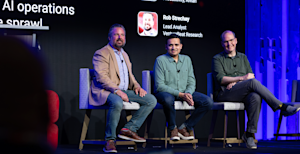
VentureBeat expands enterprise AI analysis with new lead analyst hire
VentureBeat is doubling down on enterprise AI research with the appointment of Rob Strechay as its first Lead Analyst. Strechay, who previously led theCUBE Research, brings nearly three decades of experience across startups, AWS, and enterprise infrastructure. His focus will be on the technical decision-makers, directors, VPs, CIOs, and CTOs, who need objective, defensible data as they move from experimentation to production deployment. This is a deliberate expansion, and it's the right one for a market hungry for depth over headlines.

When Commerce AI Outpaces Integration, Outcomes Falter
Enterprise AI investment in commerce is at an all-time high, yet outcomes remain wildly inconsistent. That gap isn't accidental; it's the predictable result of layering point solutions that were never built to work together. Each tool performs well in isolation, but the system leaks intent at every handoff. The fix isn't another add-on. It's architectural coherence. Brands that build that connective tissue now will compound their advantages. Those that don't will watch agentic commerce expose every fracture. The window to act is closing.

Building Trust into AI: Secure Architecture for Enterprise Agents
Taking an AI agent from prototype to production is where the real test begins. This piece tackles the often-messy transition head-on, focusing on the responsible AI, security, and governance layers that keep enterprise deployments safe. It's a grounded look at building trust into the architecture itself, not bolting it on later. For those wrestling with similar scaling challenges, it pairs well with our broader coverage on agentic workflows. We appreciate the clarity here, as it makes a complex subject feel genuinely approachable.
IBM trains thousands of consultants to deliver AI-powered business solutions
IBM is putting its money where its roadmap is. The company will train and certify tens of thousands of consultants on OpenAI's technologies, a move that signals real commitment to enterprise AI adoption. It's a practical step toward making advanced tools feel less like abstract concepts and more like everyday workflow partners. For businesses still wrestling with legacy spreadsheets, this partnership could demystify the path forward.

Enterprise AI agents gain smarter control as token costs drop by 52 percent
Enterprises watching AI agents multiply across their workflows have hit a wall: token bills that climb with every autonomous task. Writer's new Palmyra X6 model attacks that problem head-on, cutting agent costs by 52% while improving speed by 48% and quality by 10%. The real news isn't just the numbers, it's the strategy. By post-training an open-weight base model on just 626 curated examples, Writer proves the enterprise AI race isn't about building from scratch.

The hybrid AI control plane is already here, and it runs on three platforms
Enterprises don't choose one orchestration platform, they run three, on average, and they pick them for flexibility, not loyalty to any single model. Microsoft leads current usage, but Anthropic dominates forward consideration by a wide margin. The real gap: 21% can't stop a runaway agent in real time, and most admit their "agents" are still chatbots. The next move is clear, invest in monitoring and permissions, because control, not capability, is what's actually at stake.

Seeing work as it happens, Skan AI maps the missing layer for enterprise intelligence.
Enterprise AI has a context problem. Skan AI's $63 million raise targets that gap directly, betting that the messy reality of how work happens, not the clean documentation, is what models need to finally deliver. The company's screen-level observation builds a living map of process, turning friction into measurable savings. It is a smart bet on a simple truth: the smartest model is useless if it is blind to how your business actually runs.

Mature platform engineering unlocks sustainable AI value for enterprises.
Perforce's 2026 Platform Engineering Report makes one thing clear: maturity in this space now separates AI experiments from operational wins. The report's findings suggest organizations that treat platform engineering as a strategic discipline are better positioned to turn AI adoption into lasting value. That's a practical, grounded perspective we can get behind. For a related look at how AI behaves in practice, our piece "Talking to My AI Clone Taught Me to Question the Tech" offers a useful counterpoint worth exploring.

Asana's AI agents share team memory without exposing your secrets
Asana's new Agentic Work Management platform attacks a real problem: AI agents that can't remember what happened five prompts ago. The company built AWM on its 18-year-old Work Graph, turning a static database into shared memory for AI teammates. That's the smart bet, context is the moat, not the model. Bose's guardrail for confidential projects is the detail worth noting; it keeps shared memory from leaking into unauthorized hands. For teams tired of stateless chatbots, this is a practical path forward.

From Chatbots to Operational Intelligence: Building Agents That Scale
Enterprises don't fail to scale AI because the models aren't smart enough; they stumble on the messy reality of their own systems. Arun Joseph brings that truth to life with real-world lessons from scaling Deutsche Telekom's LMOS. He tackles the organizational fault lines head-on, advocates for replacing tool sprawl with core platform abstractions, and pushes beyond basic chatbots toward operational intelligence. His work with ephemeral agents and an Agent Definition Language makes this a practical, human-centered look at what's actually required.

June raises $20 million to make AI deployment simpler and more accessible
June emerged from stealth today with a $20 million pre-seed round, a clear signal that Marc Benioff-backed investors see real potential in simplifying AI adoption. The startup's premise is refreshingly direct: the hardest part of AI isn't building it, it's deploying it without drowning in complexity. That resonates. We've explored the human side of these tools before, like in our piece on questioning AI clones, and this feels like a natural next step.

Observability without compromise: keep your AI agent data in your cloud.
AI agents are generating telemetry faster than most enterprises can afford to store it, and that tension is reshaping one of software's most competitive markets. groundcover's $100 million raise signals a bet that the old architecture, where vendors charge by data volume, no longer fits an AI-driven world. Its BYOC model keeps data in your cloud, priced by hosts, not ingestion. Whether that thesis holds is unclear. But it's a practical challenge to incumbents, and a compelling reason to rethink how observability should work.

AI adoption matures as enterprises discover where real returns live
Enterprise AI is finally showing measurable returns, with the SAP Value of AI Report 2026 revealing that AI now powers nearly 30% of tasks in the average organization. That progress comes with a sharper appetite: expected returns on agentic AI jumped from 10% to 17% in a year. Still, most leaders admit the technology isn't reaching its full potential. The bottleneck isn't access to newer models, it's strategy, data quality, and governance.

The talent gap in AI narrows to just 2,000 engineers who deliver results.
Two thousand engineers. That's the entire talent pool equipped to turn enterprise AI investments into tangible returns, according to a new study. As organizations scramble to deploy AI at scale, the forward-deployed engineer has become the industry's most sought-after role. We see this as a healthy correction. It signals a move past hype and toward practical implementation, where understanding user needs matters as much as model architecture.

Beyond identity: securing enterprise AI agents for real-world resilience
Shared credentials are a known risk, but at VB Transform 2026, NTT DATA AIVista and Snowflake made the case that fixing identity alone won't secure enterprise AI agents. Mukesh Karki and Mayank Upadhyay argued for action-level authorization and tamper-resistant audit trails built into every interaction. That provability, as Karki put it, is your license to operate. It's a practical framework for scaling autonomous systems safely, and it pairs well with our coverage of recent agentic security incidents.

As AI agents multiply, identity security becomes the new frontier.
The conversation around enterprise AI security is no longer about protecting models from attack. It's about governing the identities of the autonomous agents now acting inside production systems. Hush Security's $30 million Series A signals that shift clearly. The company argues that as agents spread, from coding assistants to custom-built software, the control plane must be identity itself. That means moving beyond static credentials to broker short-lived, task-specific access. It's a practical response to a pressing question: who, exactly, is responsible for an agent's actions?

Meta expands enterprise AI beyond agents into APIs and internal tools
Mark Zuckerberg sees Meta's enterprise opportunity as far bigger than selling AI agents. On the company's second-quarter earnings call, he pointed to a broad field spanning APIs, compute, and internal software. That is a smart read of the market. Businesses do not need one flashy tool; they need practical infrastructure that fits how they already work. If you want to question how far this technology should go, our piece "Talking to My AI Clone Taught Me to Question the Tech" offers a useful counterpoint.

Building the missing backbone for enterprise AI agent trust and coordination
Enterprise AI agents are hitting a wall: they can't talk to each other, can't be trusted with permissions, and can't be audited. Five startups are already closing that gap, and their timing is sharp. The infrastructure for orchestration, observability, connectivity, and security is the real bottleneck, not the agents themselves. BAND coordinates multi-agent workflows, while Conifers speeds up cyber defense. Raindrop AI logs agent actions, and Arcade handles authorization. Omilia tackles customer experience. This is where the work gets practical, and necessary.

Nimble launches specialized AI agents to make enterprise web searches smarter.
Nimble is rolling out Web Search Agents, a new retrieval system designed to cut token costs by 51% while boosting retrieval accuracy by 21% for domain-specific enterprise workloads. The New York City startup's approach pairs self-learning retrieval algorithms with proprietary indexes and live web access, moving beyond generic search APIs to learn each customer's domain. This launch targets developers building autonomous agents, positioning retrieval infrastructure, not model quality, as the next competitive battleground.

Build your own AI layer or risk losing control of your data future.
Satya Nadella's warning cuts to the heart of the AI rush: lean on a single model for everything, and you might not survive the decade. He's right to push for ownership, whether that means building your own models or layering in AI gateways to keep your prompts separate from the model itself. It's not about tech for tech's sake; it's about control and adaptability. If you're questioning how deep this dependency runs, our piece on talking to an AI clone offers a timely reality check.

Enterprises race to buy AI compute without tracking what it costs
The compute gap isn't about buying more, it's about seeing what you already own. Across 107 enterprises, GPU utilization sits at 50% or less for 83%, yet 64% plan to switch or add providers within the year. That tension defines the moment: spending is accelerating ahead of measurement, with fewer than half tracking costs rigorously. The next wave of infrastructure decisions will be shaped by visibility, not capacity. Those who close this gap first will steer their AI economics with confidence.
Your AI agent passed your tests. Then it failed your customer.
Enterprise AI is granting agents more autonomy than the evaluations meant to govern it can support. Half of organizations have shipped an agent that passed internal tests, then failed a customer. Only 5% fully trust the automated evaluations in use today. The most-cited weakness: evaluations align poorly with real-world outcomes. Yet two-thirds are already deploying on automated results alone, or engineering toward it. That gap between autonomy and assurance is where failures scale.
Many enterprise agents are chatbots, not the orchestrated future you need.
Enterprise AI has a deployment problem, not a platform problem. Across 101 enterprises, most "agents" are still chatbot wrappers, 71% admit a quarter or fewer handle true multi-step work. The ambition is real: hybrid control planes dominate by 2026, and lock-in fears drive the architecture. But the gap between strategy and shipped reality is the story. Explore how model gravity shapes platform choice, yet leaves the hardest work, reliable execution and fiscal control, still waiting for the build-out.
Enterprise AI Trust Falls Faster Than Context Infrastructure Is Built
Enterprise agents are answering with confidence their context can't yet support. New Pulse Research across 101 enterprises shows 57% have traced a confident-but-wrong answer to missing or inconsistent data, yet retrieval is already the default context source for 38% of organizations. The fix, a governed semantic layer, is under construction: 58% are building or running one, but most haven't shipped it. Provider-native tools lead today, even as enterprises insist they want independence. The context gap isn't a retrieval problem.