enterprise data management
enterprise data management at Beyond Market Intelligence is a file of 315 stories. The newest of them: “Enterprise agents promise more than most are delivering today”, “Inkling gives enterprises an open, customizable AI model built for control.”, and “From prompt to publish: Canva puts AI website building in every user's hands.”. The gap between ambition and reality defines enterprise agent orchestration today. Thinking Machines has entered the open-weight arena with purpose. Acme AI is the next-generation, AI-powered spreadsheet platform built to replace Excel and redefine how analysts, data scientists, and enterprise teams work… The list below is every enterprise data management story on Beyond Market Intelligence, newest first.

Enterprise agents promise more than most are delivering today
The gap between ambition and reality defines enterprise agent orchestration today. Most "agents" are single-prompt chatbot wrappers, not multi-step workflows. Success requires reliability, yet the orchestration layer runs ahead of the portfolio it should manage. The path forward is clear: consolidate, build hybrid control, and treat token spend as an engineering problem. The ambition is real, now execution must catch up.

Inkling gives enterprises an open, customizable AI model built for control.
Thinking Machines has entered the open-weight arena with purpose. Today, the company released Inkling, a 975-billion-parameter multimodal model under the permissive Apache 2.0 license. Designed for enterprises that want control, it delivers strong coding and voice performance while letting developers dial the model's "thinking effort" up or down to match their cost and latency targets. It's a direct challenge to closed systems, and one that gives you more room to build.

From prompt to publish: Canva puts AI website building in every user's hands.
Code is about to get a lot more visual. Canva Code 2.0 brings AI-powered website building to every user, including free accounts. The focus isn't just on generating functional code but on making the output genuinely yours. With drag-and-drop editing and direct access to Canva's design library, the gap between a raw prototype and a polished, on-brand experience just closed significantly. It's about giving everyone the tools to build something that looks like it came from them.

Manage AI spending with the same confidence you secure your passwords.
Token spend is becoming the next enterprise budget crisis, and 1Password is moving to put IT and finance teams back in control. Its new AI Spend and Consumption Management capability, embedded in SaaS Manager, delivers a unified, real-time view of consumption across Anthropic, Cursor, and OpenAI. This isn't about cutting costs blindly; it's about building the visibility needed to direct AI investment toward what actually drives business value.

Agent-as-a-Router brings dynamic intelligence to enterprise AI model selection.
Static routing has a blind spot: it never sees whether a model actually succeeded. ACRouter fixes that by letting the router learn on the job. Its C-A-F loop tracks execution outcomes, turning each failure into a smarter decision. The result is a 2.6x cost saving over Opus-only setups, with no accuracy sacrifice. This is a practical step toward self-optimizing AI infrastructure. For teams tired of hard-coded rules, it's worth exploring how this approach fits your stack.

How Kubernetes brings order to desktop infrastructure chaos
For years, enterprise infrastructure teams have converged on Kubernetes for application deployment, reaping benefits like declarative configuration and automated scaling. However, secure desktop and application delivery—critical for remote work and regulated industries—has remained an operational outlier. Kasm Technologies addresses this split, offering a Kubernetes-native workspace platform that aligns desktop infrastructure with modern cloud practices. Explore how Kasm empowers platform teams and enhances security, as demonstrated by organizations leveraging similar strategies for AI/ML development environments.

Enterprise AI runs at half capacity as controls lag behind deployment
Wall Street's AI buildout debate has been answered: a VentureBeat Research survey of 573 technical leaders reveals that 86% of enterprises run their GPUs at half capacity or less – a clear sign of current infrastructure utilization. This highlights a critical gap: enterprises are deploying AI agents ahead of robust control measures, with many relying on single-prompt chatbots rather than true multi-step agents.

ChatGPT Work turns your AI assistant into an autonomous task manager
OpenAI introduces ChatGPT Work, a cloud-based AI agent poised to transform how professionals leverage AI. Embedded within the flagship chatbot, this new platform moves beyond simple Q&A, autonomously managing tasks across email, Slack, and calendars using the advanced GPT-5.6 model. ChatGPT Work streamlines workflows by generating documents, spreadsheets, and even websites, demonstrating OpenAI's commitment to democratizing agentic AI capabilities – a strategy highlighted by their recent confidential SEC filing.
When AI Agents Sound Certain, Missing Context Is the Real Error
A surprising 57% of enterprises have experienced AI agents delivering confidently incorrect answers, a trend highlighted in a recent VentureBeat survey. The root cause isn't model failure, but rather a deficiency in the business context provided—often stemming from reliance on retrieval systems prioritizing ease of use over accuracy. The solution? A governed, agentic context layer—a shared model of business data—is gaining traction, with 75% of enterprises currently lacking one. As Apple's recent legal action against OpenAI demonstrates, ensuring data integrity is paramount.

Google's TabFM predicts on unseen tables without per-dataset training.
Google Research’s TabFM offers a transformative approach to tabular data prediction, bypassing the traditional need for per-dataset training. This innovative foundation model treats tabular prediction as an in-context learning problem, enabling instant predictions on unseen tables with a single API call – a significant acceleration for enterprise developers. By synthesizing strengths from prior architectures, TabFM preserves data structure and unlocks scalable zero-shot prediction, potentially redefining data workflows.

Shared API keys create blind spots in 69% of enterprise AI agents
VentureBeat's latest research reveals a concerning trend: 69% of enterprises are exposing AI agents through shared API keys, creating a significant security vulnerability. A single compromised agent can inherit the permissions of up to five others, effectively erasing the forensic trail at the credential level. This exposure is driving a $22 billion acquisition spree from industry leaders like Palo Alto Networks and CrowdStrike, highlighting the urgency of addressing this gap.

Your enterprise AI strategy needs more than one interface
Enterprise AI adoption isn't about a single interface—it's about adapting AI to diverse business needs. Presented by Oracle NetSuite, this exploration reveals why assuming a universal conversational system underestimates how organizations leverage new technologies. From finance teams prioritizing accuracy to analytics groups seeking flexible data exploration, different departments require tailored solutions. NetSuite’s AI Connector Service and Model Context Protocol empower businesses to connect data securely to existing workflows, ensuring AI enhances, rather than disrupts, established operations.

From Code to Confidence: Why Enterprise AI Needs More Than Generation
The promise of AI code generation is undeniable, yet a stark reality persists: most organizations fail to translate prototyping success into enterprise-grade execution. SAP's Michael Ameling observes that 81% strategize for AI, yet only a fraction achieve operational deployment, revealing a critical gap beyond code quality. Successfully integrating AI-generated logic into complex, legacy systems demands foundational data readiness, robust governance, and a shift in developer roles—a challenge amplified by AI’s very power. Discover how to bridge this gap and unlock true enterprise value.

ChatGPT learns to listen and speak at the same time, like a real conversation
OpenAI has launched GPT-Live, a significant upgrade to ChatGPT’s voice capabilities, fundamentally redesigning how users interact with the AI. Featuring a full-duplex architecture, GPT-Live allows for simultaneous listening and speaking, mimicking natural human conversation and eliminating frustrating delays. Rolling out globally today, GPT-Live prioritizes a more fluid, intuitive experience, particularly for paid users, and introduces visual cards for enhanced interaction.

Slackbot now pulls your CRM data and charts directly from a chat message
Unlock a new level of productivity with Slack’s latest integration, connecting Slackbot directly to the Salesforce platform. Now, from a simple chat message, you can pull CRM data, generate insightful charts, and even send DocuSigns—all without leaving Slack. This marks a significant step toward a unified system, leveraging Salesforce’s extensive data and AI capabilities within the familiar Slack workspace. Discover how this transformative change can streamline workflows and empower your team, echoing insights explored in our recent article, "Information Theory and Ensemble Models."

How AI leaders turn data access into a decisive enterprise advantage
Enterprise AI adoption is accelerating rapidly, with 64% of organizations now identifying as "advanced" or "leading edge" – a dramatic shift from just 8% a year ago. According to a new Box report surveying 1,640 IT decision-makers, the key differentiator isn’t simply adopting AI, but rather robust content governance and platform flexibility. Leading companies consistently achieve higher ROI, demonstrating that structured AI implementation, rather than just experimentation, unlocks transformative business impact. Discover how to prioritize these elements and accelerate your own AI journey.

Claude Cowork expands beyond coding to empower every knowledge worker.
Anthropic is expanding the reach of Claude Cowork with a mobile and web launch, driven by compelling usage data demonstrating its broad appeal. Contrary to the narrative surrounding developer-centric AI, data reveals that the majority of Cowork users leverage the tool for "the work around the work"—business processes, content creation, and information assembly—rather than coding. This strategic shift positions Anthropic to capture a significantly larger market of knowledge workers, empowering them to transform their productivity across devices, even offline.

Trunk Tools cuts document review by 50 days with specialized AI architecture
Construction data presents a unique challenge: most general-purpose AI models struggle with the industry’s jargon-dense, abbreviation-heavy documents. Trunk Tools addresses this by building a specialized, three-layer architecture—perception, semantics, and agents—to transform data chaos into agent-ready workflows. This purpose-built stack has dramatically reduced document review cycles from months to days and prevents costly field errors.

Why smart enterprises diversified their AI strategy before Fable 5 vanished
The recent, weeks-long outage of Anthropic’s Claude Fable 5 underscores a critical shift in enterprise AI strategy. New VentureBeat Pulse Research reveals that two-thirds of organizations have already implemented a hedging posture, blending closed frontier models with open-weight alternatives or moving workflows entirely off closed APIs. This proactive stance highlights growing concerns about vendor dependency and the need for greater control. Enterprises are actively prioritizing resilience and flexibility, recognizing that reliance on a single model carries significant risk—a lesson reinforced by the unexpected disruption.
Design AI interfaces around user intent, not just chat
The rush to integrate AI often defaults to chat interfaces, overlooking a fundamental principle of user experience: matching modality to intent. Simply because Large Language Models thrive on dialogue doesn’t mean every AI capability should be presented conversationally. Great UX prioritizes the user, adapting the interface to their context and cognitive load. Explore how shifting beyond conversational tunnel vision unlocks more intuitive and effective data interactions—as discussed further in "Users Don’t Need More Tools: They Need Seamless Integrations."

How Morgan Stanley sped up reconciliation by keeping humans closer to the process
Morgan Stanley dramatically accelerated a critical reconciliation process—profit and loss (P&L) reconciliation—by deploying an internal AI agentic system called FIXR. Counterintuitively, the firm achieved a 50% reduction in processing time by prioritizing human oversight and iteratively incorporating controller decisions into automated rules. This "co-worker" approach, rather than a fully autonomous model, unlocks complex organizational workflows and exemplifies a shift toward process-first AI implementation, as highlighted by Morgan Stanley’s Managing Director, Todd Johnson.
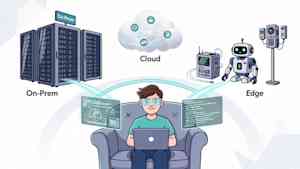
Give your AI agents the context they need, everywhere decisions happen
The competitive landscape for enterprise AI is rapidly shifting, with context becoming the defining differentiator. Platforms that can deliver the right memory, retrieval, and data at the precise moment of decision are gaining a crucial edge. Couchbase’s new AI Data Plane directly addresses this need, combining persistent agent memory, real-time context retrieval, and an enterprise-managed server.

Google delivers faster, cost-effective image generation for enterprise teams
Google today introduces Nano Banana 2 Lite (NB2 Lite), designated Gemini 3.1 Flash-Lite Image, a significant advancement in AI image generation designed for enterprise efficiency. This model delivers images in a remarkably fast 4 seconds at a competitive $0.034 per 1,000 images. Optimized for high-throughput workflows, NB2 Lite outperforms its predecessor while offering cost savings compared to other Gemini models. Explore its capabilities now via Google AI Studio, the Gemini API, and GEAP—a practical solution for rapid prototyping and automated asset generation.

Meituan unveils LongCat-2.0, the open-source coding model built on Chinese chips
Meituan has unveiled LongCat-2.0, a 1.6-trillion-parameter Mixture-of-Experts (MoE) agentic coding model now openly available on GitHub, Hugging Face, and its platform. This near-frontier model, previously powering the anonymous "Owl Alpha" which topped OpenRouter charts, disrupts enterprise AI dominance with a permissive MIT license and a unique 1-million-token context window. Notably, LongCat-2.0 was trained entirely on Chinese-manufactured chips, signaling a potential shift in AI infrastructure. Explore its competitive pricing structure and discover how it’s reshaping autonomous software engineering, as detailed in related