improvement
3 stories filed under improvement on Beyond Market Intelligence. The newest of them: “Unlock Team Momentum by Removing the AI Data Bottleneck”, “5 Principles for Enterprise Agent Systems Built to Earn Trust”, and “Tame Small Language Models by Constraining Their Output Space”. Data silos are quietly stalling even the most ambitious teams. A $100M+ company runs on its spreadsheets, and when I built an agent system to handle those workflows, I learned trust isn't a feature, it's the foundation. Acme AI is the next-generation, AI-powered spreadsheet platform built to replace Excel and redefine how analysts, data scientists, and enterprise teams work… The list below is every improvement story on Beyond Market Intelligence, newest first.
Unlock Team Momentum by Removing the AI Data Bottleneck
Data silos are quietly stalling even the most ambitious teams. When information is locked away, momentum dies. We see the same friction surfacing across industries, from inflated broker fees to the hidden costs of AI in hospitals. The fix isn't more tools; it's removing the bottleneck at the source. For a deeper look at how misplaced AI spending creates new problems, revisit our piece on rising hospital costs. For now, explore how clearing the data path can transform your team's workflow.

5 Principles for Enterprise Agent Systems Built to Earn Trust
A $100M+ company runs on its spreadsheets, and when I built an agent system to handle those workflows, I learned trust isn't a feature, it's the foundation. This post breaks down five principles that decide whether such systems survive production, from verifiability to continuous improvement. It's a grounded look at what actually works. If you're questioning how much to rely on AI outputs, our piece "Verify Your AI's Understanding" pairs well with this. Explore how to build agents people will actually use.
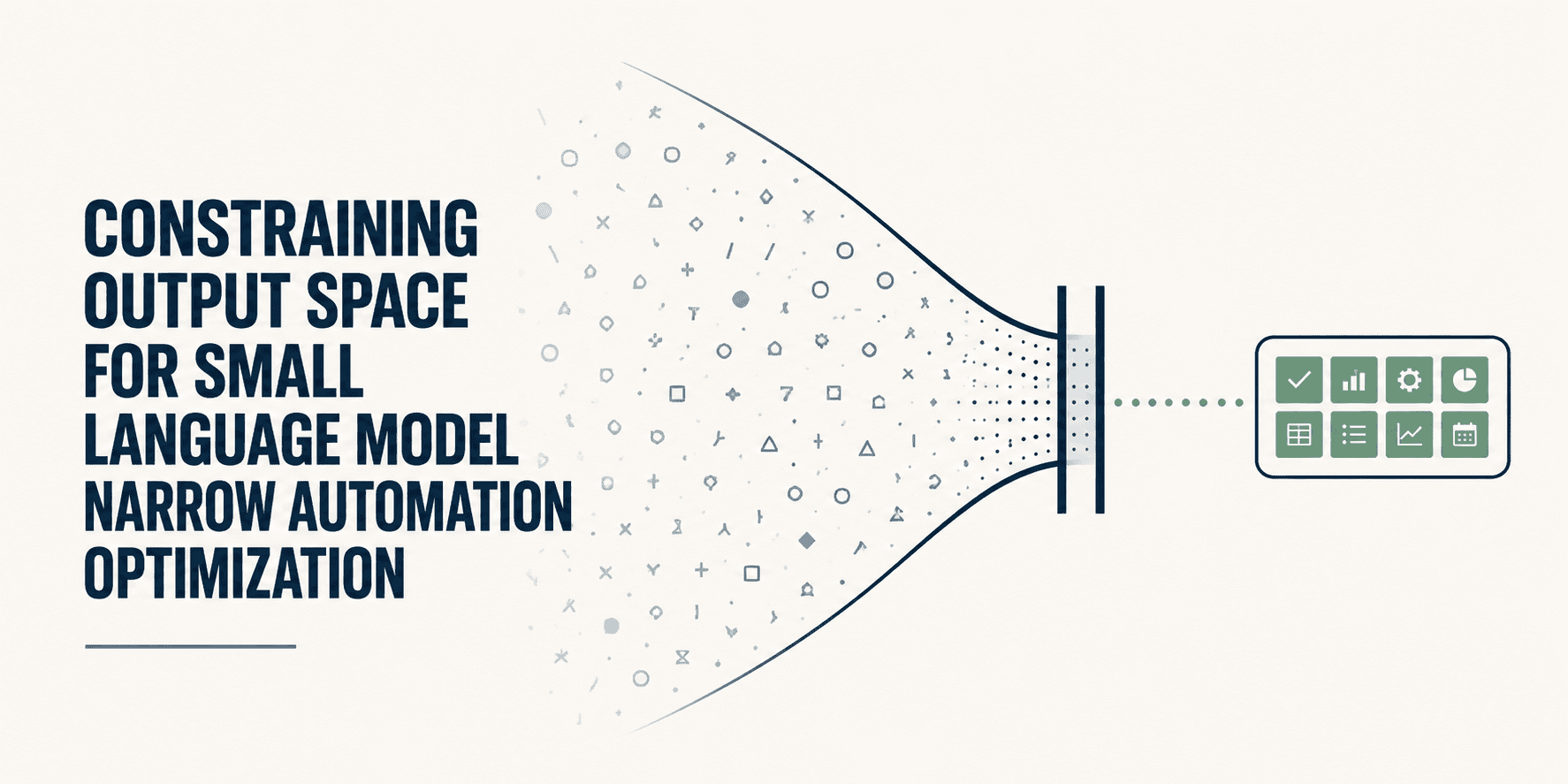
Tame Small Language Models by Constraining Their Output Space
Parsing generated text is a losing game. Every format variation you forget to handle becomes another silent failure. This first entry in our narrow automation optimization series tackles the real solution: constraining the output space from the start. It's a practical technique that saves time and spares you the headache of brittle regex. For a broader take on connecting systems, our piece on bridging retrieval and action offers a useful companion. This approach is simpler than it sounds, and it works.