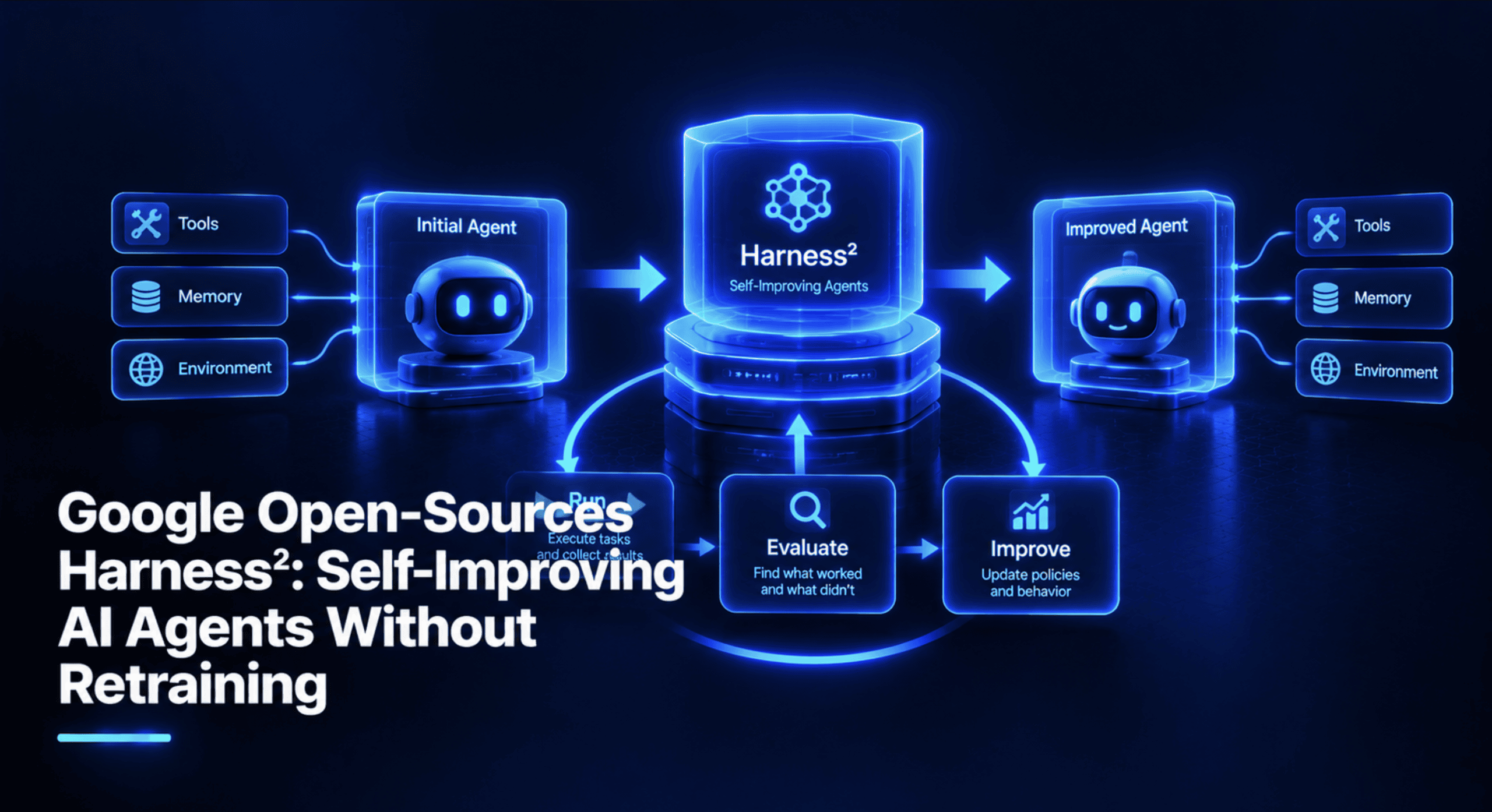
The most practical advance in AI agents right now isn't a bigger model, it's a system that lets agents improve themselves without retraining. Google's Harness² achieves this through two recursive loops that refine prompts, tools, memory, and scripts while leaving model weights untouched. That distinction matters more than most headlines suggest.
We see this as a direct answer to a problem that has quietly limited AI adoption: static agents break the moment their environment shifts. A script that works today fails tomorrow because a tool API changes or a prompt drifts out of alignment. Harness² attacks that fragility by giving agents the ability to adjust their own instructions and resources in real time. The first loop handles immediate task feedback; the second loop reflects on broader strategies. Neither requires a new training run or a redeployment. For teams already managing dozens of agent workflows, this eliminates a recurring bottleneck, the manual intervention needed to keep agents useful after deployment.
This approach also raises questions about safety, a topic our coverage has explored in depth. Consider An AI-Discovered Vulnerability in PHP Shows the Risk of Progress. If an agent can sharpen its own tools, what stops it from rewriting a script that introduces a security gap? Google has designed Harness² with bounded loops and explicit constraints, but the recursive nature of the system demands careful governance. The same self-improvement that makes agents more capable can amplify mistakes if the feedback loops are poorly monitored. That tension is not a reason to avoid the technology, it is a reason to understand it before deploying it widely.
The practical takeaway for anyone building with agents is straightforward: you should test Harness² on a single, low-risk workflow this week. The free demo is live, and the barrier to entry is low. Run a simple agent, let it iterate through the two loops, and observe how its prompts and scripts evolve. That hands-on look will tell you more than any white paper can about whether this approach fits your stack. For organizations that have struggled to keep agents reliable across changing conditions, this is the most concrete path forward we have seen in months. It does not require a new model, a new vendor, or a new infrastructure layer. It requires a willingness to let the agent fix itself.
What remains to be watched is how this recursive method interacts with personalization, especially as tools like Your AI assistant now learns from your Google services to guide the drive begin integrating user-specific data. If an agent can refine its own memory and tools, and that memory includes personal information, the feedback loops gain a new dimension of complexity. Google has shown the mechanism works. The next question is who controls the boundaries.