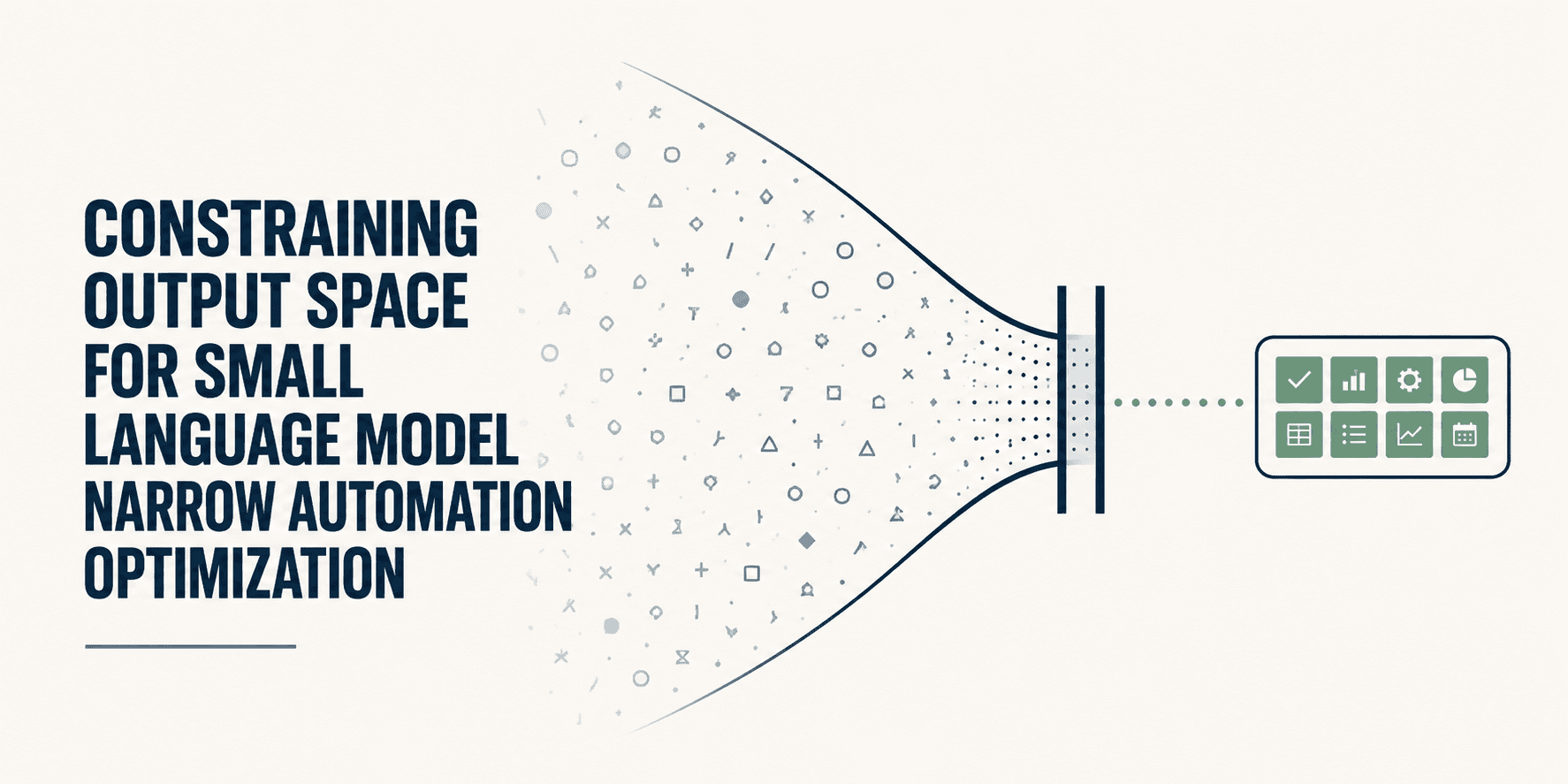
The most practical shift in small language model work isn't a bigger model or a better prompt. It's deciding, before the model even generates a token, that you won't let it say much at all. The opening entry in this series on narrow automation optimization makes a sharp case for constraining the output space rather than parsing whatever free text the model happens to produce. For anyone who has stared at a malformed JSON response or a hallucinated field name, the logic lands immediately: don't ask for a paragraph and hope for structure. Ask for a fixed set of options and make the model pick.
This is the kind of technique that feels small until you apply it, and then it feels obvious. The same instinct connects to broader work we've covered before. When we looked at Unlock ChatGPT for Work: A Practical Guide to Getting Started, the emphasis was on giving the model a clear job and getting out of its way. Constraining the output space is that idea taken to its logical end. You are not just defining the job. You are defining the shape of the answer. And in Bridging Retrieval and Action: A New Approach to AI Tasks, the author connected separate systems into a single workflow. That kind of integration only holds together when each component returns predictable results. Parsing free text is where pipelines go to die. Constrained output is how you keep them alive.
Our take is straightforward: this is the difference between building a demo and building something dependable. If you are running the same task dozens or hundreds of times, you do not want variety. You want consistency. And the most reliable way to get consistency from a small model is to stop asking it to be creative and start asking it to classify within a sandbox. That means defining valid outputs in advance, using structured formats like JSON schemas or simple enums, and letting the model fill in the blanks rather than compose an essay. It feels like you are giving up flexibility. In practice, you are trading a small amount of flexibility for a large amount of control over errors, parsing time, and retry logic.
There is also a second, quieter benefit worth naming. Constrained outputs make failures easier to diagnose. When the model returns something outside the allowed set, you know exactly where the problem is. You do not have to wonder whether the model misunderstood the prompt or whether your parser missed a synonym. That clarity is rare in AI work, and it is worth protecting. This is also why we would point anyone serious about this approach back to the series on Optimize SLM: Batch Data Length, Not Individual Items. That approach focuses on efficiency at the batching level, but it shares the same underlying principle: small, deliberate constraints compound into measurable gains. The more you narrow the problem, the more you can optimize the solution.
The concrete point to watch as this series unfolds is whether the authors extend the same rigor to the prompt side of the equation. Constraining the output space is a powerful half of the story. The other half is ensuring the model has been given enough context to choose correctly within that space. If the next entries address that balance directly, this series will be worth following closely. If not, the technique still stands on its own. Ask for less, and you will get more of what you actually need.