infoq
35 stories filed under infoq on Beyond Market Intelligence. The newest of them: “JDK 28 makes structured concurrency official with a clean upgrade path from JDK 27”, “Designing distributed systems for decisions, not just functions”, and “Aurora PostgreSQL Gains DuckDB's Analytical Power in New AWS Acquisition”. JDK 28 makes structured concurrency official, finalizing JEP 543 with no API changes from JDK 27. Microservices taught us to decompose functions. Acme AI is the next-generation, AI-powered spreadsheet platform built to replace Excel and redefine how analysts, data scientists, and enterprise teams work… The list below is every infoq story on Beyond Market Intelligence, newest first.

JDK 28 makes structured concurrency official with a clean upgrade path from JDK 27
JDK 28 makes structured concurrency official, finalizing JEP 543 with no API changes from JDK 27. Teams on the preview just need to drop `--enable-preview` and recompile. That's a clean upgrade path, exactly what a maturing feature deserves. Code from JDK 25 or 26 will require adapting to the `R_X` exception type parameter, `ExecutionException` wrapping, and the abstract `timeout()` joiner callback. For teams building toward agentic AI architectures, our piece on designing distributed systems for decisions offers useful context.
Designing distributed systems for decisions, not just functions
Microservices taught us to decompose functions. Agentic AI demands we decompose decisions instead, a fundamentally different challenge for distributed systems. Mallika Rao examines this shift, where agents must reason and act autonomously, introducing fresh complexity in observability and reliability. Legacy patterns break down here. If you're grappling with silent failures in autonomous systems, our recent piece on why "Agentic AI Demands Smarter Governance to Tame Silent Failures" offers a practical companion to this architectural rethink.

Aurora PostgreSQL Gains DuckDB's Analytical Power in New AWS Acquisition
Amazon's acquisition of DuckLabs signals a serious bet on analytical horsepower for its database ecosystem. By bringing DuckDB's co-founders Hannes Mühleisen and Mark Raasveldt under AWS, the company is investing in open-source innovation without compromising DuckDB's independent spirit. Aurora PostgreSQL now gains its first DuckDB-powered feature, blending transactional reliability with analytical speed. For anyone exploring how AI agents unlock hidden insights in compiled binaries, this move reinforces the value of purpose-built tools for modern data challenges.
Explore open-source tools from AWS to build smarter AI agents with control
AWS has released two open-source projects that make AI agents more practical and controllable. Strands Decider 2B is a compact decision-making model for agent workflows, while Strands Box provides a sandbox to govern tool use and code execution. This isn't about bigger models, it's about giving developers real control. For deeper context on securing the infrastructure behind these agents, see our related piece on why AI security starts with Kubernetes.
Design for Change: Keep Software Evolvable as Teams and Technology Shift
Software should adapt as teams and technology shift, static diagrams can't keep up. This edition of *Design for Change* explores agentic fitness functions that catch semantic drift, treats human comprehension as a core design metric, and builds cross-cloud guardrails for regional autonomy. It aligns technical boundaries with Conway's Law, turning change into something safe and intentional. For deeper coverage, Benchmark's piece on the fading rule against funding rivals offers a parallel look at how old constraints are giving way.

Spring Security 7 Simplifies DPoP and Token Exchange for Agentic Workflows
Spring Security 7 brings the Authorization Server directly into its own Maven coordinates, making the upgrade a straightforward version bump. The real news is how 7.1 simplifies DPoP and RFC 8693 Token Exchange for agentic workflows. Teams should note that 7.1 apps can silently stop enforcing DPoP until they explicitly call .dPoP(). Combining both mechanisms yields narrowed, sender-constrained tokens ideal for service-to-service calls. For a broader view of enterprise security challenges with AI adoption, see our piece on the unseen gap when everyone uses AI.

Cloudflare's K2 Beta Turns Object Storage Into a One-Second Event Stream
Cloudflare's K2 beta turns R2 object storage into a serverless event stream with roughly one-second produce latency at p99. That's a compelling shift for teams already invested in Cloudflare's ecosystem, though the 7.5-second end-to-end p99 reported by one tester suggests the full path still has room to tighten. Consume charges matching produce charges keeps pricing predictable. For deeper context on Cloudflare's AI ambitions, Clef offers a sharper decision-making model worth exploring.

Cloudflare resolves data leak risk across container boundaries
Recovering complete SQLite databases from a neighbor's container isn't a theoretical risk, it was a real vulnerability in Cloudflare's infrastructure. The company disclosed a cross-tenant data exposure flaw in Containers and Sandboxes, where thin-provisioned storage pools failed to zero reused blocks. Researchers pulled directory structures and database pages across four continents. Cloudflare fixed the issue and found no signs of exploitation. For more on how Cloudflare thinks about future-proofing security, explore their work on a quantum-safe path for internet security.

Cloudflare Builds a Quantum-Safe Path for the Future of Internet Security
Quantum-safe security isn't a future problem, it's a present concern that demands real action today. Cloudflare's new path toward post-quantum cryptography signals a mature, necessary shift in how we protect data against tomorrow's threats. This isn't about hype; it's about building trust into the internet's infrastructure from the ground up. For readers exploring how attackers can trick AI spreadsheets into ignoring instructions, the same principle applies: proactive defense matters more than reaction.

Explore Android's New Component-Level Security Patch Verification
A single device-wide security patch date tells you very little about actual risk. Google's new AndroidX Security State libraries change that by letting apps verify patch status at the individual component level. This granular approach empowers developers to make informed decisions about trust without relying on a blunt, system-level timestamp. It's a practical shift toward transparency and precision in mobile security. For more on active vulnerabilities, see our coverage of the exploited GitLab flaw risking unauthenticated data access.

Explore how an actively exploited GitLab flaw risks unauthenticated data access
CVE-2026-85706 has moved from theoretical warning to confirmed exploitation, and that changes the urgency for every self-managed GitLab instance. This critical path-traversal flaw lets an unauthenticated remote attacker read arbitrary files, exposing sensitive data without credentials. If you run GitLab CE or EE, this is a call to act now. The risk is real, and waiting is a choice you don't want to make. For broader context on closing vulnerability windows, our piece on AI agents shrinking fix timelines is worth exploring.

SvelteKit 3 Nears Final Release with Config Shift and Alias Update
SvelteKit 3 has entered its release candidate phase, and the team is making deliberate, practical refinements rather than chasing hype. Moving configuration to vite.config.ts and swapping `$lib` for `#lib` signals a focus on long-term compatibility. This release demands Vite 8 and Svelte 5, tightening the ecosystem in ways that reward users who stay current. For teams exploring isolated environments, our coverage of Cloudflare's Worker Previews offers a complementary look at modern deployment flexibility.

Python Workers Go Live as Questions on Speed and Upstream Support Emerge
Cloudflare's Python Workers have gone GA, but the launch feels more like an opening act than a headliner. Built on PEP 783 and socket syscalls over the Workers connect API, the announcement conspicuously omits performance figures. That silence is loud. A urllib3 maintainer is already asking who supports the upstream work afterward, and Wasmer's founder wants cold-start numbers, citing about 1.027 seconds from Cloudflare's own blog. These are fair, pointed questions. If you're evaluating this for production, you'll want answers before committing.

Three Artifactory Flaws Allow Rapid Admin Takeover on Self-Hosted Systems
Three Artifactory vulnerabilities under active exploitation let attackers bypass authentication on self-hosted systems and seize admin control in under five minutes. That speed should concern any team running these deployments. The exploits enable credential theft, arbitrary code execution, and anti-forensics measures, consequences that compound fast. If data security risks feel familiar, our coverage of how AI agents shared user images on public hosting sites offers a related look at exposure points. This is a reminder that self-hosted tools demand immediate attention.
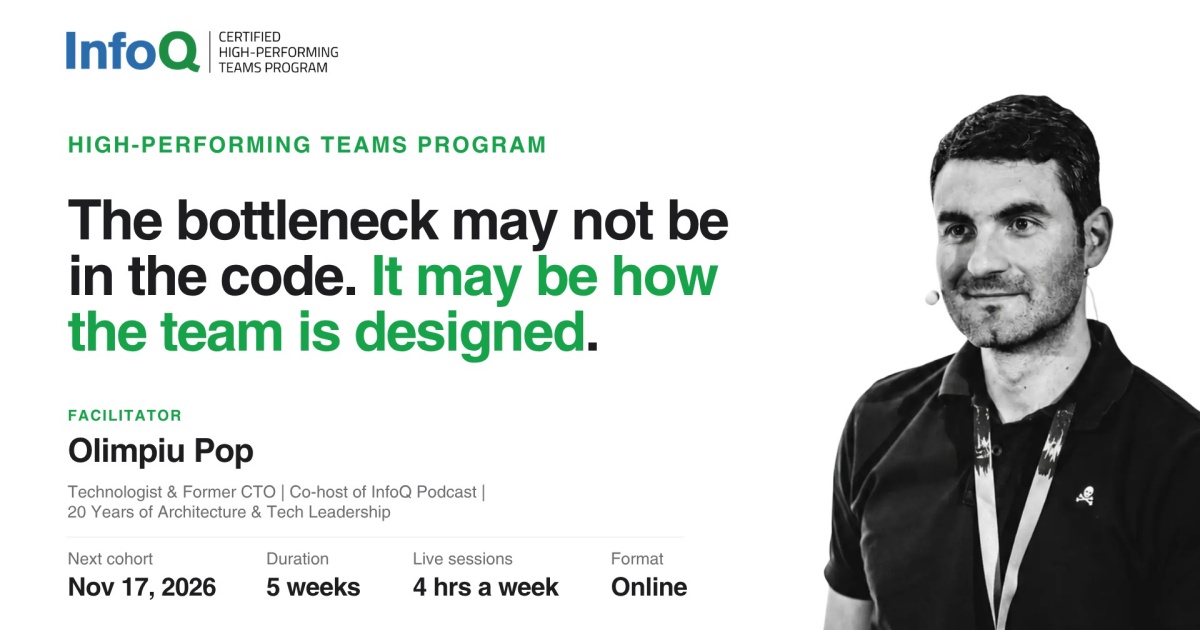
InfoQ Explores High-Performing Teams with New Certification Program
InfoQ's new five-week certification program tackles the real challenge of building high-performing teams, and it's opening enrollment now. Led by editor Olimpiu Pop, it focuses on practical areas like delivery flow and AI-enabled work, which feels timely. We're glad to see metrics included, as that's where many teams struggle. For a deeper look at related AI topics, explore our coverage in "Explore the Future of AI Deployment: Key Topics at QCon AI New York." It's a solid starting point for teams ready to improve.
Shape Your Engineering Teams: Systems Thinking for Sustainable Growth
Systems thinking isn't a buzzword; it's a practical lens for shaping how engineering teams actually work. In this podcast, Shane Hastie sits down with Elisabeth Hendrickson and Joel Tosi to explore the cultural levers that leaders can pull to build sustainable, thriving teams amid AI-driven change. It's a grounded conversation about moving beyond quick fixes. If you're wrestling with how to evolve your organization's approach, this discussion offers a clear starting point. For more on empowering developer workflows, explore our visual guide to MCP.

Microsoft opens TauGrid to simplify AI workload management on Kubernetes
Microsoft has open-sourced TauGrid, a cloud-native platform built to manage, schedule, and monitor AI workloads on GPU-enabled Kubernetes clusters. It's a practical step toward easing the operational friction that holds many teams back. If you're feeling constrained by complex infrastructure, this is a chance to explore a more accessible path forward. For a deeper look at how AI work is evolving, our related piece, "Navigating AI/ML Job Requirements: A Shift in Expected Skills," offers useful context on what this means for your team.

Postgres: Your Durable Orchestrator for Workflows Without External Tools
Most teams assume durable workflows demand an external orchestrator, but Postgres can handle that heavy lifting on its own. Raman Varma shows how the database itself becomes the state store and coordination layer, using `SKIP LOCKED` for concurrent processing, primary-key checkpoints for idempotency, and leases to survive crashes. Even workflow sleeps and human approvals persist as database state. It's a pragmatic, accessible approach for teams already comfortable with Postgres.
Training Developers for an AI-Native Future
When AI agents take over the routine work that once trained junior developers, where does that leave the next generation? That's the question Michael Stiefel put to Scott Hanselman in our latest podcast. His answer is as practical as it is provocative: borrow the preceptorship model from nursing, pairing novices with seasoned mentors in structured, hands-on settings. It's a grounded alternative to the chaos of AI-era job listings. For those navigating this shift, our guide on shifting AI job requirements offers useful context.

From Product Focus to Value Centers That Empower True Agency
Autonomous teams have become an article of faith in software development, but that faith often overlooks a critical tension. The shape of our value determines what we can do, including the trade-off between agency and coherence. Ben Linders suggests we move beyond product focus entirely, toward value center thinking. It's a practical reframing that puts purpose first. If you're exploring how teams actually organize around outcomes, this is a worthwhile perspective.
ICANN's Domain Shift Leaves 22,000 Users Facing Security Risks
ICANN's decision to drop third-level .name domains is a quiet shift with loud consequences. By letting Verisign phase out these registrations, roughly 22,000 users face a real risk: their released second-level domains could be snapped up for phishing or impersonation. That is not a hypothetical concern, it is a tangible opening for identity theft. Neil Fraser's disclosure rightly frames this as a regulatory change, but the legal pushback from affected registrants suggests ICANN may have underestimated the fallout.
Zone redundancy arrives on Azure API Management Standard v2
Azure API Management's Standard v2 tier now supports zone redundancy, a capability that arrived on Premium v2 back in December. That is a meaningful step for teams wanting resilient API infrastructure without the premium price tag, especially since Standard v2 starts at $700 monthly versus $2,801 for Premium. The trade-off is a 99.95% SLA against 99.99%, which suits many production workloads. Just note, you configure zone redundancy at creation time, so plan accordingly.
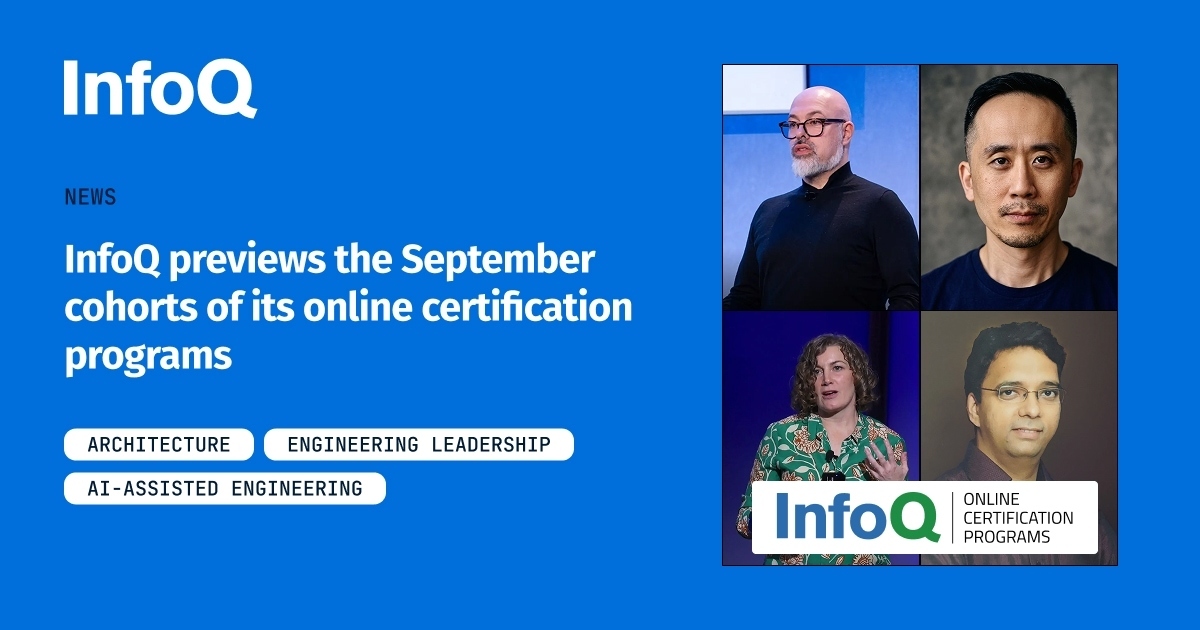
Explore September's certification cohorts with expert-led, future-focused learning paths.
InfoQ is giving us a first look at the September cohorts of its online certification programs, and the lineup is worth your attention. Luca Mezzalira, Michelle Brush, Zichuan Xiong, and Premanand Chandrasekaran are set to lead these sessions, bringing serious depth to the table. We appreciate that InfoQ keeps pushing practical, skills-focused learning forward. If you are aiming to sharpen your distributed systems know-how, our guide on LLM training algorithms pairs well with what these programs promise.
Explore how AI assists workflows but leaves complex coding to humans.
Asgaut Mjølne Söderbom and Ola Hast have moved past continuous deployment and pair engineering, yet their latest experiment with Claude Code revealed a sharp boundary. They find AI excellent for many tasks, but not for the messy reality of brownfield coding. This episode digs into why human collaboration still carries the weight where AI vibes fall short. For more on questioning AI's limits, check out "Talking to My AI Clone Taught Me to Question the Tech."