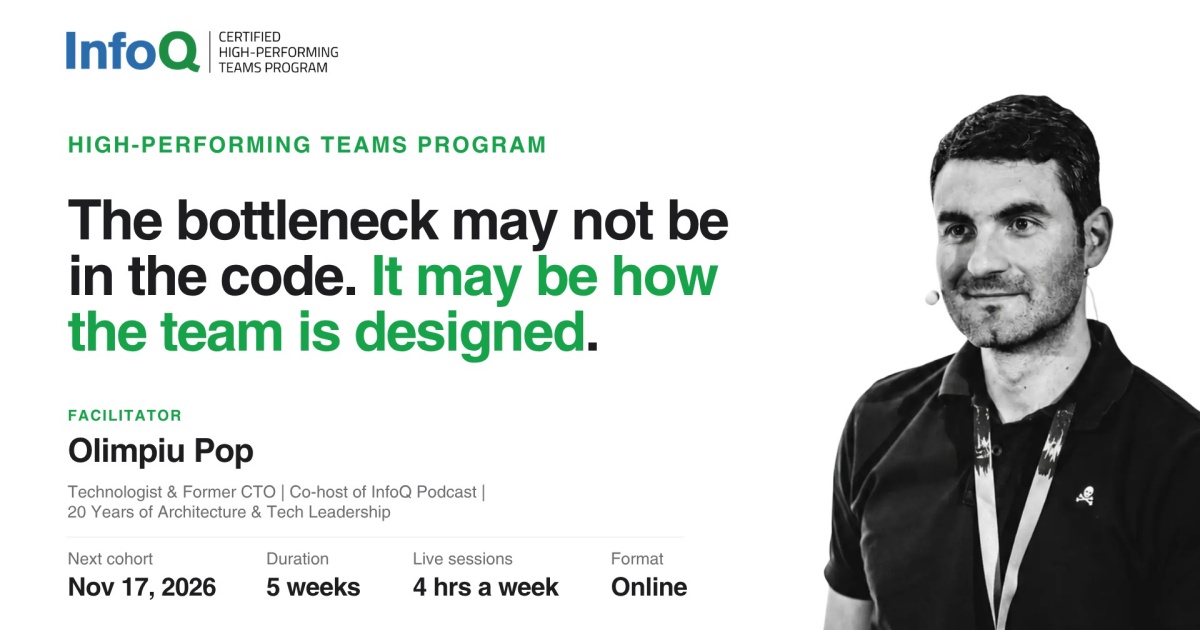
The emergence of structured certification programs focused on high-performing engineering teams signals a crucial shift in how organizations approach software development. InfoQ’s new five-week program, facilitated by Olimpiu Pop, tackles a complex challenge: moving beyond individual brilliance to cultivate truly effective teams. This isn't just about agile methodologies or stand-up meetings; it's about designing teams for optimal flow, integrating AI to augment human capabilities, and rigorously measuring progress—all critical components of a modern, data-driven engineering organization. It's encouraging to see InfoQ, a respected voice in the engineering community, directly addressing this need, particularly given the increasing demand for scalable and adaptable teams in today’s rapidly evolving technological landscape. This focus aligns well with explorations we’ve previously undertaken, such as our examination of Unlock Your Codebase: Explore AI-Powered Knowledge Graphs for Seamless Development, where we explored how knowledge graphs can significantly improve team understanding and collaboration within a codebase—a foundational element for high performance.
The inclusion of "AI-enabled work" within the curriculum is particularly noteworthy. For too long, discussions around AI in software development have centered on code generation or automated testing. This program appears to recognize that the true potential of AI lies in augmenting the capabilities of engineers, streamlining workflows, and freeing them from repetitive tasks to focus on higher-level problem-solving. It's a move towards a more symbiotic relationship between humans and machines—a necessary evolution given the complexity of modern software projects. This approach echoes the insights shared in our Podcast: Signals and Levers: Building Thriving Engineering Organizations, where experts discussed the importance of building organizational structures that enable and encourage experimentation and adaptation, a process heavily influenced by effective AI integration. Measuring team performance, the program's focus on metrics, is also vital; without clear, actionable data, it’s difficult to identify bottlenecks and optimize workflows. Understanding the nuances of measurement, and avoiding pitfalls, is paramount, something that our community has previously discussed, as evidenced by threads like [Question about TMLR [D]](/post/question-about-tmlr-d-cmu5hixuq01er5ngmnqv4sxd6), highlighting the challenges of evaluating complex machine learning models and their impact on overall system performance.
The certification format itself is a smart choice. Five weeks provides a concentrated learning experience, allowing participants to delve deeply into the subject matter and apply their knowledge in a practical setting. The facilitated nature of the program, with Olimpiu Pop at the helm, suggests a focus on interactive learning and peer collaboration, which are essential for fostering a shared understanding of these complex concepts. This structured approach contrasts with the often fragmented nature of online learning resources, providing a more cohesive and impactful experience. It also addresses a growing need for validation in the rapidly evolving field of AI-powered engineering – a recognized credential can demonstrate a commitment to staying current and developing essential skills. We’re seeing a clear trend towards specialization within engineering teams, and this certification program positions individuals to become valuable contributors in this new era.
Ultimately, the success of this program will depend on its ability to translate theoretical concepts into tangible improvements in team performance. It's not enough to simply learn about engineering team design or AI-enabled work; participants need to be able to apply these principles to their own teams and see measurable results. The program’s emphasis on metrics and delivery flow suggests a focus on practical application, which is encouraging. As organizations increasingly rely on software to drive their businesses, the ability to build and maintain high-performing engineering teams will become even more critical. The question now is: will this certification program provide the tools and knowledge necessary to meet this growing demand, and more importantly, will it foster a culture of continuous improvement within engineering organizations?