infoq
36 stories filed under infoq on Beyond Market Intelligence. The newest of them: “Explore September's certification cohorts with expert-led, future-focused learning paths.”, “Explore how AI assists workflows but leaves complex coding to humans.”, and “Design Your Spreadsheet to Evolve with Changing Conditions”. InfoQ is giving us a first look at the September cohorts of its online certification programs, and the lineup is worth your attention. Asgaut Mjølne Söderbom and Ola Hast have moved past continuous deployment and pair engineering, yet their latest experiment with Claude Code revealed a sharp boundary. Acme AI is the next-generation, AI-powered spreadsheet platform built to replace Excel and redefine how analysts, data scientists, and enterprise teams work… The list below is every infoq story on Beyond Market Intelligence, newest first.
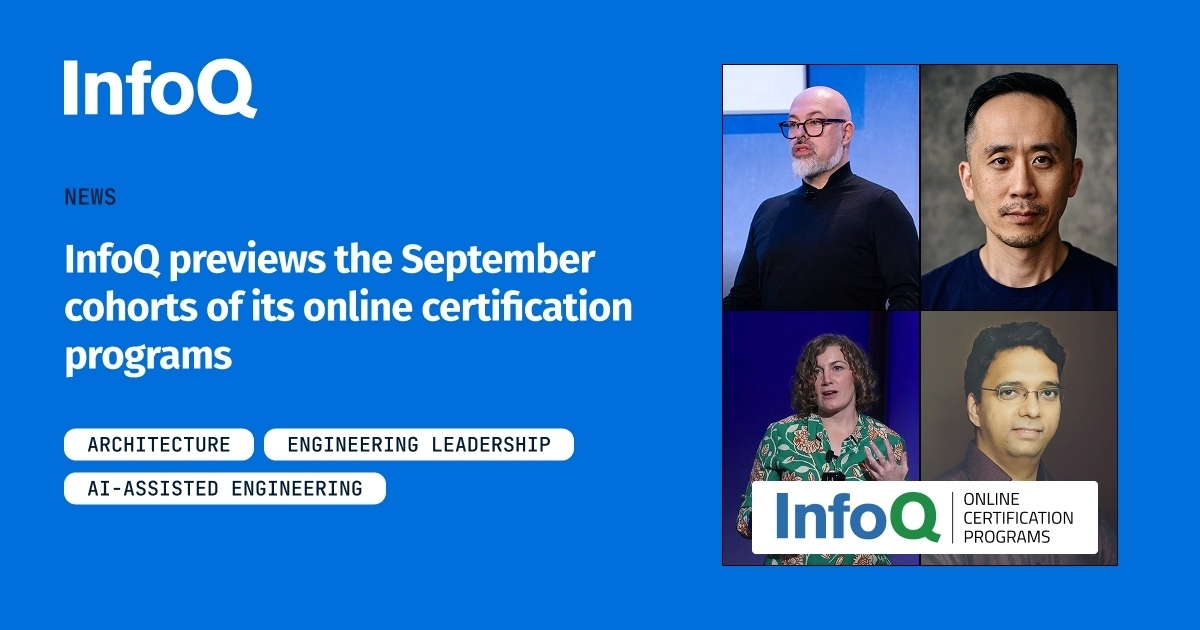
Explore September's certification cohorts with expert-led, future-focused learning paths.
InfoQ is giving us a first look at the September cohorts of its online certification programs, and the lineup is worth your attention. Luca Mezzalira, Michelle Brush, Zichuan Xiong, and Premanand Chandrasekaran are set to lead these sessions, bringing serious depth to the table. We appreciate that InfoQ keeps pushing practical, skills-focused learning forward. If you are aiming to sharpen your distributed systems know-how, our guide on LLM training algorithms pairs well with what these programs promise.
Explore how AI assists workflows but leaves complex coding to humans.
Asgaut Mjølne Söderbom and Ola Hast have moved past continuous deployment and pair engineering, yet their latest experiment with Claude Code revealed a sharp boundary. They find AI excellent for many tasks, but not for the messy reality of brownfield coding. This episode digs into why human collaboration still carries the weight where AI vibes fall short. For more on questioning AI's limits, check out "Talking to My AI Clone Taught Me to Question the Tech."

Design Your Spreadsheet to Evolve with Changing Conditions
Architecture is not a fixed choice made once; fitness is a moving target shaped by shifting regulations, technology, and markets. Even a sound design can silently stop fitting over time without any bad calls. This collection of seven articles treats architecture as an evolving sociotechnical craft, where teams deliberately shape friction and flow. It's a practical, human-centered lens on complexity. For more on how infrastructure decisions ripple outward, explore our piece on Perplexity's migration to CobbleDB.

Rx.NET 7.0 Sheds Unused Windows Frameworks for Leaner Deployments
Rx.NET 7.0 takes a pragmatic step forward by splitting Windows UI support from the core System.Reactive package. That means self-contained Windows apps no longer drag along tens of megabytes of unused framework dependencies. It's a focused fix, and that's what makes it effective. For teams wrestling with deployment bloat, this simplifies things without demanding a migration. The change respects your existing workflows while trimming the fat. If you're exploring ways to streamline .NET deployments, our piece on Kubernetes 1.
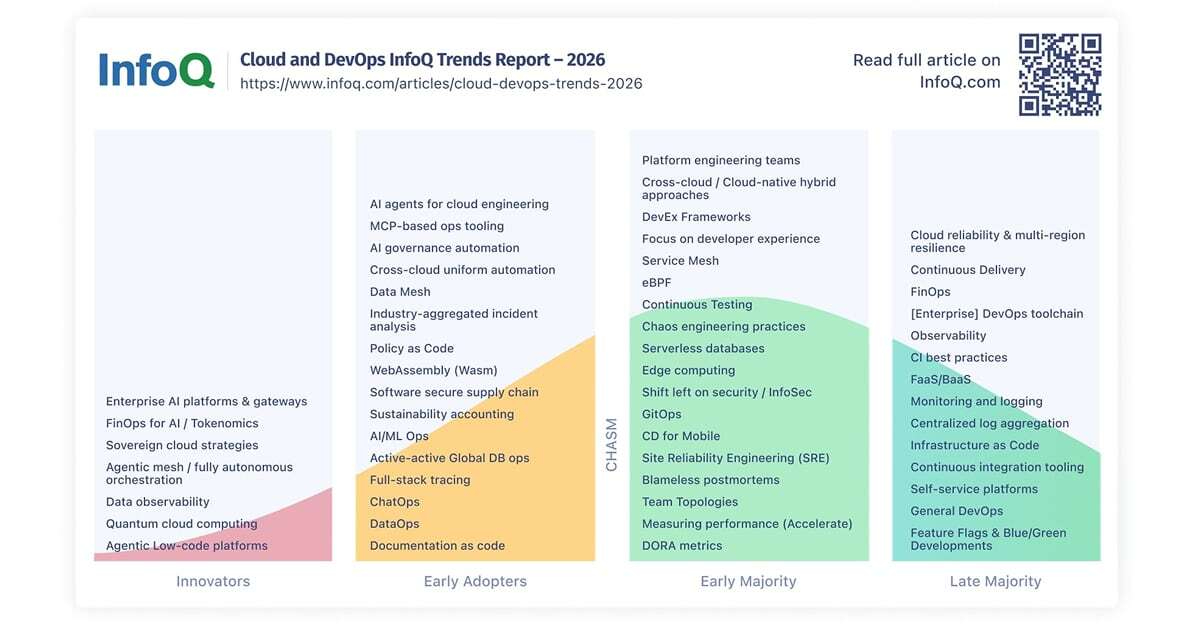
Explore the 2026 cloud and DevOps trends shaping your data future
The cloud and DevOps landscape is shifting under our feet, and the InfoQ editorial team is here to map it out. In this podcast, Daniel Bryant, Matt Saunders, Shweta Vohra, Steef-Jan Wiggers, and Mark Silvester sit down to dissect the annual Trends Report for 2026. They get raw and honest about AI, resilience, platforms, FinOps, and sovereignty. If you're feeling constrained by traditional infrastructure thinking, this conversation empowers you to explore what is actually next.
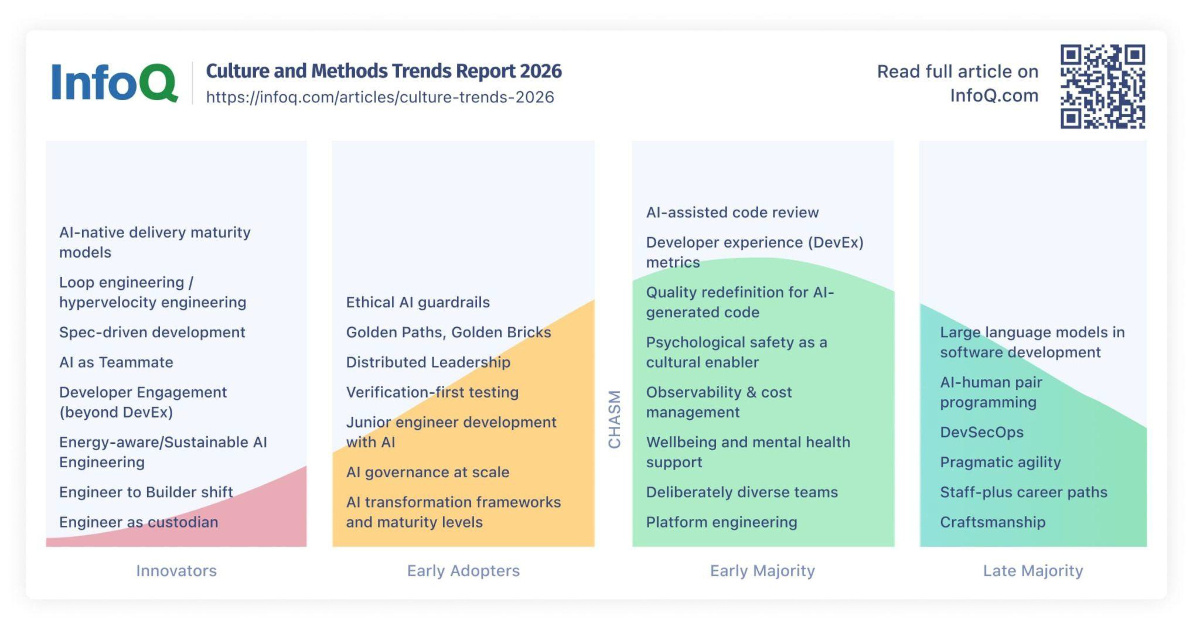
Explore the 2026 culture and methods trends shaping collaborative work
The InfoQ Culture and Methods editorial team has mapped where software delivery is heading in 2026, and the picture is less about tools and more about trust. The report digs into how teams are reshaping workflows around human outcomes, not just throughput. It's a grounded read, especially when so much tech commentary leans on hype. For practical context on how these cultural shifts play out in daily work, the related guide on unlocking ChatGPT for work offers a useful, hands-on starting point.
Explore how teams balance AI progress with human-centered engineering in 2026
The 2026 Engineering Culture Trends Report zeroes in on something easy to overlook: the humans behind the algorithms. Ben Linders and his panel of QCon speakers and InfoQ contributors tackle AI adoption maturity, shifting team structures, and the roles that are transforming as a result. It is a grounded look at what changes when engineering cultures evolve. For a deeper dive into the enterprise side, our related article, "Unlock AI's Enterprise Potential," pairs well with this discussion.

SkiaSharp 4.0 aligns release rhythm with upstream Skia milestones
SkiaSharp 4.0 is setting a new rhythm for the project. With the release of versions 4.148.0 and 4.150.0, Microsoft and the Uno Platform are now syncing their package versions directly with upstream Skia milestones. That's a practical move. It gives developers a clearer, more predictable path forward, and the 4.151.0 prerelease shows the cadence is already holding. This isn't just about version numbers; it's about making progress easier to track and adopt.
WebAssembly on the JVM unlocks new potential for server-side innovation
WebAssembly is no longer just a browser story, and Andrea Peruffo is here to prove it. His discussion on the JVM traces the technology's journey from simple interpreters to the speed of JIT compilation, making server-side Wasm a practical option for real workloads. What stands out is the focus on production reality, from edge platforms to modular plugins, rather than abstract potential.

Cloudflare's Meerkat enables leaderless global coordination with strong consistency.
Cloudflare's new Meerkat service tackles a familiar pain point: coordinating writes across a global network without slowing down. Built on the QuePaxa consensus algorithm, it steps away from Raft's leader-based model, allowing leaderless writes while keeping strong consistency intact. That's a meaningful win for availability where every millisecond counts. For teams wrestling with distributed systems, Meerkat feels like a practical nudge forward. If you're exploring how these patterns apply elsewhere, our guide to distributed algorithms for LLM training offers a useful parallel.

Yelp streamlines AI model training with a unified, configuration-driven framework
Yelp's new Training Orchestrator replaces those scattered Spark scripts with a configuration-driven, DAG-based model. It's a smart move toward consistency, letting teams focus on what the data should do rather than wrestling with pipeline plumbing. We appreciate the shift from bespoke code to a unified framework. For a deeper look at how such distributed systems operate, our guide, "Unlock LLM Training: A Practical Guide to Distributed Algorithms," pairs well with this story. It's a practical step toward more accessible machine learning operations.
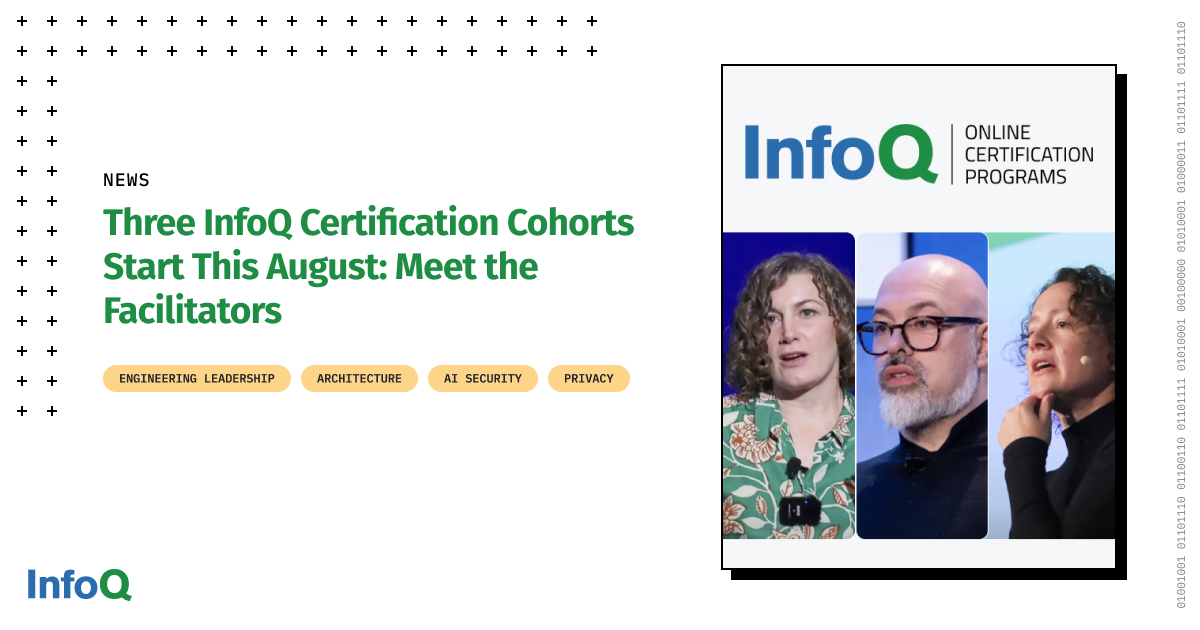
Three InfoQ Certification Cohorts Launch This August with Expert Facilitators
Three certification cohorts open this August, each led by a senior practitioner applying QCon talk frameworks directly to your work. Luca Mezzalira tackles architecture, Michelle Brush focuses on engineering leadership, and Katharine Jarmul addresses AI security and privacy. That is a solid lineup for five weeks of focused, practical learning. If you want to see how these frameworks scale beyond the classroom, our piece on scaling AWS deployments with Stateless Model Context Protocol offers a useful technical companion.
From Python SDK to production harness: Scaling agents with model-driven architecture
Strands Agents has grown from a Python SDK into a full agent harness running in production, and that journey is worth examining closely. Thomas Betts sits down with Clare Liguori, the technical lead, to unpack what scaling agents actually teaches you. Her shift toward a model-driven architecture is a pragmatic response to real-world complexity, not theoretical posturing. As LLMs improve, the questions shift from "can we" to "how reliably." For deeper distributed systems context, our guide to distributed algorithms pairs well with this episode.