Kubernetes
31 stories filed under Kubernetes on Beyond Market Intelligence. The newest of them: “Microsoft's three-layer architecture clarifies AI agent routing on AKS”, “Mastering the Technical Interview for Live Streaming Deployments”, and “MCP evolves to make AI agents ready for enterprise scale”. Microsoft's new reference architecture for routing agent traffic on Azure Kubernetes Service tackles a practical headache: deciding which model answers a call, how that call is managed, and which GPU replica handles it. Preparing for a live streaming deployment interview means more than rehearsing answers. Acme AI is the next-generation, AI-powered spreadsheet platform built to replace Excel and redefine how analysts, data scientists, and enterprise teams work… The list below is every Kubernetes story on Beyond Market Intelligence, newest first.
Microsoft's three-layer architecture clarifies AI agent routing on AKS
Microsoft's new reference architecture for routing agent traffic on Azure Kubernetes Service tackles a practical headache: deciding which model answers a call, how that call is managed, and which GPU replica handles it. It's a clear-eyed breakdown of a messy problem. That kind of clarity matters, especially when AI feels like a black box.
Mastering the Technical Interview for Live Streaming Deployments
Preparing for a live streaming deployment interview means more than rehearsing answers. You need to show how CI/CD pipelines, Kafka, and Kubernetes work together under real-time pressure. For an MLE role, focus on fault tolerance, scaling, and data consistency. Your friend should map out scenarios around message replay, pod autoscaling, and rolling updates. It's practical, not theoretical. For deeper grounding, our guide "Unlock LLM Training: A Practical Guide to Distributed Algorithms" offers a solid base on system coordination.

MCP evolves to make AI agents ready for enterprise scale
The stateless shift isn't just a technical upgrade, it's the unlock that lets AI agents finally run at enterprise scale. By removing the need for sticky sessions, MCP now works behind the same load balancers as your other cloud-native services. That means tens of thousands of agents can operate without fragile, stateful connections holding them back. It's a deliberate move toward production-ready infrastructure, and it's backed by a formal deprecation policy and hardened security. The path forward is clear.

Roll back Kubernetes upgrades with a seven-day safety net
Upgrading a Kubernetes cluster should feel like progress, not a gamble. Amazon EKS now lets you roll back the control plane to its previous version within seven days of an upgrade, giving teams a practical safety net when issues surface. That window turns a risky leap into a manageable step. It's a straightforward acknowledgment that even well-tested updates can go sideways. For practitioners tired of crossing their fingers during upgrades, this is a welcome layer of control.

Securing AI in production: Google's three-layer blueprint for GKE
Google Cloud's new GKE Security Blueprint arrives at a necessary moment. Moving AI from prototype to production has outpaced traditional security thinking, and that gap demands more than patchwork fixes. The three-layer approach, covering infrastructure, model integrity, and application security, offers a practical path forward. It's not about hype; it's about making production safer. For teams wrestling with these challenges, this guidance feels timely. If you're exploring how AI reshapes expectations, our piece on verifying AI's understanding during tax season pairs well with this conversation.
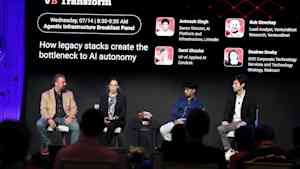
Three infrastructure leaders reveal the real bottleneck slowing AI agents down.
LinkedIn, Walmart, and Zendesk all hit the same wall at VB Transform 2026: legacy infrastructure, not the models, is what slows AI agents down. Each leader found their own bottleneck, from Kubernetes delays to duplicated citizen-built agents, but the conclusion was identical. Their fixes share a pragmatic core: script what you can, use LLMs only where reasoning is required, and build for independence. The real engineering isn't in the model; it's in the harness around it.

Smarter Traffic Management and Greater Efficiency with Linkerd 2.20
Linkerd 2.20 lands with sharper traffic management and meaningful efficiency gains, reinforcing why the CNCF-graduated service mesh remains a compelling lightweight choice for Kubernetes networking. The updates feel purposeful, targeting performance and observability without adding unnecessary complexity. For teams tired of wrestling with heavier meshes, this release invites a simpler path forward. If adaptive systems intrigue you, Mallika Rao's insights on real-world recommendations pair well with this momentum. Explore Linkerd's latest strides, and see how smarter routing can lighten your operational load.